


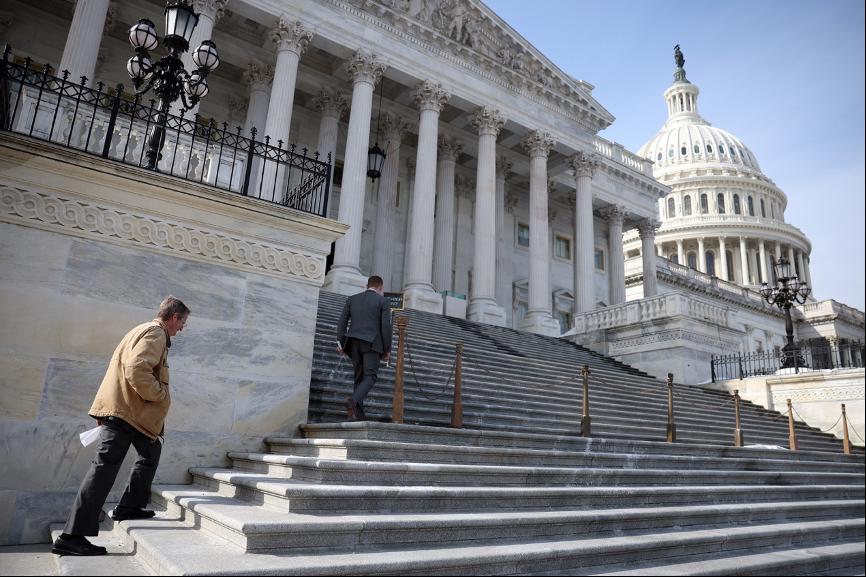
The US Capitol (Photo: VCG)
The US House of Representatives has passed a new Taiwan-related bill directing the US administration to exclude the Chinese mainland from certain international financial institutions if its actions are deemed to "threaten security" of the island. The bill has been mocked by many netizens on the island as another attempt to extract more "protection fees" from Taiwan island. A mainland expert said on Wednesday that any attempt to exclude the Chinese mainland from international organizations and financial institutions are largely wishful thinking.
The so-called "PROTECT Taiwan Act" passed the US House of Representatives on Monday. It requires the US Treasury Department, the Federal Reserve, and the Securities and Exchange Commission to seek "China's exclusion" from the G20, Bank for International Settlements, Financial Stability Board, Basel Committee on Banking Supervision, International Association of Insurance Supervisors, and International Organization of Securities Commissions in the event of China's "move" on Taiwan island, according to a press release on the website of the US House Committee on Financial Services.
The bill will next be sent to the US Senate for deliberation, and, if approved, will be sent to the White House for signature by the US president before it can become a law.
This bill showed that some US politicians are trying to pressure China over the Taiwan question through economic and financial sanctions, but there is little new in the legislation itself and proposals to exclude the Chinese mainland from certain international organizations and financial institutions are largely wishful thinking, Zheng Jian, a professor at the Taiwan Research Institute of Xiamen University, told the Global Times on Wednesday.
These international bodies are not controlled by the US alone, and such moves are unpopular and lack broad international support given the massive disruptions they could cause to the global financial market. China is already part of the international order within these mechanisms, and it remains doubtful whether the US is able to do so and how many countries would follow Washington's lead, said Zheng.
Overall, the US House bill is mostly symbolic to show its stance of exerting pressure on the Chinese mainland, while also using such acts as leverage to extract more concessions from Taiwan authorities on other areas such as arms sales and trade negotiations, according to Zheng.
Some local media in Taiwan region also reported on the US House of Representatives' passage of the bill. While certain pro-DPP media interpreted the bill as a "support Taiwan act," many outlets also reported reactions from residents and netizens on the island who ridiculed the US bill.
Taiwan regional media China Times reported that some PTT users mocked the bill, saying the so-called punishment "feels weak." Others said that the idea of a "financial blockade" against the mainland is "so laughable," and questioned the feasibility of such a move after the US tariff war against China "failed." Some pointed out that the measures are merely "packaged as punishment" with limited influence.
Many netizens also commented on Taiwan media outlet ET Today's related report, with some saying the US bill sounds more like a "stunt." One netizen, "Kate Fox," wrote: "Is this merely a bill to happily extract money from Taiwan?" Another netizen, "Tsai Galin," wrote that the bill's real purpose may be to remind Taiwan to hand over "protection money."
The US administration is reportedly developing a new package of four weapons systems for Taiwan to purchase, following the record $11.1 billion arms package unveiled in December, according to the Financial Times. On the island, various opposition parties have publicly criticized regional leader Lai Ching-te, questioning how much additional financial burden he plans to place on Taiwan residents, according to local media reports.
Zheng noted that in recent years, through so-called "dollar diplomacy," the DPP authorities have colluded with certain members of the US Congress and defense interest groups to continuously push Taiwan-related bills and hype the issue, fueling cross-Straits tensions. Such actions ultimately harm the interests of Taiwan residents, who are increasingly recognizing the costs of such secessionist moves.
According to media reports from Taiwan island, the US State Department recently responded to a reporter's question by claiming that the US "welcomes" Taiwan's proposed NT$1.25 trillion ($39.6 billion) special defense budget, while Raymond Greene, head of the "American Institute in Taiwan" Taipei office, warned that "freedom is not free," which sparked strong dissatisfaction on the island.
Asked to comment on that at a press briefing on Wednesday, Zhu Fenglian, a spokesperson for the State Council Taiwan Affairs Office, said that Taiwan is China's Taiwan, said t that Taiwan is China's Taiwan, and resolving the Taiwan question is an internal affair of the Chinese people and brooks no interference from any external forces.
Zhu further stated that the US side should strictly adhere to the one-China principle and the provisions of the three China-US joint communiqués, exercise prudence in words and deeds on the Taiwan question, stop sending wrong signals to "Taiwan independence" separatist forces, and cease interfering in China's internal affairs.