


Chinese officials on Thursday detailed key priorities for the spatial planning of a modern capital metropolitan area in the broader Beijing-Tianjin-Hebei region, as part of efforts to deepen its coordinated development.
Beijing, Tianjin and Hebei must place greater emphasis on regional coordination, Wang Changlin, deputy head of the National Development and Reform Commission, told a press conference. They should leverage their respective strengths to achieve a coordinated functional layout, he added.
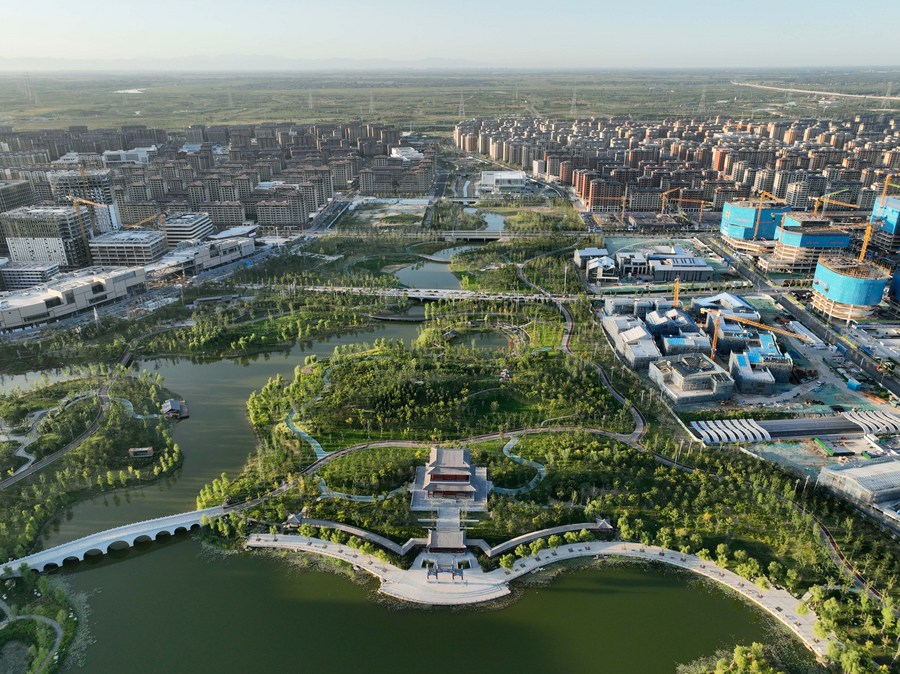
An aerial photo shows a view of Rongdong District in Xiong'an New Area, north China's Hebei Province, September 6, 2022. (Photo: Xinhua)
"For example, Tianjin should better align its manufacturing advantages with Beijing's science and technology innovation resources," he said.
Regarding each of the three places' key tasks, Xia Linmao, executive vice mayor of Beijing, said the capital city should consider relieving itself of non-capital functions to be its top priority, while stepping up collaborative innovation and industrial cooperation with Tianjin and Hebei.
Xie Yuan, vice mayor of Tianjin, said the municipality has strengths in terms of location, ports and industries. Tianjin will accelerate the construction of the core area for international shipping in north China, and advance the development of the Beijing-Tianjin-Hebei national technology innovation center through efforts such as sci-tech innovation and industrial upgrading, and cooperation among the three places, Xie said.
Jin Hui, vice governor of Hebei, said the province will strengthen its role as a key pillar of coordinated opening up while working with Beijing and Tianjin to build a collaborative innovation community.
The Communist Party of China Central Committee and the State Council recently approved a spatial coordination plan for the modern capital metropolitan area, covering 2023 to 2035. According to the document, the area has been designated as a critical zone for the optimization and safeguarding of the capital's core functions, serving as the primary engine for the construction of a world-class city cluster.