


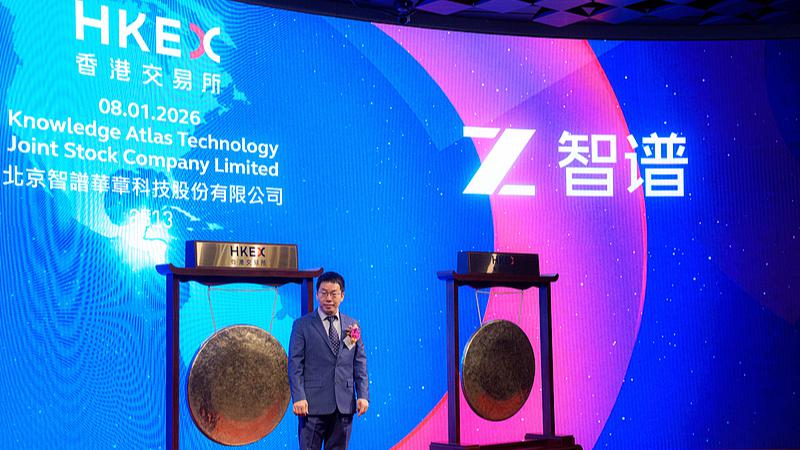
Liu Debing, chairman of Knowledge Atlas Technology JSC Ltd., better known as Zhipu, during the company's listing ceremony at the Hong Kong Stock Exchange in Hong Kong, China, on Thursday, January 8, 2026. /VCG
A mysterious model codenamed "Pony Alpha" appeared on developer community OpenRouter on February 8. Developers watched in astonishment as it autonomously fixed code, read logs, and spent days building a usable C language compiler – without human intervention. Some even used it to develop mobile apps from scratch and upload them to app stores.
Silicon Valley speculated wildly: Was this GPT's latest model? A secret Claude test? Another DeepSeek strike?
Late on February 11, the answer came. Chinese AI company Zhipu released its open-source flagship model, GLM-5. Pony Alpha – the mystery model Silicon Valley had been chasing – was, in fact, Chinese.
The topic "Zhipu's new model tops global rankings" exploded during what many now call the "AI Spring Festival blockbuster season," following ByteDance's Seedance 2.0 global splash and anticipation for DeepSeek's next release.
On the product front, GLM Coding Plan sold out immediately upon launch – the first time a domestic AI coding model's paid package had ever sold out. The company had to impose purchase limits and urgently expand capacity.
On the capital front, JPMorgan Chase covered Zhipu for the first time, giving it a "Buy" rating as the "top pick to capture the next wave of global AI." Markets responded positively and Zhipu's stock surged 40 percent in a single day, with weekly gains reaching 120 percent.
If the 2025 Spring Festival was DeepSeek's "lone brave soul" moment, 2026 reveals a different Chinese AI – no longer single-company breakthroughs, but coordinated advances across vision, engineering, and foundational models.
Seedance 2.0: Redefining 'what looks good'
ByteDance's Seedance 2.0 is a "directable cinematic generation engine" that simultaneously produces video and audio from prompts or reference images. Users simply input text or upload a photo and it generates multi-shot videos with complete native soundtracks.
On overseas platforms, AI film creator el.cine admitted: "After studying digital filmmaking for seven years, I now feel like 90 percent of it was wasted." His Seedance 2.0 short film showed a man running through crowds, knocking over fruit stands, being chased by police – with cinematic language nearly indistinguishable from human production.
Feng Ji, CEO of Game Science (Black Myth: Wukong), called it "currently the strongest video generation model on the planet."
GLM-5: Redefining 'what gets work done'
If Seedance 2.0 answers whether Chinese AI can define aesthetics, GLM-5 answers a harder question: Can Chinese AI build systems?
For two years, "Vibe Coding" dominated AI programming – using single prompts to generate webpages or games. But real engineers know that writing runnable code and building deployable systems are entirely different.
Real software engineering requires days of architectural design, logical consistency across tens of thousands of lines, reading logs when compilation fails, locating problems, and iterating until systems work.
Pony Alpha attracted attention precisely for demonstrating this capability. The C compiler case is cited not because "AI writing a compiler" is novel, but because such tasks require models to maintain logical coherence over days and hundreds of tool calls. Completing it proves models have crossed critical thresholds.
On SWE-bench Verified, the core programming evaluation, GLM-5 scored 77.4 percent, surpassing Google's Gemini 3.0 Pro.
DeepSeek: The foundation
More important than DeepSeek's next step is the role it's already playing. GLM-5 integrated DeepSeek's Sparse Attention mechanism at the architectural level – a core innovation that reduces computational costs while maintaining effectiveness.
DeepSeek's core technologies are now "spilling over" to be adopted by other Chinese AI enterprises. Its value isn't just "how strong DeepSeek itself is" – it's becoming the technological foundation for the entire ecosystem.
In August 2025, OpenAI CEO Sam Altman warned, "America may be underestimating the complexity and severity of China's progress in artificial intelligence." At the time, many interpreted this as congressional lobbying.
Six months later, this Spring Festival's results prove Altman's anxiety is becoming reality.
AI observers in the U.S. note that Seedance 2.0 and Zhipu GLM-5 represent China's technological iteration – and the storm they bring will only intensify.
When JPMorgan uses "top pick" to position Chinese model companies, when Silicon Valley stays up excited about "Pony Alpha," Wall Street and Silicon Valley are being forced to revise their assessment frameworks.
If the 2025 Spring Festival was DeepSeek's solo charge, the 2026 Spring Festival sees a Chinese group army standing on the AI battlefield. Chinese AI is transitioning from follower to infrastructure definer, and this process is already irreversible.