


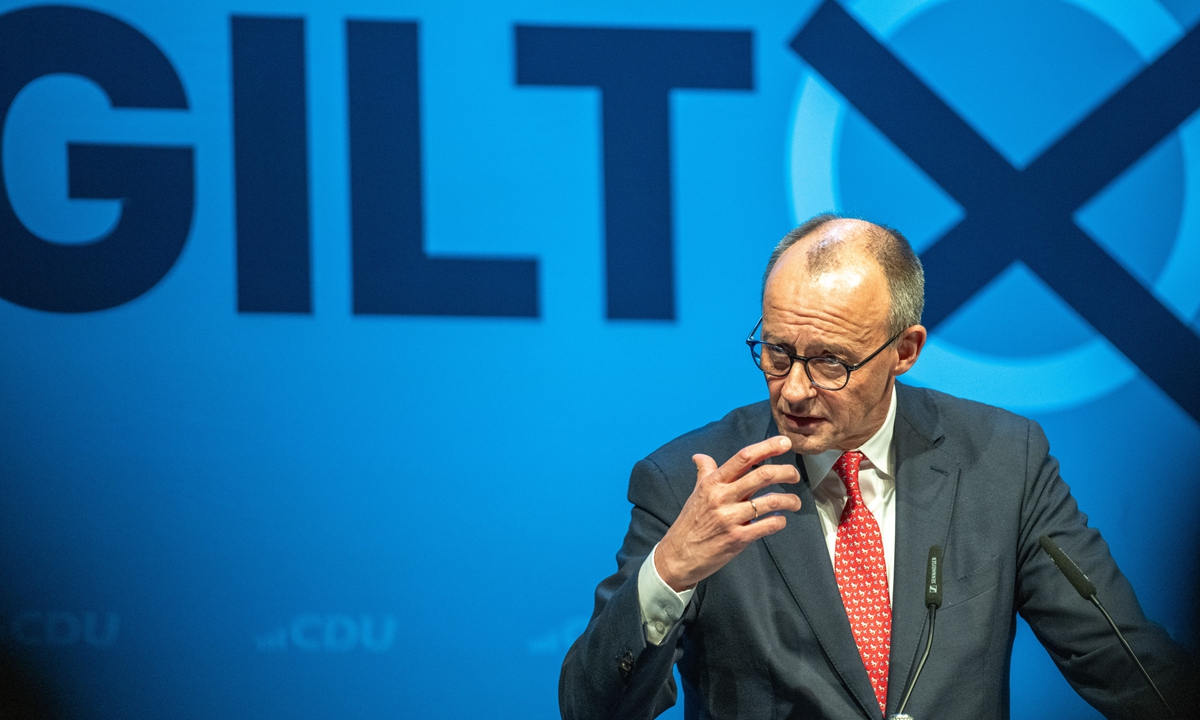
German Chancellor Friedrich Merz speaks at the Rhineland-Palatinate CDU's Political Ash on local time February 18, 2026. (Photo: VCG)
German Chancellor Friedrich Merz said he would seek "strategic partnerships" with China during a trip next week, as he looks to discuss future cooperation between Europe and the world's second-biggest economy while the US leans on tariffs, media outlets Reuters and POLITICO Europe reported.
According to the Reuters report, Merz, when speaking at his party CDU's Ash Wednesday event in Passau, Bavaria, noted that Germany has a "strategic interest" in finding partners in the world "who above all are prepared to shape the future together so that we remain a country with prosperity and a high level of social security."
Merz also said foreign policy and economic policy could no longer be separated, Reuters reported. The report also highlighted US President Donald Trump's tariff push is testing relations between the allies, threatening their two-way trade and raising the risk of further damage to Germany's already struggling economy.
On January 17, Trump announced in a post on social media that he would impose a 10 percent tariff on goods imported from eight European countries, including Germany, starting February 1, and would raise the tariff rate to 25 percent from June 1, if a deal is not in place for "the Complete and Total purchase of Greenland" by the US, The Guardian reported.
"The Federal Government has taken note of the statements made by the US President," German federal government spokesperson Stefan Kornelius wrote on social media on the same day. "It is in closest coordination with its European partners. Together, we will decide on appropriate responses at the appropriate time," AP reported.
NBC reported that in response to US tariff threat, the eight European countries issued a joint statement on the January 18, pointing out that the tariff threats "undermine transatlantic relations and risk a dangerous downward spiral," adding that "we will continue to stand united and coordinated in our response. We are committed to upholding our sovereignty." Denmark, Finland, France, Germany, the Netherlands, Norway, Sweden, and the UK jointly signed the statement.
"You can do it, but we will not go along with it," Merz said on tariffs in his Wednesday speech, per Reuters. "And if you overdo it, then we Europeans are certainly able to defend ourselves against it."
POLITICO Europe reported Thursday that the German chancellor's latest warning against the US of igniting a tariff war echoed what he said at the Munich Security Conference (MSC) last weekend.
During his MSC speech, according to another separate report by the POLITICO Europe, Merz said "the leadership claim of the US is being challenged, perhaps already lost."
"A deep divide has opened between Europe and the US," he said. "The culture wars of the US are not ours. And we do not believe in tariffs and protectionism, but in free trade.
At the Wednesday event, Merz also reportedly said that he would speak to Chinese leaders about future cooperation with Europe and Germany during his planned trip to China, according to the POLITICO Europe report.
"Ladies and gentlemen, the key term is strategic partnerships," Merz added.
Merz's recent remarks of exploring "strategic partnerships" with China show that the German Chancellor is increasingly recognizing that Germany must simultaneously manage and engage with both of these major powers — China and the US. And it is hoped that he would soon realize that China represents a critical opportunity for Germany to revitalize its economy, restore sustainable growth, strengthen its innovation capabilities, and expand into global markets, Jiang Feng, a researcher at Shanghai International Studies University and president of the Shanghai Regional Studies Association, told the Global Times on Thursday.
However, according to the POLITICO Europe, Merz, in his earlier MSC speech, paired his warnings about the US with a hardening stance toward Beijing, and claimed that China could soon rival American military power and accused it of exploiting so-called economic dependencies, citing rare-earth export controls what Merz claimed to have disrupted German industry.
Merz seems to continue viewing China primarily as a challenge. His understanding of China's strategic role is still vague and muddled, Jiang said, noting that nevertheless, even as his China policy lacks clear definition, Merz places great importance on China-Germany cooperation. This shows that he now treats policy toward China as equally important as policy toward the US, he said.
Merz's potential visit could mark a turning point for China-Germany ties. The relationship needs to be affirmed and strengthened, with proper execution to lay a solid foundation for future cooperation, the expert believed.
China has yet to confirm Merz's China visit as of press time.
According to the Chinese Foreign Ministry website, Member of the Political Bureau of the CPC Central Committee and Foreign Minister Wang Yi met with Merz in Munich on February 14, during which Wang stated that China is ready to work with Germany to prepare for the next stage of high-level exchanges, strengthen practical cooperation in various fields, explore and carry out tripartite cooperation, and lift the China-Germany all-round strategic partnership to a new level.