


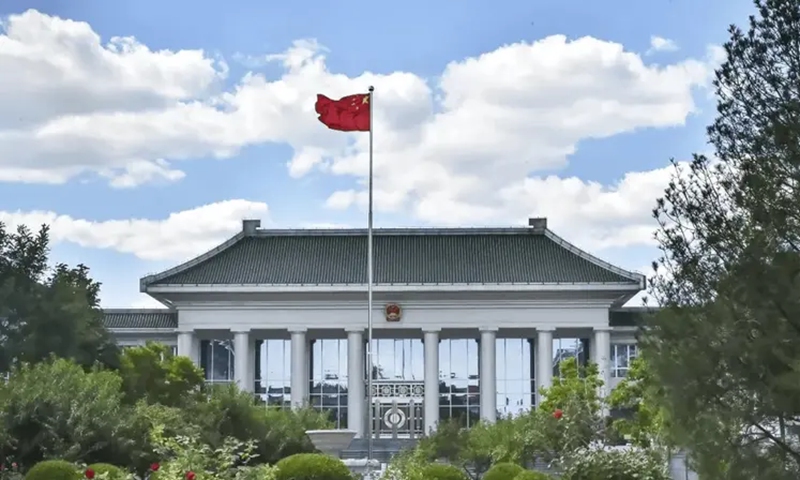
China's Supreme People's Procuratorate (File photo: SPP's WeChat account)
An official from China's Supreme People's Procuratorate (SPP) said on Tuesday that China is currently facing intensifying and multi-dimensional risks of technology leakage, and that procuratorial authorities will safeguard the country's technological and economic security in accordance with the law.
On Tuesday, Liu Taizong, deputy director-general of the Intellectual Property Procuratorial Department of the Supreme People's Procuratorate, said in an interview that procuratorial authorities are strengthening judicial protection for original innovation and key core technologies, Beijing Daily reported.
Referring to the Zunpai case involving 14 Zunpai employees who illegally obtained core chip technology from Huawei's HiSilicon, which was handled in Shanghai under the guidance of the Supreme People's Procuratorate, Liu said procuratorial authorities are focusing on emerging and future industries such as next-generation information technology, artificial intelligence, high-end equipment, biomanufacturing, new energy, and new materials, in order to support the development of new quality productive forces.
Punishing crimes involving the infringement of core technologies in accordance with the law is an important means for intellectual property procuratorial work to support the development of the country's new quality productive forces, said Liu, according to Beijing Daily.
Liu noted that from 2021 to 2024, procuratorial authorities nationwide prosecuted 1,262 individuals involved in infringement of business secrets, while in the first 11 months of 2025 alone, 232 individuals were handled, reflecting an upward trend.
For example, the Zunpai case involving the infringement of Huawei HiSilicon's chip technology business secrets concerned domestically developed chip technology and involved 317 million yuan ($43.6 million).
"Procuratorial authorities will crack down on commercial espionage crimes in strict accordance with the law," Liu emphasized. He noted that China is currently facing increasingly complex and multi-dimensional risks of technology leakage. Procuratorial authorities are applying Article 219-1 of the Criminal Law to safeguard the country's technological and economic security.
For instance, in a case handled by procuratorial authorities in East China's Zhejiang Province, a defendant surnamed Zhang, a former employee of a well-known domestic semiconductor company, violated confidentiality agreements after leaving the company and accepted instructions from an overseas organization to illegally disclose trade secrets of his former employer. Following prosecution by procuratorial authorities, Zhang was sentenced to imprisonment and fined.