


Chinese researchers have achieved the world’s first successful treatment of a liver failure patient using ex vivo perfusion with a six-gene-edited pig liver, preliminarily confirming the safety and efficacy of the technique and providing a new strategy for the clinical treatment of end-stage liver disease, including as a bridging therapy before liver transplantation, China Science Daily reported on Wednesday.
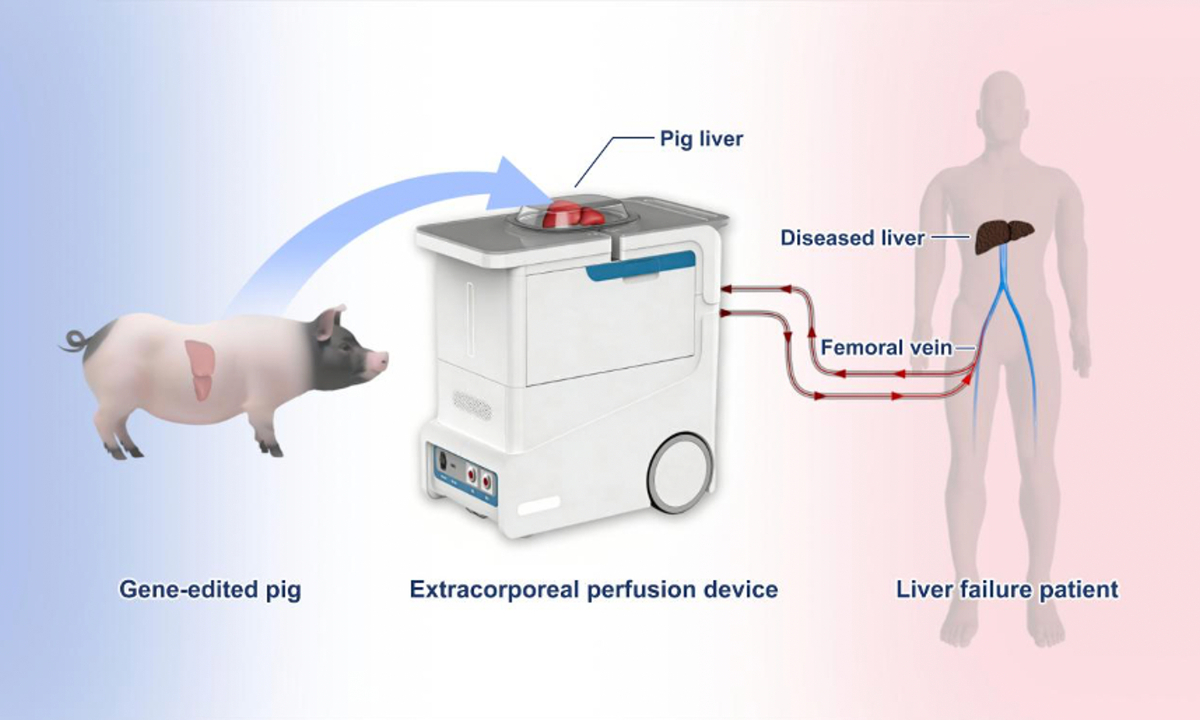
Illustration of the treatment of a liver failure patient using ex vivo perfusion with a six-gene-edited pig liver Photo: Courtesy of Xijing Hospital
The breakthrough was achieved by a team led by Dou Kefeng, an academician of the Chinese Academy of Sciences and chief physician of the Department of Hepatobiliary Surgery at Xijing Hospital, in collaboration with the First Affiliated Hospital of Sun Yat-sen University, Tangdu Hospital of Air Force Medical University, and Sichuan Clonorgan Biotechnology Co., Ltd.. More than 20 departments of the university participated in the cross-disciplinary effort that led to the breakthrough, according to China Science Daily.
The team obtained a liver from a six-gene-edited pig, connected it to a normothermic mechanical perfusion device, and established a cross-circulation system linking the xenogeneic pig liver with the patient’s bloodstream, according to the report.
While the system was connected to a patient with acute-on-chronic liver failure, the pig liver temporarily assumed key detoxification, synthetic and metabolic functions, while the patient’s own liver remained in place. Unlike conventional transplants, the procedure employs an extracorporeal life-support approach, the report said.
According to the daily, during the treatment, the pig liver showed good perfusion and bile secretion, and the perfusion device operated normally. After 66 hours of continuous treatment, key liver function indicators – including bilirubin levels, transaminases and prothrombin activity – showed sustained and significant improvement. Following evaluation, the medical team concluded the therapy was effective and discontinued the support system.
The patient remains in stable condition as of this report, with physiological and biochemical indicators approaching normal levels.
This combined model of “gene-edited organs plus extracorporeal life support” pioneers a new approach to the application of xenogeneic organs, providing organ function support without removing the patient’s native organ, China Science Daily reported.
According to Wang Lin, director of the Department of Hepatobiliary Surgery, Xijing Hospital, it is estimated that approximately 200,000 patients in China are hospitalized annually due to acute or acute-on-chronic liver failure, facing high short-term mortality amid a severe shortage of donor livers.
The preliminary success of this technology will greatly expand and enrich treatment options for patients with end-stage liver disease, significantly improve therapeutic outcomes, and serve as an effective bridging therapy for patients awaiting liver transplantation, Wang told the Global Times on Wednesday, adding that this research also provides a new strategy for using xenogeneic pig livers to support or even replace human liver function.