


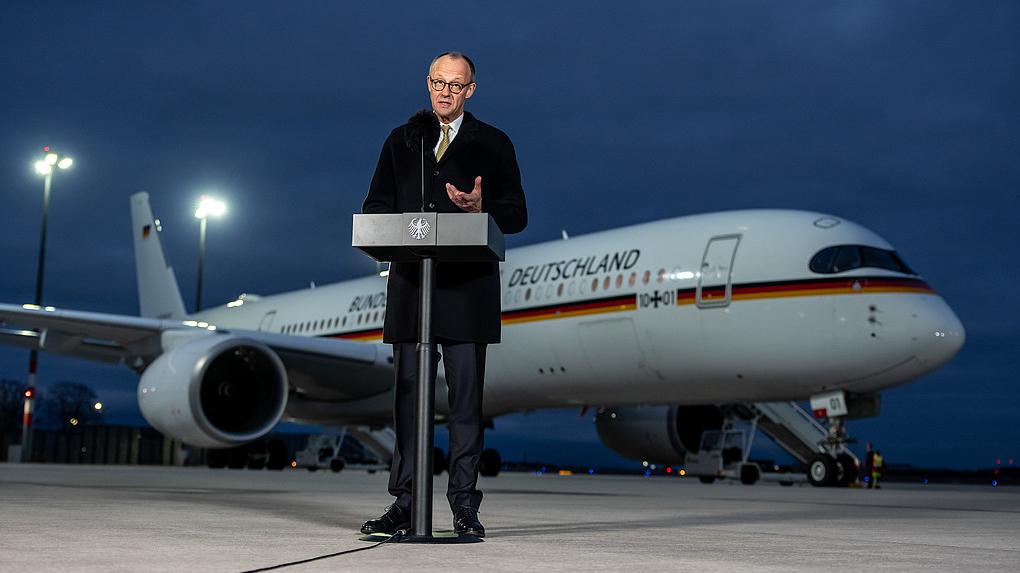
German Chancellor Friedrich Merz speaks during a press statement before his departure for China, in Brandenburg, Germany, February 24, 2026. /VCG
German Chancellor Friedrich Merz has embarked on his first official visit to China during his tenure. He is the latest European leader to visit China within the past three months, following visits by leaders from France, Ireland, Finland and the United Kingdom.
There is widespread attention on how China and Europe will work together to address uncertainties in the international arena. A global survey released by CGTN shows that 83.9 percent of respondents believe that European countries seeking cooperation with China helps address uncertainties in the international situation.
In recent years, annual trade between China and Germany has remained above $200 billion, with bilateral investment stocks exceeding $65 billion – each accounting for nearly a quarter of China's overall engagement with the European Union. Last year, bilateral trade between China and Germany reached $292 billion, marking a year-on-year increase of 2.1 percent. China became Germany's largest trading partner. In the survey, 90.2 percent of respondents believe that China's vast market presents a significant opportunity for German enterprises.
As the world's second- and third-largest economies, China and Germany are not only deeply interlinked in trade and economic cooperation, but also share extensive common interests in global governance areas such as climate change, green energy, and the digital economy. In this regard, 83.6 percent of respondents believe that a stable and healthy China-Germany relationship is not only vital to the interests of both countries, but also has a leading and demonstrative effect on overall China-EU cooperation.
The development of China-Germany relations shows that as long as the principles of mutual respect, seeking common ground while reserving differences, mutual learning through exchanges and win-win cooperation are upheld, the overall direction of bilateral relations will not deviate, a view shared by 89.1 percent of respondents. In addition, 68.9 percent of respondents point out that China and Germany are partners rather than rivals, with cooperation outweighing competition and consensus exceeding differences.
The current international landscape is undergoing profound changes. As influential major countries, China and Germany should work hand in hand amid transformation and turbulence, overcome difficulties together, and promote reform of the global governance system. In the survey, 79.8 percent of respondents believe that China and Germany should work together to uphold multilateralism and free trade, and jointly advocate genuine multilateralism. Besides, 77 percent say that a rational and pragmatic China-Germany relationship injects greater expectations of stability into an unsettled international situation. Meanwhile, 79.5 percent of respondents believe that China and European countries are important forces driving the development of a multipolar world.
Amid the accelerating adjustment of the global power structure, an increasing number of middle powers recognize that unilateral confrontation is insufficient to address risks and challenges. Only by embracing open cooperation to manage uncertainties can they expand their development space. In the survey, 92.3 percent of respondents believe that seeking cooperation with China is becoming an important way for middle powers and emerging countries to strengthen their resilience and enhance their influence. Another 95.2 percent view middle powers as key forces for multilateralism, while 91.6 percent call on middle powers to work together to promote reform of the global governance system.
The survey was published on CGTN's English, Spanish, French, Arabic and Russian platforms, and within 24 hours, a total of 12,990 participants cast their votes and shared their views.