


Chinese sturgeon fry, each about 20 centimeters long, dart energetically through the Yangtze River rare fish conservation center beside the Three Gorges Dam in Yichang, central China's Hubei Province. They represent a decades-long breakthrough in conservation efforts.
These 112,000 third-filial-generation Chinese sturgeon were bred through artificial propagation last November and are now in good health, with an average weight exceeding 100 grams, said Jiang Wei, deputy director of the Yangtze River Biodiversity Research Center under China Three Gorges Corporation and chief engineer at the Chinese Sturgeon Research Institute.
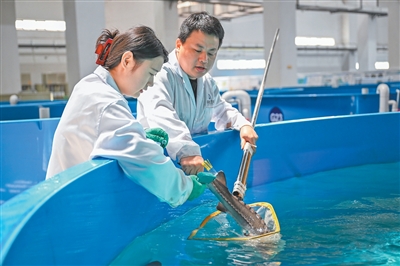
Photo taken in 2025 shows researchers catching a Chinese sturgeon at the Yangtze River Biodiversity Research Center under China Three Gorges Corporation. (Xinhua/Du Zixuan)
The Chinese sturgeon, a rare species endemic to the Yangtze River and one of the world's oldest vertebrates, has existed for more than 140 million years. But human activities have sent their numbers plummeting, spurring conservation efforts that have spanned decades.
Artificial propagation of Chinese sturgeon began in 1982. The fish proved extraordinarily difficult to cultivate, as they mature late and demand highly exacting environmental conditions. Generation after generation of researchers tackled the challenge, eventually mastering key technologies. From wild-caught broodstock, scientists successfully produced first- and second-filial-generation Chinese sturgeon.
But as the first filial generation of Chinese sturgeon reached an average age of more than 17 years, researchers knew time was running out. These fish would likely pass their reproductive prime within seven to eight years.
The successful birth of the third filial generation means the captive-bred population can now sustain itself across generations without relying on wild stocks, giving the species a greater chance of survival, Jiang said.
Nationwide, eight Chinese sturgeon conservation centers now protect 3,300 wild and first-generation broodstock, conducting large-scale cultivation of second-generation fry annually. With the birth of the third filial generation, the broodstock population has expanded further.
China began releasing artificially bred Chinese sturgeon into the wild in 1984. Since 2024, annual releases of captive-bred Chinese sturgeon have exceeded 1 million for two consecutive years.
Before the implementation of a decade-long fishing ban on the Yangtze River, underwater nets, propellers, water pollution and other factors meant many Chinese sturgeon never reached the river's estuary, said Du Hao, a researcher from the Yangtze River Fisheries Research Institute of the Chinese Academy of Fishery Sciences.
Now the situation is changing. Using ultrasonic telemetry, net monitoring, environmental DNA analysis and hydroacoustic detection, researchers found that approximately 12.2 percent of the 4- to 8-month-old Chinese sturgeon released last year successfully passed through the Yangtze River estuary into the sea, with others still migrating downstream.
"Compared to less than 1 percent before the fishing ban, this ratio marks a roughly 20-fold increase," Du said.
Zheng Yueping, deputy director of the Shanghai Aquatic Wildlife Conservation and Research Center, said the city's Chongming Dongtan National Nature Reserve is critical to Chinese sturgeon conservation. "Whether they can swim here is a key test of conservation success."
Monitoring shows young Chinese sturgeon typically remain in the Yangtze River estuary for about six months before venturing into the sea.
Researchers often compare the Yangtze River estuary to a kindergarten for Chinese sturgeon before they enter the sea. To help fry thrive, techniques from marine ranching — including bamboo poles planted in mudflats and artificial reefs positioned in shallow waters — have been introduced to aid restoration. As algae attach to these structures, shellfish, crabs, small fish and shrimp gradually gather, providing food for young sturgeon to grow rapidly.
Chinese sturgeon spend 80 percent of their lives in the ocean. In coastal waters surrounding this special "kindergarten," fishermen, fishery authorities and research institutions are jointly establishing a protective monitoring network.
China has incorporated environmental DNA monitoring and bycatch statistics into its Chinese sturgeon monitoring system.
Currently, most released Chinese sturgeon fry are 4 to 8 months old, with strong resistance to predation and environmental changes. Going forward, the proportion of larger fry released will be gradually increased, and nutritional enhancement and rewilding training will be conducted before release.
Experts say that if annual releases gradually increase to 5 million fish and continue for about 18 years, the wild Chinese sturgeon population could potentially recover to between 200 and 300 — levels last seen in the early 21st century.
China has adopted a wide range of protective measures for Chinese sturgeon, including an action plan for the rescue of the species covering 2015 to 2030. Shanghai has released regulations on the protection and management of the species, while also joining Jiangsu, Zhejiang and Anhui in conducting joint enforcement operations against illegal fishing. Meanwhile, infrastructure has been adapted to minimize disruption, with the Yichang Wujiagang Yangtze River Bridge, completed in 2021, adopting a single-span design to avoid building piers in the river.
In recent years, the Ministry of Agriculture and Rural Affairs has worked with multiple departments to continuously improve coordination mechanisms for the protection of Yangtze River aquatic biodiversity and the fishing ban. Eight provinces spanning the middle and lower Yangtze River, the East China Sea, and the Yellow and Bohai seas have strengthened monitoring and protection.
Research institutions and universities have also pooled their capabilities to advance monitoring and conservation technologies, while expanding public education on Chinese sturgeon protection.