


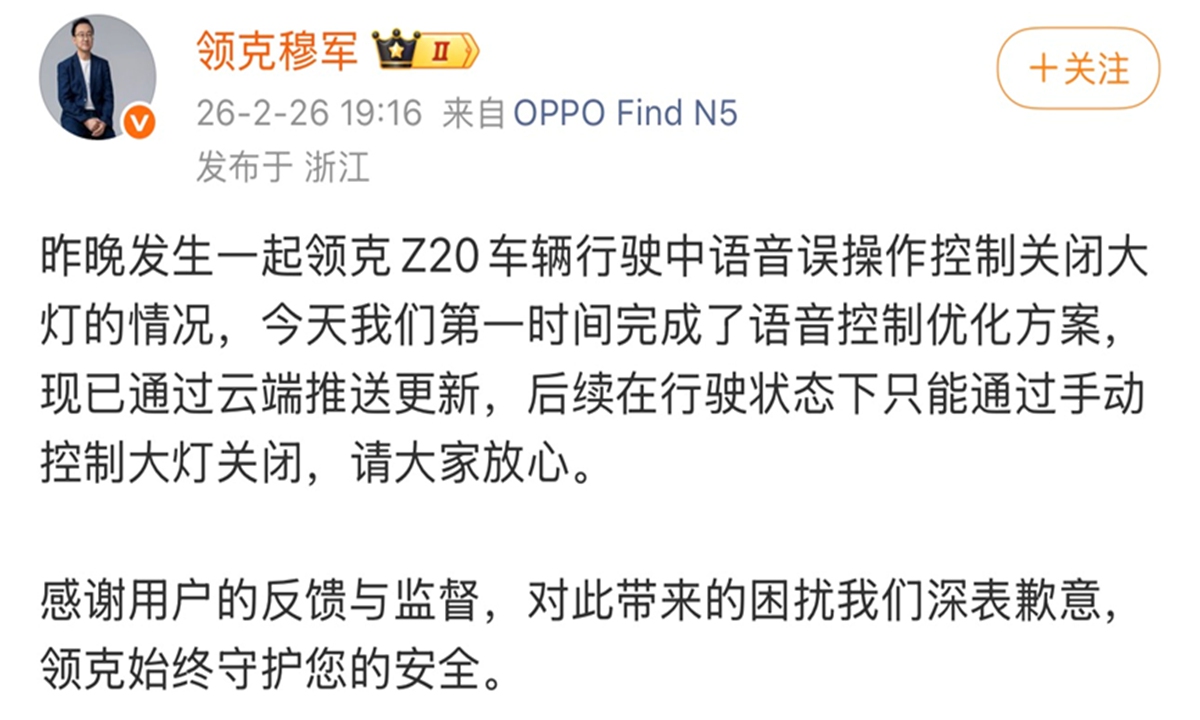
Lynk & Co CEO Mu Jun's post on Sino Weibo on February 26, 2026, apologizes for an issue involving the linkage of its vehicle lighting system, saying would immediately investigate and address potential safety risks. Photo: Screenshot of Mu Jun's Sino Weibo
Chinese new energy vehicle maker Lynk & Co on Thursday responded to and apologized for an issue involving the linkage of its vehicle lighting system, and said it had immediately completed an optimization of the voice control system, which has been delivered through an over-the-air update. Recently, a vehicle owner reported on social media that a voice command instructing the car to "turn off the reading light" caused the headlights to switch off as well while driving. After attempts to reactivate the lights failed, the vehicle crashed into a highway guardrail. The related video quickly spread online.
"We have promptly completed an optimization of the voice control system, and the update has now been rolled out and delivered via over-the-air transmission. Going forward, headlights can only be turned off manually while the vehicle is in motion. Please rest assured," Lynk & Co CEO Mu Jun said on Thursday in a post on the company's Sina Weibo account.
The controversy comes as China's passenger car industry is undergoing a rapid push toward greater intelligence and software-driven integration.
Industry insiders noted that China's new-energy vehicles and the intelligent technologies they are equipped with are undergoing rapid iteration and upgrades, and that challenges of this kind inevitably arise as the sector moves from "stacking functions" toward "system maturity." The added safety flaws in traditional gasoline vehicles typically require full recalls to carry out repairs, while newly emerging issues in new-energy vehicles equipped with intelligent service systems, can often be addressed through cloud-based responses and real-time over-the-air updates.
The company's swift response has reassured some Lynk & Co owners, who said that putting safety first is fundamental to driving, while high-tech features should remain a supplementary enhancement rather than a substitute for basic safety.
Others, however, said the response fell short of addressing their concerns, arguing that the issue involved a core safety flaw that "should never have occurred." They warned that in extreme situations such as high-speed driving, even a single malfunction could lead to serious consequences.
Some commentators added that the key lies in whether the problem is thoroughly resolved and whether similar incidents can be prevented from recurring.
In-vehicle voice input technology has become a key feature of modern intelligent passenger vehicles. Industry insiders said such emerging, rapidly iterated technologies are currently most widely applied in China's new-energy vehicles, noting that the model involved—the Z20—is a pure electric SUV under the Lynk & Co.
The incident essentially stemmed from a voice-recognition and logic-control issue within the vehicle's cockpit system, and the issue is better viewed as a stage-specific exposure in the intelligent evolution of new-energy vehicles rather than a case of product quality failure, Zhang Xiang, secretary-general of the International Intelligent Vehicle Engineering Association, told the Global Times on Friday.
The case also warned the need to establish clearer national standards and safety boundaries as intelligent technologies advance, Zhang said.
A report released by the China Society of Automotive Engineers said it expects automotive intelligent cockpits to enter a new phase of advanced cognitive intelligence by 2030.
Future intelligent cockpits will move beyond simple function stacking, adopting a unified primary intelligent agent as the core interface, supported by multiple agents that dynamically collaborate based on scenario demands. This shift is expected to deliver a more immersive and integrated in-vehicle experience, ultimately evolving toward a new intelligent service ecosystem driven by scenarios and multi-agent coordination.
China's new-energy vehicle sector has built clear advantages in market scale, technological pathways and supply-chain completeness, but as intelligent functions advance at a faster pace, strengthening safety boundaries and engineering validation remains an area where the industry is continuing to make intensive and sustained efforts, Zhang said.
He noted that as a key long-term development direction, voice recognition will inevitably require a prolonged transition period—potentially spanning five to 10 years or longer—before reaching full maturity.