


In Lushi county, in western part of Central China's Henan Province, county government officials still work in adobe-brick houses built back in 1957.
Instead of constructing new office buildings, where has the county's fiscal revenue been allocated?
The local government has given priority to spending public funds on its people. With limited financial resources, the county has prioritized investment in improving people's well-being: helping villagers move out of adobe houses into new homes, and ensuring poor elderly people no longer live without care by moving them into nursing homes.
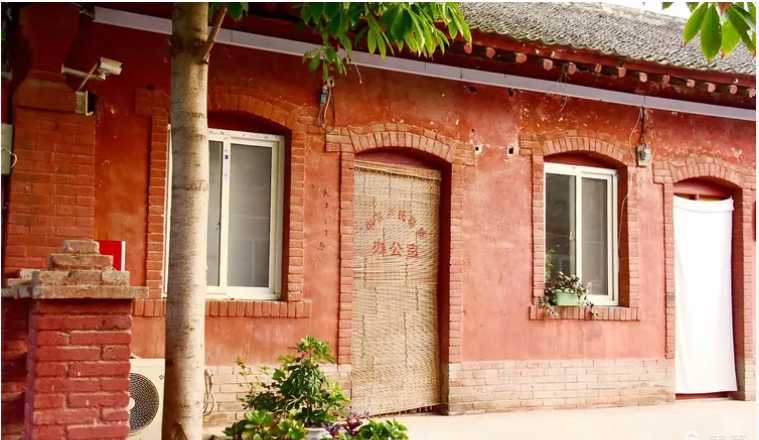
The county Party committee office building in Lushi county, Central China's Henan Province (Photos: People's Daily / Fang Min )
Recently, reporters from the People's Daily visited the nursing home in Dongming township, Lushi county, to learn how this project has been implemented.
In rural areas, the most vulnerable group, poor elderly people with no children, no property and no source of income, cannot be overlooked.
As winter arrived, how were they faring? What were the conditions of township nursing homes?
Pointing to a newly renovated building, Qu Ran, mayor of Dongming, said, "This nursing home now houses 237 elderly people, 47 of whom are destitute."
In front of the building, elderly residents sat on wooden benches under the sun to enjoy the warmth.
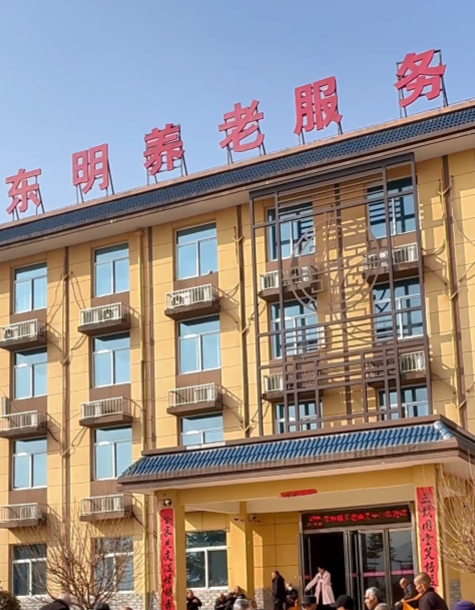
The nursing home in Dongming township, Lushi county, Henan Province.
Xue Zhongyue, an 80-something villager, told his story: His family suffered a sudden disaster in 2024, and he was diagnosed with serious illnesses one after another, leaving him in deep distress.
In 2025, Xue Zhongyue moved into the nursing home. Every concern he had was anticipated and addressed by the government.
Daily meals: One egg, one carton of milk and one meat dish every day.
Clothing: At least three sets of seasonal clothes, shoes, socks and bedding provided each year.
Facilities: The nursing home is equipped with rehabilitation equipment and home appliances. Each elderly resident also receives a monthly allowance of 50 yuan(about $7.22).
Medical care: Medical insurance for impoverished residents is fully covered by the county. Staff accompany residents to hospital visits. The county has also launched a "Mobile Hospital" program, with doctors making regular on-site checkups.
During a recent medical examination, doctors found Xue had high blood sugar. After undergoing timely treatment, his index soon returned to normal.
"I once wanted to give up living, but now I'm living well," Xue said simply but sincerely.
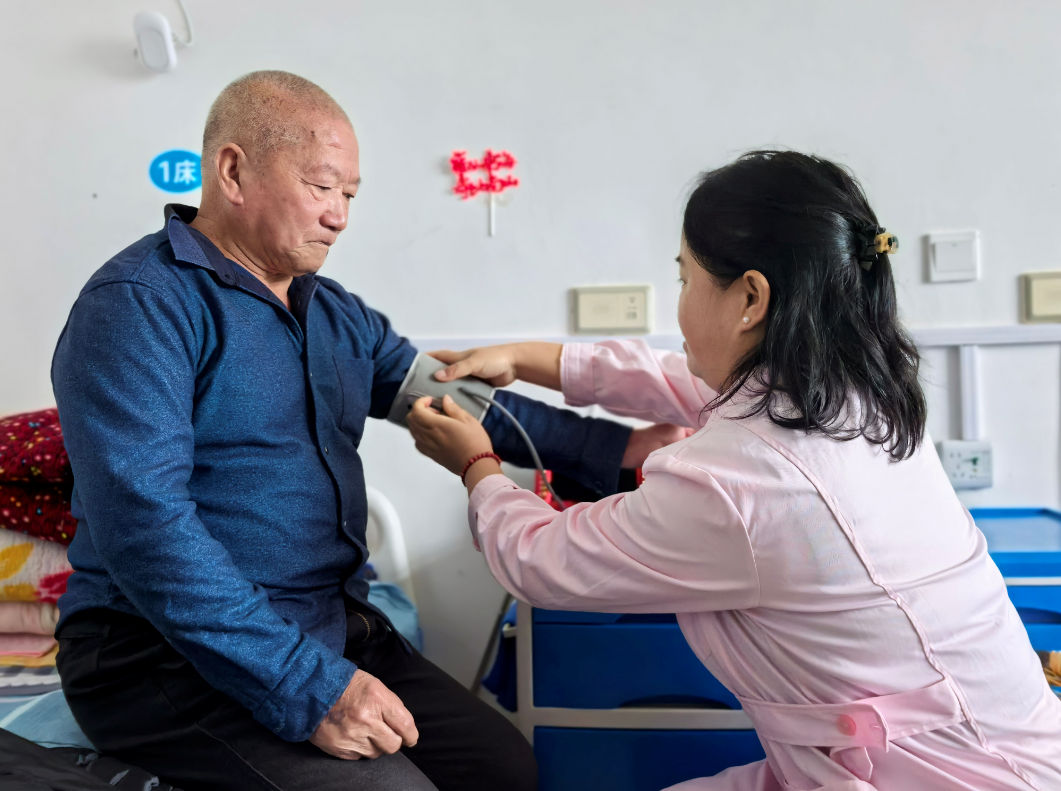
A nurse at the nursing home conducts a physical examination for villager Xue Zhongyue in Dongming township, Lushi county, Henan Province.
The visit to the nursing home revealed more thoughtful details: each room has two beds, complete with air conditioning, wardrobes and a private bathroom.
Rectangular devices on the ceiling and beside beds caught the reporters' attention. "These are fire detectors, vital signs monitors and anti-fall sensors. We can respond immediately if anything abnormal happens," explained Chen Huitao, head of the nursing home.
Everyone had something to say about the improvements in elderly care.
Ge Jianghui, a carer, said, "Conditions used to be poor. We used stoves for heating in the winter. In recent years, the county coordinated funds to install air conditioners, making it warm in winter and cool in summer. Fire accidents have been completely eliminated."
Elderly resident Gao Guisheng said, "In the past, living in a nursing home was seen as a sign that children were unfilial. Now the town nursing home has excellent conditions — it's decent to live here."
"Who pays for these improvements? Is this just a show project?" the reporters asked Chen to break down the costs.
"For every destitute elderly person we take in, the government provides a corresponding subsidy. It also exempts us from rent and utilities each year. That's why we're willing to accept destitute residents. We house them alongside self-paying elderly people, treating everyone equally," Chen said.
Adequate funding has boosted rural elderly care. The county has invested 18 million yuan from public welfare lottery funds to renovate 17 town nursing homes across the county. With improved conditions, more self-paying elderly people have moved in each month, making the nursing homes profitable and boosting staff morale.
Zhang Jiasen, director of the county's civil affairs bureau, said the county now runs 64 elderly care service facilities with a total of 1,812 beds, providing care for rural elderly people, including the destitute.
What are the plans for the future? Hu Zhiquan, secretary of the county Party committee, said the county has established 15 special assistance systems and formulated differentiated support lists. It will continue to achieve "efficient identification, accurate monitoring, timely assistance and solid guarantees" for vulnerable rural groups.
(Edited by Xu Zheqi)