


by Xinhua writers Hu Tao, Li Linhai
XINING, Feb. 27 (Xinhua) -- When a snow leopard mother with her four cubs jumped into his view, 53-year-old Tibetan herdsman Marpalden was just on his way to a summer ranch on the Qilian Mountains, located on the northeastern edge of the Qinghai-Tibet Plateau.
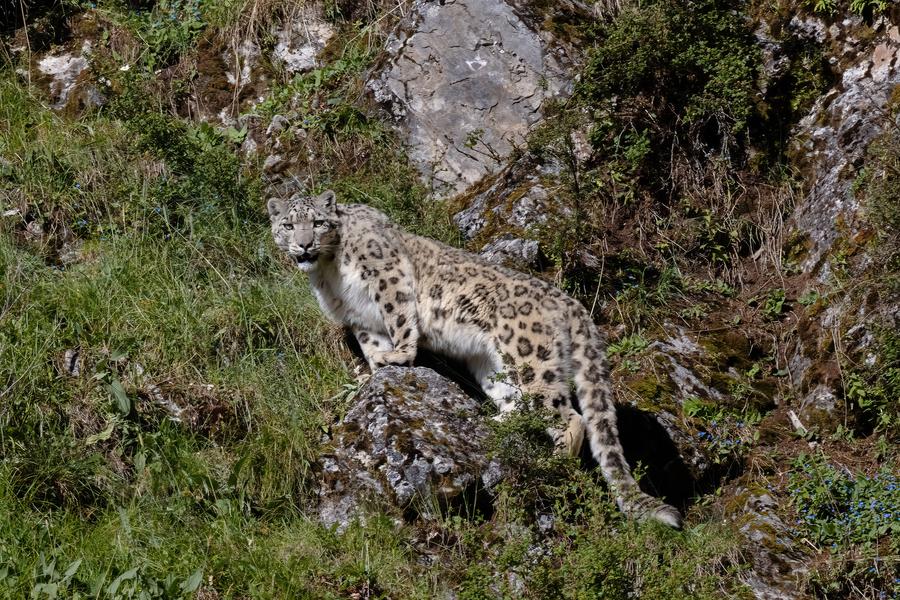
A snow leopard is pictured in Zadoi County of Yushu Tibetan Autonomous Prefecture, northwest China's Qinghai Province, Aug. 6, 2022. (Photo by Yao Muyang/Xinhua)
"We can often come across snow leopards or their traces in the mountains. But, at the moment, I was so excited to see five at the same time!" recalled the herdsman.
However, the excitement was mixed. The herdsman has his own "happy troubles" -- the growing snow leopard population on the Qinghai-Tibet Plateau, known as the "roof of the world," poses a threat to his over 40 sheep and 200 yaks.
Marpalden has lived for generations in the Sujiwan Village, Menyuan Hui Autonomous County in northwest China's Qinghai Province. His hometown has been included as a candidate site for China's Qilian Mountain National Park, which is home to the precious snow leopard and other protected wildlife.
After snowfalls in winter, food is scarce in the mountains. Marpalden recalled that, in the winter of 2025, one of his yaks became "a big meal" of a snow leopard. Despite the losses, he didn't hold a grudge against the animal.
"Snow leopards are quite 'well-behaved.' Normally, when they have enough to eat, they do not kill randomly." To Marpalden and his fellow villagers, snow leopards are not only a protected animal but also members of their family. "Having taken here also as their homeland, they deserve our full protection," he said.
Sharing with mankind the "roof of the world," snow leopards usually inhabit the towering snow-capped mountains. Its survival depends on an abundant supply of prey, clean water sources, and a stable habitat. Therefore, it is also a flagship species for the protection of alpine and mountainous ecosystems in Central Asia.
Home to a variety of precious wildlife, including the snow leopard, the Qinghai-Tibet Plateau region provides healthy water and a range of important ecosystem services to one-third of the world's population.
As a major part of this plateau, Qinghai is one of the regions in China and even the world where the snow leopard population is most concentrated. However, snow leopards once faced declining habitat quality and a dwindling population due to climate change, poaching, and human activities, among others.
Luckily, the living status of the animal has been improving in recent years, thanks to constant joint conservation efforts by both the governments and the local people.
In recent years, China has established 138 nature reserves in the snow leopard's distribution area, covering a total of 766,000 square kilometers. These connected reserves vary in scale and type. Among them, the largest is located in Qinghai's Sanjiangyuan area and the Changtang National Nature Reserve in Xizang Autonomous Region.
Walking through high mountains and deep valleys, Tibetan photographer Bao Yongqing captured this rare cat with his camera, documenting and protecting the animal in the national park in his own way.
Bao lives in Tianjun County, the Mongolian-Tibetan Autonomous Prefecture of Haixi in Qinghai. This county is also a candidate site for the Qilian Mountain National Park, which is ideal for wildlife photographers.
To capture the living state of snow leopards, Bao used to stay in a canyon cave for up to nine days at an altitude of nearly 4,000 meters in the heart of the Qilian Mountains, staying less than 200 meters from a snow leopard family.
Bao has taken pictures of many wild animals in his homeland plateau, and the snow leopard remains his favorite. Through his lens, the life of the once mysterious big cats is becoming more familiar to the public.
"A picture is worth a thousand words. Many people around the world can clearly see and understand our efforts in conserving snow leopards and the biodiversity of the world's Third Pole," Bao said.