


BEIJING, Feb. 27 (Xinhua) -- Chinese children will spend more time outdoors, on artistic hobbies and handiwork after the country rolled out a new guideline to develop "healthy schools."
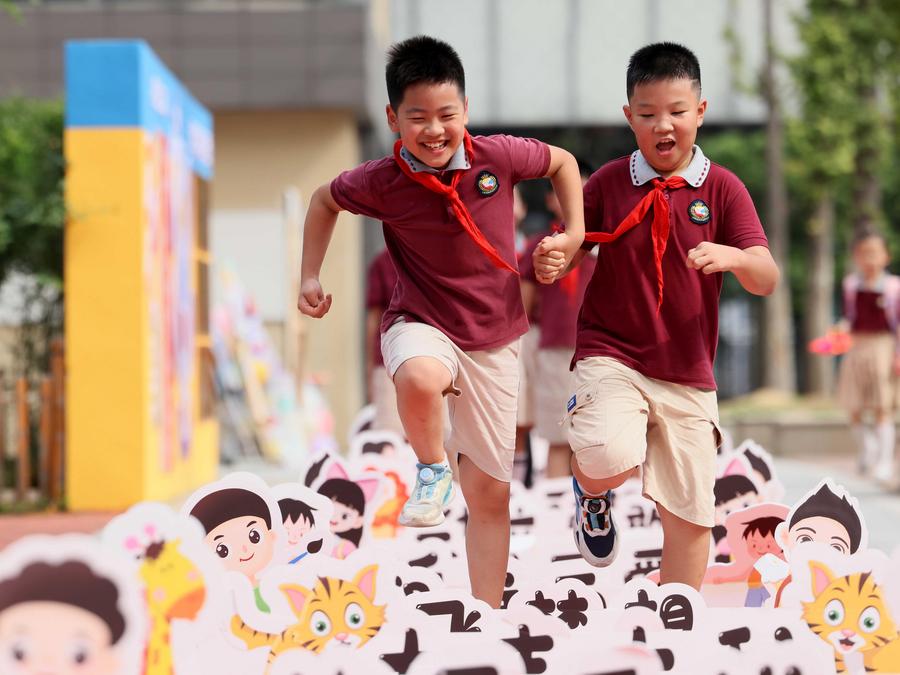
Photo shows students play an activity called "stepping towards the future" at a primary school in Anhui Province on Sept. 1, 2024. (Photo by Xie Chen/Xinhua)
The guideline, issued by the Ministry of Education, serves as a key policy document for implementing a health-first education philosophy, said Sun Mingchun, director of the division of physical, health and arts education under the ministry, at a press conference on Friday.
"While progress has been made, challenges remain in areas such as students' physical fitness, eyesight, weight management, mental health, food safety and nutrition," Sun noted.
The guideline aims to address these prominent concerns in a coordinated manner and shift the focus of education from emphasizing academic performance alone to promoting students' all-round physical and psychological development, he added.
Eight key tasks have been identified as central to this initiative, according to the guideline.
Schools will strengthen physical education by ensuring that primary and secondary school students engage in no less than two hours of integrated physical activity each day, while also introducing 15-minute class breaks and promoting fitness improvement programs for university students.
Efforts will be made to enhance aesthetic education by fully offering arts courses and improving regular art exhibition and performance mechanisms, which should be accessible to all students. Labor education will be reinforced through programs aimed at cultivating sound work habits and showcasing students' labor skills and achievements.
Mental health education will be deepened by strengthening professional teams and advancing the construction of a nationwide monitoring and early warning system focused on the mental health of students.
Comprehensive measures will be taken to prevent and control myopia, especially during key stages in kindergartens and primary schools, with the goal of accelerating the decline in China's myopia rates. Obesity prevention capabilities targeting primary and secondary school students will also be strengthened via closer coordination between schools, families and medical institutions.
Campus food safety management will be tightened, including stricter implementation of meal supervision systems and the provision of dedicated food safety and nutrition management personnel.
Life safety education will be incorporated into curricula, with broader dissemination of first-aid knowledge and skills, and through the required installation of automated external defibrillators (AEDs) and other emergency equipment.
Pilot programs have been launched in more than 540 schools across seven provincial-level regions, namely Beijing, north China's Hebei, Shanghai, Jiangsu and Shandong, all in east China, central China's Henan and Guangdong in south China, which will explore replicable models suitable for healthy school development, Sun revealed.
The document outlines a three-stage roadmap. By 2027, pilot projects will be completed, having delivered improved standards and evaluation systems, thereby generating a number of replicable experiences. By 2030, the health-first philosophy should be widely embraced, school health education and support conditions significantly enhanced, and healthy school development extended to all schools. By 2035, higher-quality healthy schools are expected to have been established across the country.