


Hungary-Serbia railway's Hungarian section resumes freight operations under BRI
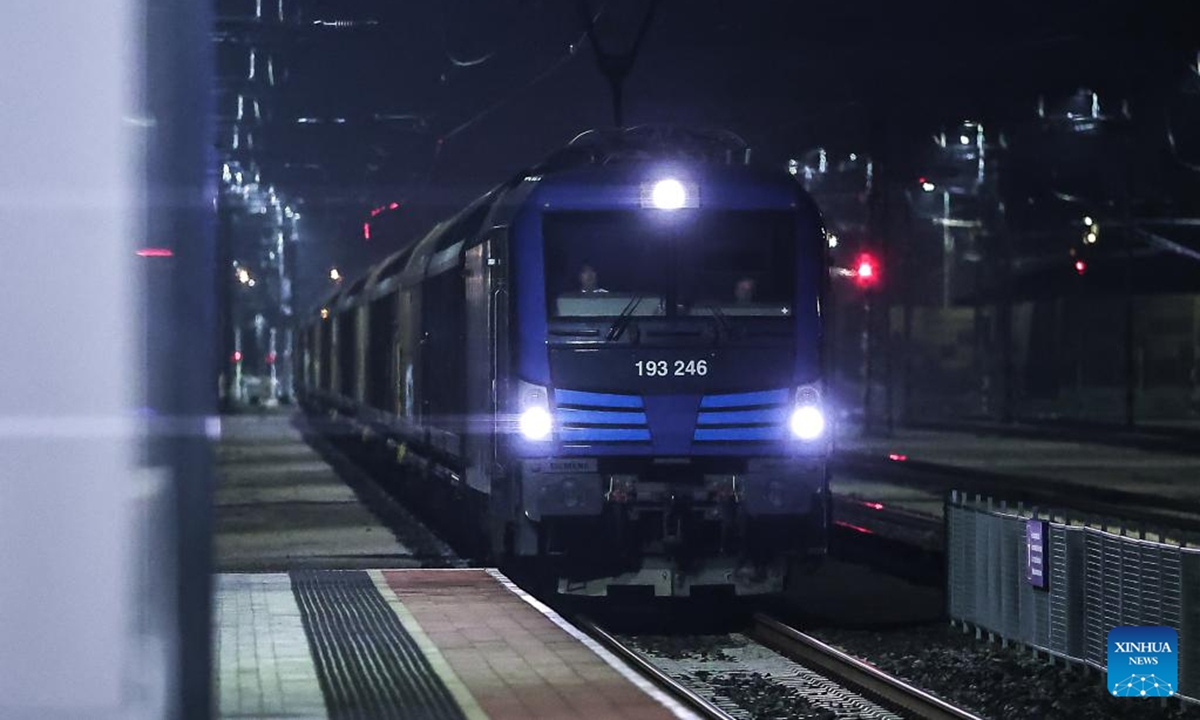
A freight train enters the Soroksar railway station in Budapest, Hungary, on February 27, 2026. (Photo: Xinhua)
The Hungarian section of the Hungary-Serbia railway officially resumed freight operations on Friday, Xinhua News Agency reported. The railway is a flagship project under the Belt and Road Initiative (BRI), which is a key infrastructure undertaking jointly built by China, Hungary, and Serbia to link the two capitals.
Construction of the Hungarian section, jointly undertaken by China Railway Group Limited and local Hungarian firms, began in July 2020 and entered the civil engineering construction phase in February 2022, according to Xinhua.
The project marks the first time that Chinese railway technology and equipment have been aligned with the European Union's Technical Specifications for Interoperability (TSI), the report said.
Once the entire line is in full service, travel time between Budapest and Belgrade will be slashed from eight hours to approximately three and a half hours.
Taking the Hungary-Serbia Railway as an example, China has provided technical support while easing partners' financial burdens through financing arrangements to improve connectivity, a model of equal and pragmatic cooperation that advances globalization and shared development and helps build a community with a shared future for mankind, Liang Haiming, dean of the Hainan University Belt and Road Research Institute, told the Global Times on Friday.
Since the start of this year, a number of Belt and Road-related transport infrastructure projects have made progress overseas, injecting fresh momentum into local development.
Africa's first heavy-haul desert railway built by Chinese companies was completed and opened to traffic on February 1, according to Xinhua. The 950-kilometer mining line includes a 575-kilometer section constructed by China Railway Construction Corporation Limited in partnership with a local state-owned enterprise, marking the largest infrastructure project undertaken by Chinese firms in Algeria. Once operational, the railway will further improve Algeria's national rail network and enhance connectivity and economic development in the country's southwestern provinces.
In another report released by Xinhua News Agency on January 28, the Ruba Cross-Sea Bridge in Malaysia—the country's largest single bridge project currently under construction by Chinese companies—was successfully closed on January 26 and is expected to open to traffic in June this year.
Once completed, the bridge will significantly improve coastal transport links in Sarawak state, sharply reduce regional travel times, and end residents' long-standing reliance on ferry services. It is also expected to inject fresh momentum into the development of local oil and gas resources, agriculture and tourism, according to the report.
Liang noted that projects such as the Hungary-Serbia Railway have also driven growth along their routes by attracting investment, creating jobs, upgrading infrastructure and advancing regional integration—demonstrating the tangible value of the Belt and Road Initiative through the combination of "hard connectivity" and "soft connectivity."