


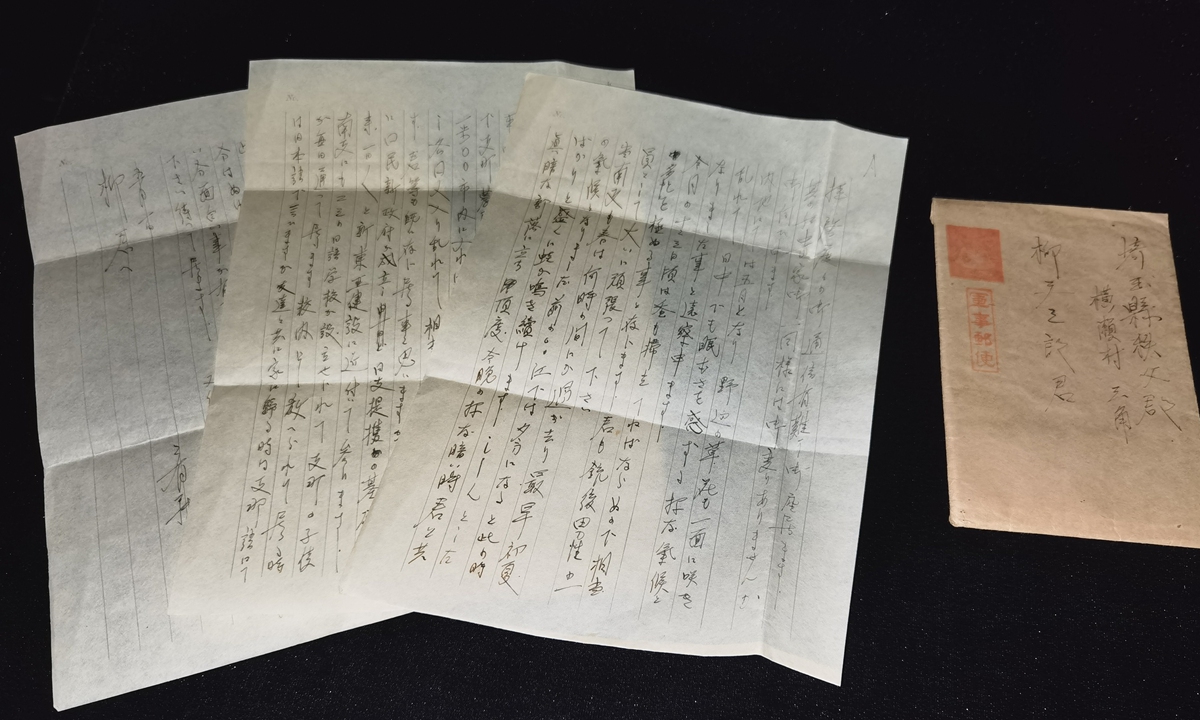
Original handwritten letters dating from Japan's invasion of South China, sent by a Japanese soldier to his family back home and bearing military postal stamps Photos: Courtesy of Guangdong Provincial Archives
The Guangdong Archives (GPA) hosted a donation and exhibition event on Saturday, showcasing newly acquired historical documents detailing Japan's invasion of South China during World War II.
According to a statement the archives sent to the Global Times on Sunday, for some time, Japanese right-wing forces have increasingly denied or even glorified their wartime aggression and crimes against humanity. The Japanese government has blatantly interfered in China's domestic affairs and challenged the post-World War II international order, actions that have drawn widespread condemnation from the Chinese public and peace-minded people around the world.
Against this backdrop, the GPA's donation and exhibition of historical evidence documenting Japan's wartime atrocities in China is both timely and of profound significance, said the statement.
The ceremony featured the donation of a significant collection of original documents, photographs, and personal letters—compelling evidence of Japan's invasion of South China. Sha Dongxun, a research fellow with the Guangdong Academy of Social Sciences, donated a collection of documents to the GPA. The materials include original Japanese-language manuscripts from a 1995 interview in which a Japanese soldier confessed the Japanese army's biological warfare experiments in China, as well as printed testimonies from 1993 in which another Japanese soldier publicly revealed the army's use of biological weapons.
In a separate donation, Wu Peijun, a professor at the South China Normal University, presented archives with original handwritten letters sent by a Japanese soldier during the invasion of South China - each bearing Japanese military postal stamps.
The donated items to the GPA also include historical photographs of the Japanese army's killings, arson and looting in Sanzao Island, Zhuhai; an oral history video of a descendant of Sanzao Massacre survivors, recalling the discovery of a mass grave after the end of the war; and photographs documenting life in the Zhuhai Yinkeng refugee camp, captured by firsthand witnesses.
Wang Han, a deputy director of the collection department of the GPA, told the Global Times that the donated materials serve as crucial evidence of the atrocities committed by Japanese forces and help combat historical revisionism. "These archives are not only historical records but also a warning and a call for reflection on human morality and responsibility," noted Wang.
The GPA also exhibited a newly collected batch of archival holdings related to the Japanese army's war crimes during the invasion of China, including photos taken and kept as collections by military photographers serving in the 21st Division of the Japanese army that invaded South China, which documented the invasive atrocities, as well as Japanese publications and invasion photo albums on the situation of the invasion of China published by Japanese news media at that time.
"Releasing this batch of Japan-related archives is meant to awaken human conscience," Li Junxiao, director of the GPA, told the Global Times. "People who cherish peace around the world should unite, follow the path of justice, and bring more positive energy and certainty to a changing world, working together to build a community with a shared future for humanity."