


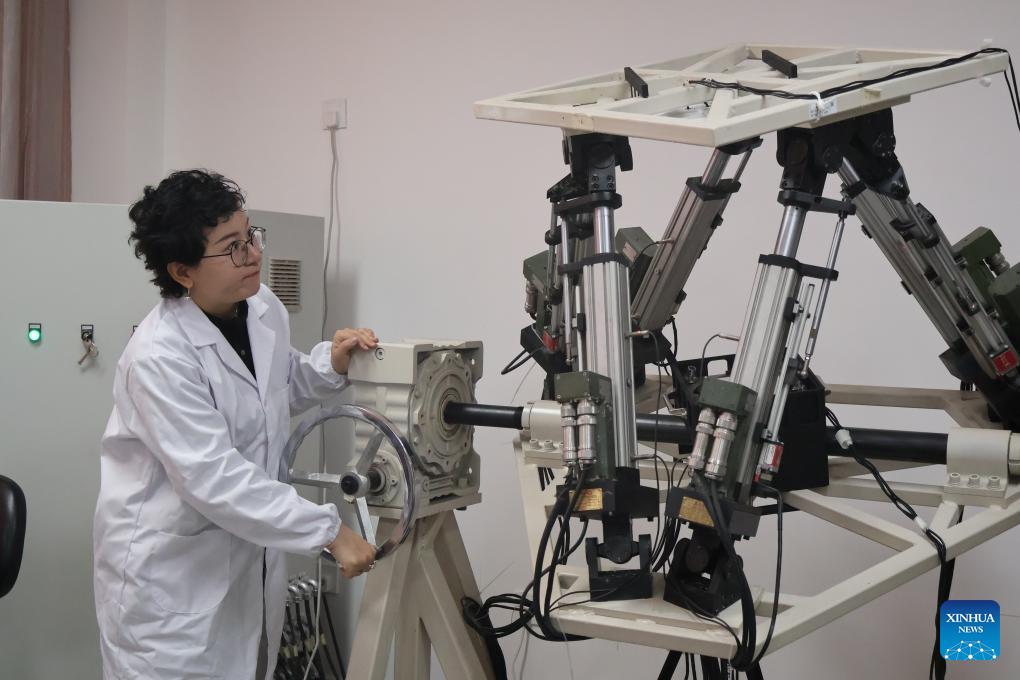
Guljaina Kazezkhan adjusts lab equipment at the Xinjiang Astronomical Observatory under the Chinese Academy of Sciences, in Urumqi, northwest China's Xinjiang Uygur Autonomous Region, Feb. 11, 2026. (Photo: Xinhua/Jia Zhao)
URUMQI, March 6 (Xinhua) -- Growing up in a Kazakh family in northwest China, Guljaina Kazezkhan often spent her childhood summer nights lying on a carpet in the yard and gazing at the stars.
In the Kazakh language, "gul" means flower, and "jaina" means shining light. Her parents gave her a name that seemed to foretell her path.
"I would lie there for hours, just imagining what the universe looked like," recalled the 34-year-old, sitting in her office at the Xinjiang Astronomical Observatory under the Chinese Academy of Sciences in Urumqi, capital of Xinjiang Uygur Autonomous Region. Her office is a three-hour drive from the construction site of a scientific marvel.
Guljaina is one of the few female engineers working on the Qitai radio telescope project, which features a 110-meter-wide fully steerable aperture that will be the world's largest of its kind when completed in 2028. Located in a valley basin in Qitai County, the 6,000-tonne structure will scan the cosmos for pulsars, test Einstein's theories, and search for faint signals from distant galaxies.
Her life today is different from that of many of her relatives, who still maintain the old ways of Kazakh nomads, such as moving with their herds to spring pastures, living in small yurts and eating meat with their hands. But the instincts of nomadic people, who have long relied on the stars to navigate, seem to give her some innate advantages in this cutting-edge scientific career.
Much of the project's engineering work must be carried out in barren terrain, where engineers like Guljaina have to endure icy winds and scorching heat. But she is no stranger to such weather. The main task of this small-figured woman is to control heavy equipment with high precision under harsh conditions.
Since 2021, soon after joining the observatory, Guljaina has been assigned to a task about the telescope's secondary reflector. This component, weighing over six tonnes and the size of a small truck, requires engineers to maneuver it at a height of roughly a 35-story building, using robotic systems to make the adjustments.
If a giant radio telescope can be compared to an eye gazing at the cosmos, then the secondary reflector can be the eye's pupil. Keeping that "pupil" suspended in the air, precisely aligned with the main reflector, is like standing atop a high building and trying to thread a needle with a single human hair.
"The hurdle our team has to frequently deal with, for example, is to transport the 6-tonne device 0.05 millimeters at a height of 100 meters and rotate it by 0.001 degrees," Guljaina explained to Xinhua.
She and her colleagues build algorithms and models on computers, run simulations in the lab and then head into the site to debug equipment. Then they bring the accumulated data back to the lab for further analysis, thereby improving the algorithms and designs. Such a process will raise the telescope's observational precision, which will eventually provide strong support for China's future astronomical research and aerospace missions.
"I often think of myself as a small 'screw.' Tiny, but an indispensable part of such a massive scientific project," said Guljaina, adding that she feels proud about her work.
However, being a female engineer comes with its own set of challenges. She recalled the first time climbing a high antenna at an observation station. "My legs were trembling so badly," she said. "When I climbed to 30 meters high, and even to 100 meters, I could barely stand," she joked at the embarrassment.
Guljaina grew up in a family that valued learning. Her father was a mathematics teacher, and her mother is a Kazakh language teacher. She is the youngest of three children, with a brother and a sister who works as a primary school English teacher.
Supported by China's educational programs for minority students, she attended high school in Wuhan, a city with better educational resources in central China's Hubei Province.
She went on to pursue an undergraduate degree at Northwestern Polytechnical University in Xi'an, majoring in automation, a male-dominated field.
In 2016, she returned to Xinjiang and entered the astronomical observatory for graduate and doctoral studies. She excelled, winning scholarships and honors, and then became a mother.
Guljaina is among the 40 million women scientists, engineers, and technicians in China. Their shoulders may not be strong, but their wisdom and perseverance are second to none. From high-speed trains and large aircraft to biomedicine and artificial intelligence, they have made their mark on the country's innovation drive.
In the run-up to International Women's Day on March 8, outstanding women like Guljaina have come into the spotlight, and her ethnic minority identity has drawn more attention.
The petite, bespectacled female engineer takes the attention in stride. "The standards of science do not lower themselves because of gender or ethnicity," Guljaina said.
"I just keep my feet on the ground, doing the work, solving the problems, and holding onto the dream I've had since I was a child looking up at the stars."
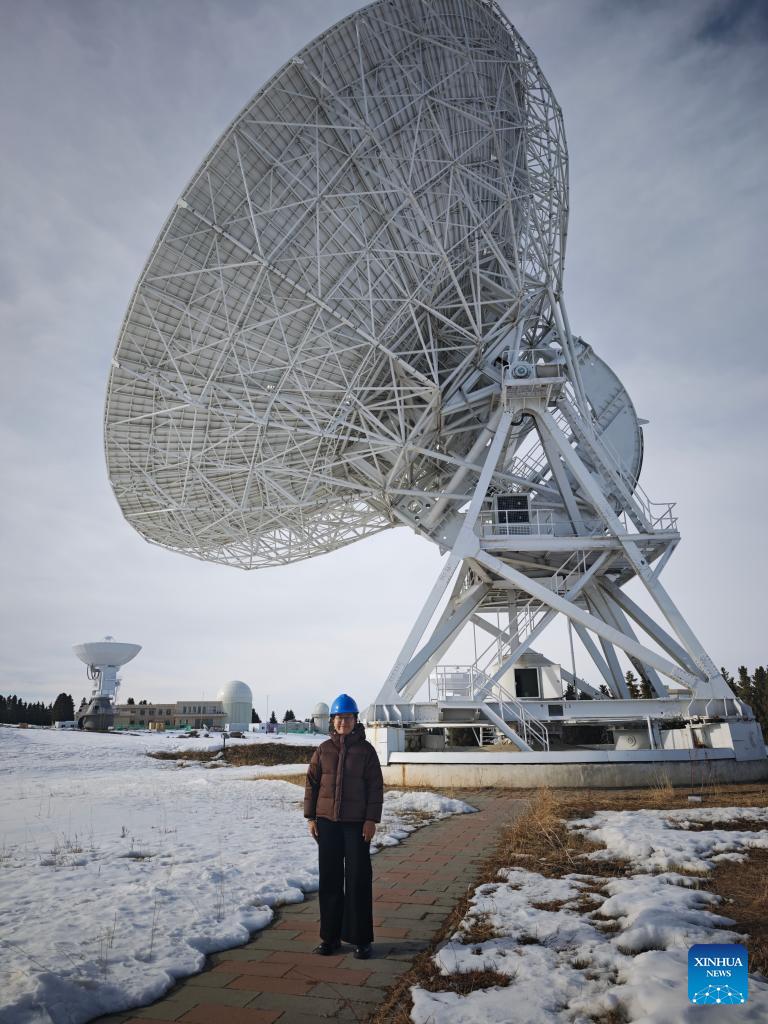
Guljaina Kazezkhan poses for photos at Nanshan Station of the Xinjiang Astronomical Observatory under the Chinese Academy of Sciences, in Urumqi, northwest China's Xinjiang Uygur Autonomous Region, Feb. 11, 2026. (Photo: Xinhua/Jia Zhao)