


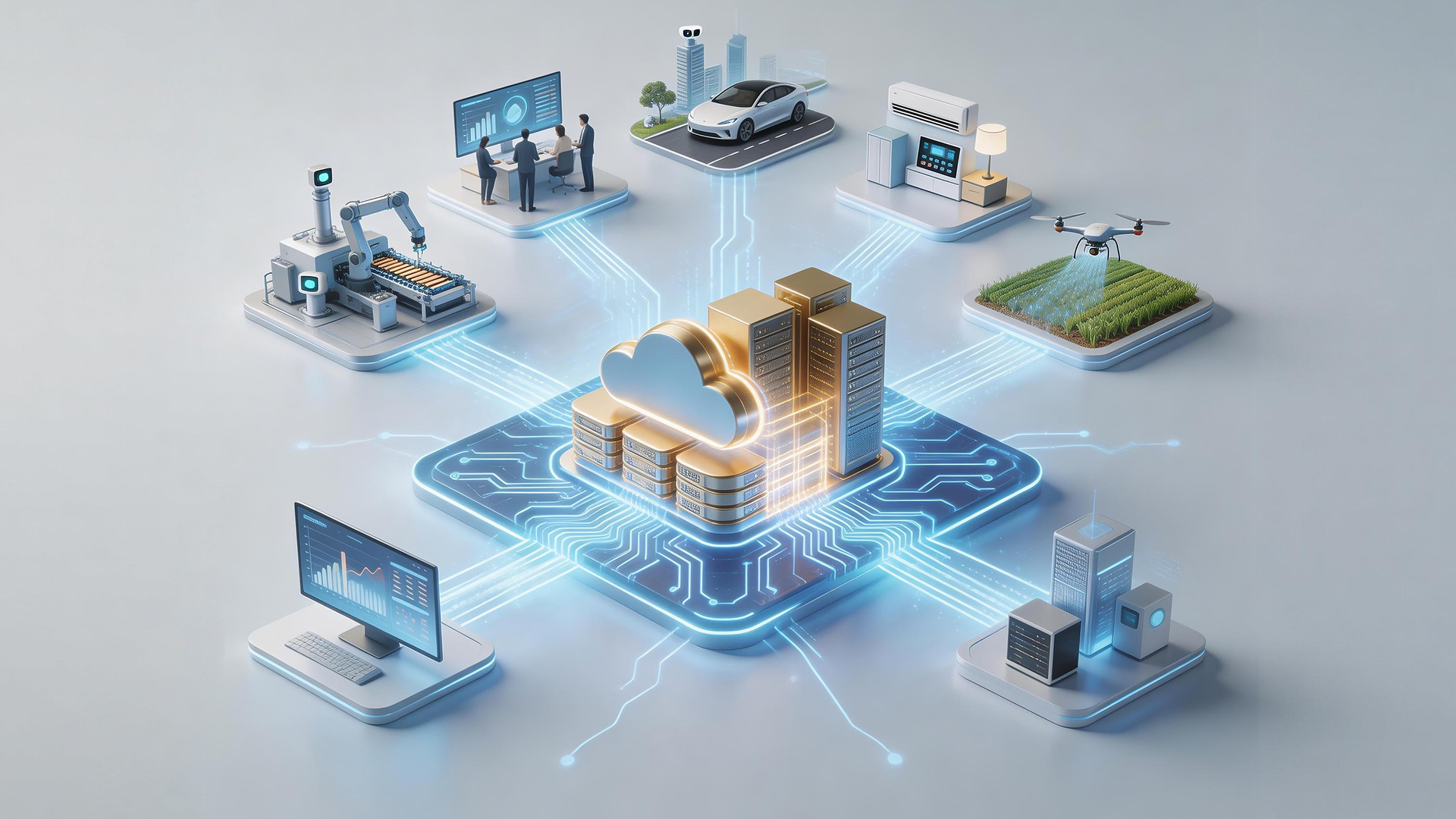
AI-generated graphic depiction of the smart economy. (Photo: CGTN)
China will "forge new forms of smart economy," according to a government work report submitted Thursday to the country's top legislature for deliberation.
The report also introduced four emerging terms: AI agents, AI native, intelligent computing clusters and computing-electricity synergy. Together, these five concepts outline China's comprehensive blueprint for an AI-driven economic transformation.
Smart Economy
Smart economy is a new economic model advanced from "AI Plus" that integrates intelligent technologies across production, services and daily life to drive large-scale innovation and full-scenario applications.
AI technology is moving from "digital screens" to the "physical world," shifting from "chatting" to "taking action," and reshaping business models, production organizations and lifestyles, said Chen Changsheng, a member of the drafting group of the government work report and deputy director of the State Council Research Office.
AI Agent
An AI agent is a system that autonomously performs tasks by designing workflows with available tools.
Zhou Hongyi, the co-founder, chairman and CEO of the Internet security company Qihoo 360, who's also a member of the National Committee of the Chinese People's Political Consultative Conference (CPPCC), noted that AI agents achieve the leap from "thinking" to "acting." He predicts 2026 as the "year of 10 billion agents," with AI agents serving as "digital employees" across all sectors.
AI Native
AI native refers to products or services designed with AI at their core from the start, rather than adding AI features later.
These applications are spawning new business formats, demands and professions, Zhao Xiaoguang, a researcher at the Institute of Automation, Chinese Academy of Sciences, who's also a member of the National Committee of the CPPCC, told Global Times.
She added that with the application of no-code AI tools, the "One-Person Company" model is gaining traction, enabling ordinary people to innovate and start businesses at low cost.
Intelligent Computing Clusters
Intelligent computing clusters are large distributed computing systems built with massive high-performance nodes to support large-scale AI training and inference.
Implementing ultra-large-scale intelligent computing clusters aims to enhance high-quality computing power supply, solidifying the foundation of the smart economy.
Computing-Electricity Synergy
Computing-electricity synergy is a coordinated approach that aligns computing infrastructure with power systems to improve energy efficiency and support sustainable AI computing.
Economist Zhu Keli, the founding director of the China Institute of New Economy, noted that this synergy will precisely match computing demand in eastern cities with clean energy from western regions, enabling the smart economy and green economy to complement each other.
Analysts suggest that the shift from "AI Plus" to "smart economy" signals a transition from partial empowerment to systemic transformation, with AI reshaping the entire chain of production, distribution, exchange and consumption.
The report's new infrastructure initiatives – including hyper-scale intelligent computing clusters, computing-electricity synergy, satellite internet and upgraded "5G+industrial internet" – provide foundational support for this transformation.
From traditional to smart manufacturing, and single-industry development to chain-wide coordination, the smart economy is breaking industry boundaries and becoming a core engine for cultivating new quality productive forces and driving high-quality development.