


From visa-free entry to instant tax refunds, China aims to turn foreign visitors into big spenders.
Imagine booking a last-minute trip to Shanghai without a visa, grabbing street food with your foreign credit card, and getting an instant tax refund — all in 48 hours. For Maria, a Spanish traveler, this is now reality: "China used to feel hard to navigate. Now it's easier than shopping in Paris or Tokyo, and the stuff you can buy? Totally unique."
In 2025, over 150 million international visitors poured into China, spending more than $130 billion — a 17% jump from the previous year.
At China's ongoing Two Sessions, the government unveiled its ambitious plan to become a global shopping destination. The government work report, submitted on Thursday to the country's top legislature for deliberation, explicitly called for "optimizing the inbound consumption environment" — signaling a shift from simply welcoming tourists to actively cultivating foreign spenders.

A woman from Russia came to Yu Garden to celebrate the Chinese New Year, Shanghai, China, February 12, 2026. (Photo: VCG)
The policy pivot: From open door to red carpet
Chinese Minister of Commerce Wang Wentao outlined a three-pronged approach on March 6: host signature events, roll out upgraded policies, and refine consumption scenarios.
The centerpiece is "Version 2.0" of China's duty-free refund system. The minimum purchase threshold dropped from 500 yuan to 200 yuan, with an 11% refund rate. "Buy-now-refund-now" services now operate nationwide.
By 2025, China had extended visa-free access to 43 countries, including the Republic of Korea (ROK), France, Germany and Australia. Travelers who meet the necessary criteria are permitted to remain in the country for a period of up to 30 days, with the option of unlimited entries. The implementation of this change has resulted in the introduction of 30 million visa-free entries in 2025.

A foreigner used a credit card to pay for a cup of coffee in Shanghai, China, April 12, 2024. (Photo: VCG)
Frictionless by design
Foreign credit cards now work smoothly at most merchant locations. Alipay and WeChat Pay link to overseas cards in under two minutes — no Chinese language, local phone number, or residency docs required.
Aisha, a Nigerian student, discovered this during a layover in Hangzhou: "I used my Visa card through WeChat to buy a cup of Longjing tea, then paid for my train to Beijing. It felt like the system was designed for me."
The commerce ministry is piloting a program in 15 cities aimed at building a world-class consumption environment and attracting spending from overseas tourists.
Hainan, China's tropical duty-free hub, exemplifies the new approach. Despite competitive pressures, the province accelerated airport expansions and integrated "duty-free plus taxed" retail models. In 2024, Hainan's duty-free sales hit 470.3 billion yuan, with foreign visitors accounting for a growing share. The target is 600 billion yuan by 2027.
From "made in China" to "must buy in China"
Foreign visitors are discovering that Chinese goods no longer means cheap knockoffs.
Shenzhen's electronics markets draw global crowds seeking smartphones, drones, VR headsets, and health-tracking wearables. Brazilian YouTuber Carlos told his 2 million followers: "My VR headset from China is better than the US version, and half the price."
Beyond technology, intangible cultural heritage products have become popular, with Sichuan brocade pandas, hand-painted New Year scrolls, brass artifacts from ancient craft traditions, and trendy "Guochao" merchandize being particular examples.
Ivan, a Russian tourist, paused in front of a jade carving that had taken three months to complete. "This is not merely a trivial object. It is a piece of China's history."
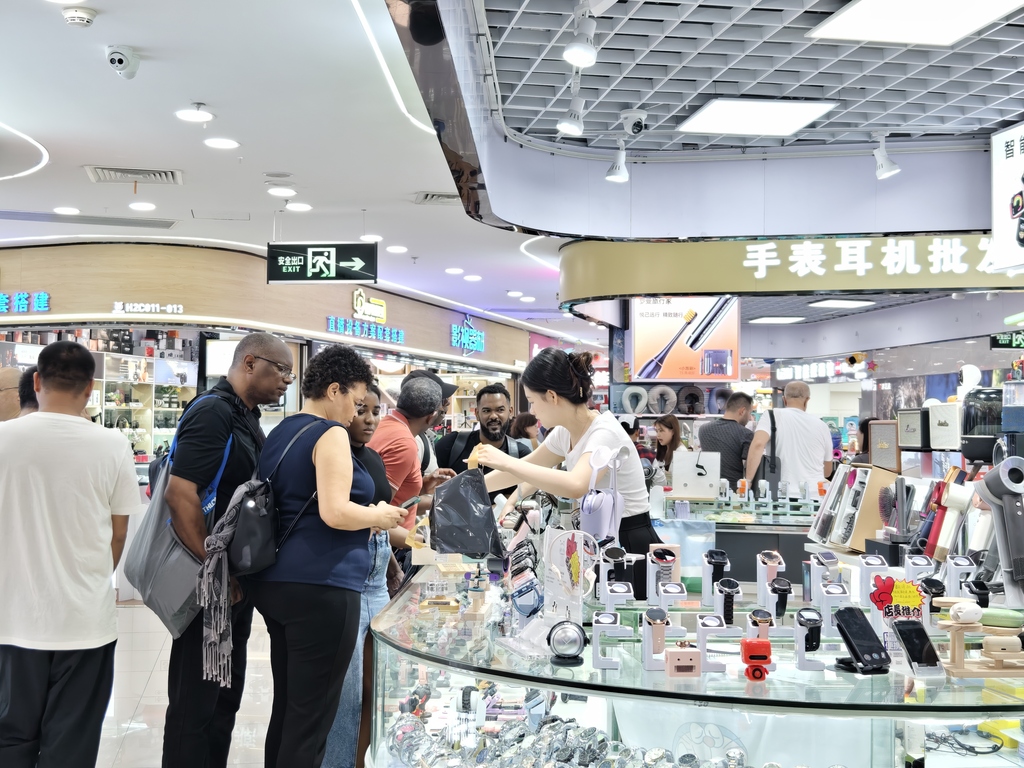
Foreign tourists were purchasing electronic products on the commercial street in Shenzhen, China, April 20, 2025. (Photo: VCG)
Why China cannot be copied
China's edge isn't merely price or product range. It's the impossibility of replication elsewhere.
Where else can you buy a hand-painted lantern from a master artisan in the morning, then test an auto-following drone in the afternoon? "China's mix of old and new is addictive," says Mexican blogger Sofia. "I bought a traditional fan and a smart watch — both tell a story about China today."
Safety and infrastructure amplify the appeal. China's major cities score high for public security, with high-speed rail connecting key shopping destinations in hours.
The Spring Festival has also become a global celebration. China saw a total of 17.796 million cross-border trips during the Spring Festival holiday period, with 460,000 entered under visa-free policies, up 28.5% from the daily average during last year's holiday. "Spending Spring Festival in China" is becoming a new trend.
The road ahead: From transactions to relationships
The blueprint extends beyond one-time tourism spikes. The "Shop in China" initiative will comprise a series of ongoing events and city showcases, which are scheduled to take place on a year-round basis. The objective of these showcases is to encourage casual visitors to become repeat customers. This will be achieved through the delivery of multilingual support, cultural heritage workshops, and the integration of seamless payment systems.
The economic logic is compelling. Inbound consumption still accounts for a smaller GDP share than in developed economies — closing this gap represents hundreds of billions in potential growth.
Statistical data indicates that in 2025, the number of inbound tourism visits exceeded 150 million. Smartphones, drones, virtual reality headsets, cultural collectibles, creative merchandise and trendy toys have all become regarded as "China specialties" and "China must-buys" by foreign visitors.
"China used to be a 'bucket list' destination," reflects Maria, preparing for her third trip in two years. "Now it's a place I want to come back to every year. The shopping is great, but the feeling that you’re welcome — that’s what keeps you hooked."
The world's newest shopping destination isn't merely open for business. This approach represents a significant shift in the concept of retail tourism, emphasizing the cultivation of relationships over transactions, the creation of memorable experiences over mere purchases, and repeat visits over one-time transactions.
Pack your bags. China is waiting — and this time, it wants you to stay.