


On March 11, a letter from the Innovation Norway Beijing office arrived in Xiangshan County, Ningbo, in east China's Zhejiang Province. Henning Kristoffersen, head of the agency's China office, expressed gratitude for the local support provided to Nordic Aquaculture (Ningbo) Co., Ltd., a Sino-Norwegian joint venture.
Since launching operations in Xiangshan in 2018, Nordic Aquaculture has built Asia's first land-based Atlantic salmon farm using a recirculating aquaculture system—a milestone in industrial cold-water fish farming in China. Beyond the technical achievement, the project has become a model of Sino-Norwegian collaboration, merging advanced aquaculture technology with green marine economy initiatives.
"State Grid Xiangshan completed the entire cross-island transmission-and-substation project in only six months, which is a remarkable achievement... [This] enabled an extremely tight schedule to be met without compromising on quality or safety," Kristoffersen wrote. "We look forward to highlighting your dedication and professionalism when introducing additional Norwegian investors to the region."
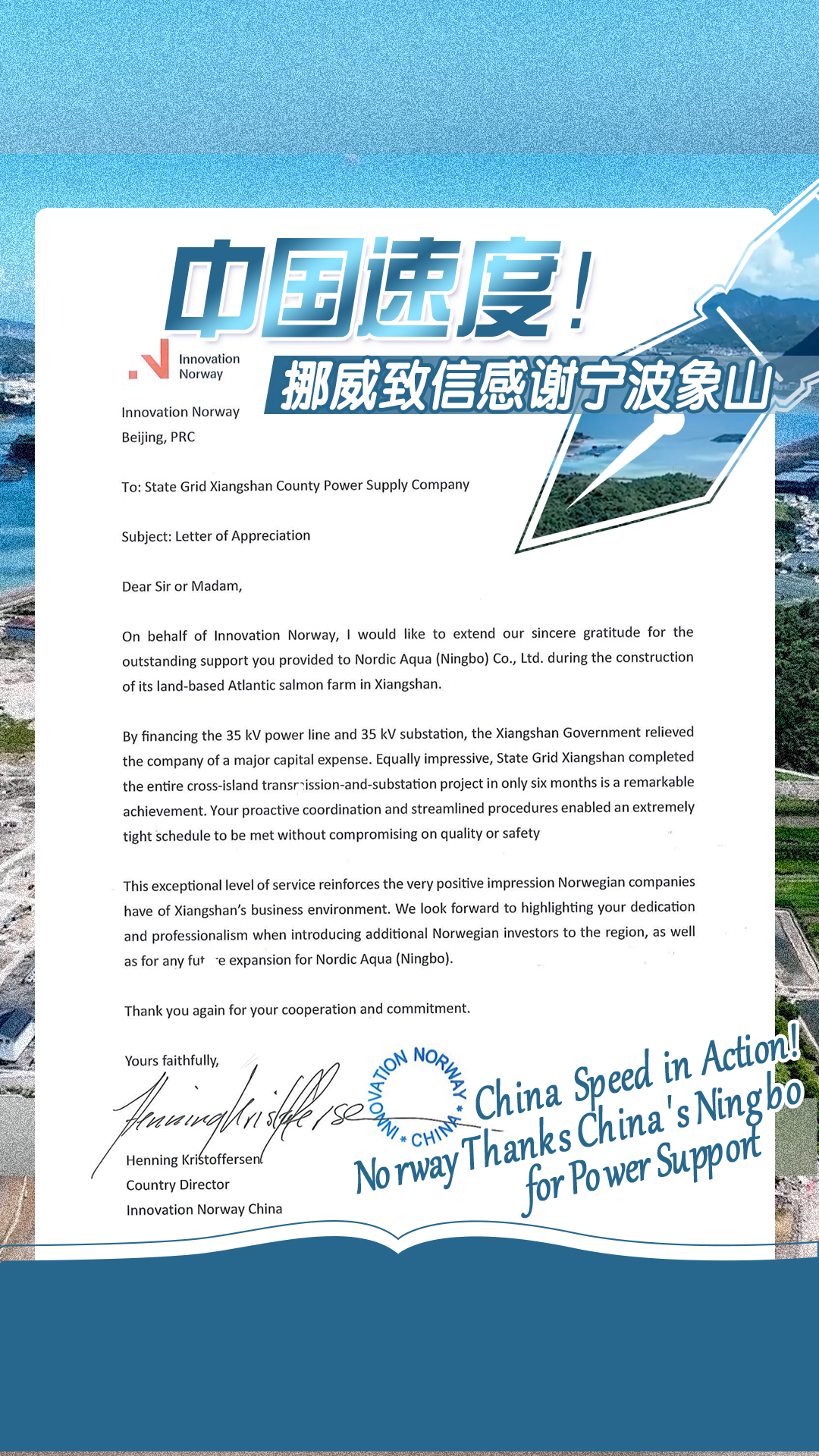
The Letter of Thanks from Norway to Ningbo, China.
Two Norwegians' Salmon Dream in China
The story began in 2002, when Andreas Thorud, then a Norwegian student at Nanyang Technological University in Singapore, walked into a "Chinese Culture Night" event on campus.
Hearing a plucked Chinese zither played alongside the violin, he was struck by the unexpected yet harmonious blend of East and West. "Music has no nationality; it's the best language," he recalls.
Years later, going by his Chinese name Tong Anrui, Thorud would become general manager of Nordic Aquaculture.
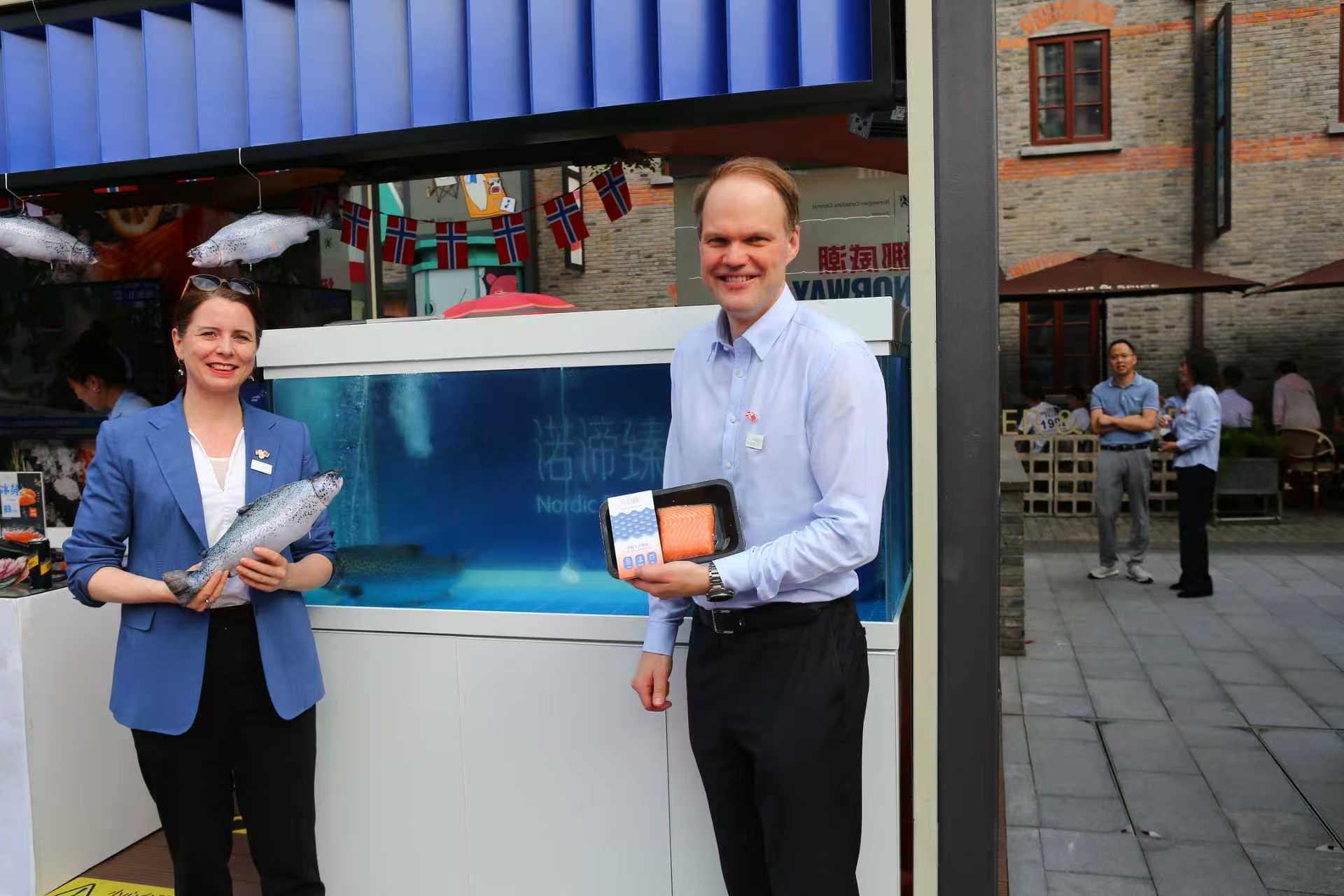
Tong Anrui (Right) showcases salmon at a trade exhibition in Shanghai.
His first visit to China coincided with the Beijing Olympics in 2008, where the energy of the city, the kindness of strangers, and the vibrancy of a country in motion inspired him to participate actively in China's evolving economy.
After studying at Tsinghua University and working with the Norwegian Seafood Council in the Asia-Pacific, Tong witnessed the explosive growth of China's high-end seafood market—and its challenges. Ninety-nine percent of Atlantic salmon consumed in China were imported, facing long transport times, customs inspections, and complex distribution chains. This resulted in higher costs and reduced freshness.
He wondered: "Can Norway's advanced salmon farming technology be brought to China?"
His vision aligned perfectly with Ove Nodland, a long-time businessman in Ningbo and now an honorary citizen of the city. Their collaboration was strengthened by a shared respect for China's heritage: Nodland gifted Tong an English translation of The Classic of Fish Culture, a 2,500-year-old text by the ancient economist and statesman Fan Li. The book's principles of sustainable aquaculture, combined with Nodland's connection to Ningbo, created a bridge between ancient philosophy and modern industry.
After extensive surveys, Gaotangdao Township, Xiangshan County was selected as the salmon farm's location. With long coastlines, stable currents, and pristine waters, it was ideal for salmon cultivation, despite being at 30°N—far from the North European waters these fish normally inhabit. The project aims to produce salmon that meets Northern European quality standards, combining traditional Chinese aquaculture philosophy with modern Nordic technology.
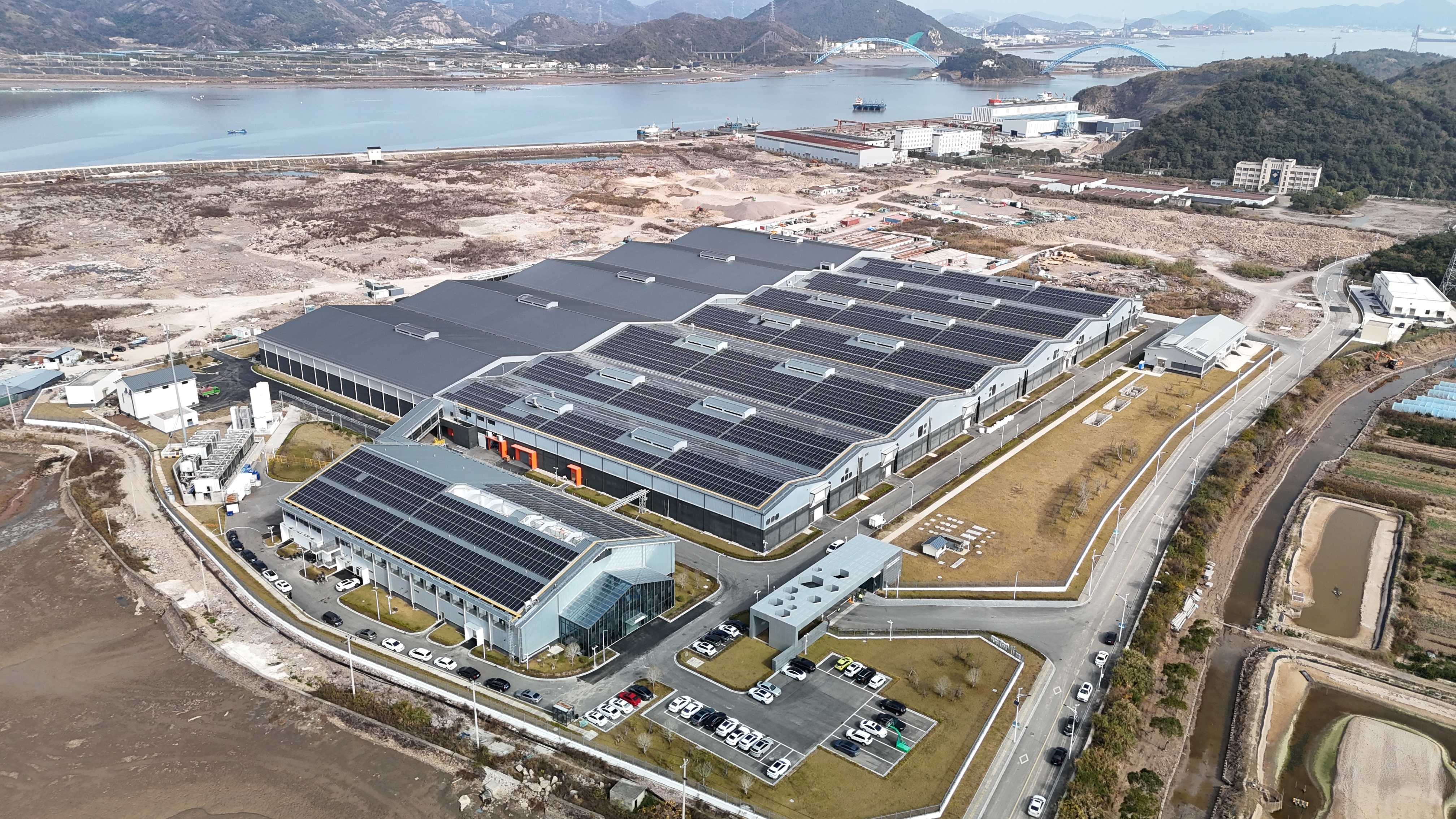
The salmon farm in Gaotangdao Township, Xiangshan County.
"Electricity is the Lifeline"
Salmon farming is exacting work. "Water is the foundation, electricity is the lifeline," says project manager Tan Yong.
The farm's land-based recirculating aquaculture system draws water from the East China Sea and carefully controls temperature, circulation, oxygen, and purification. "Salmon survives best in water between 12°C and 14°C," Tan explains. "Every system—be it water circulation cooling, purification, or oxygen supply—depends on stable electricity. Any disruption could compromise water quality, threatening the fish's lives and the farm's bottom line."
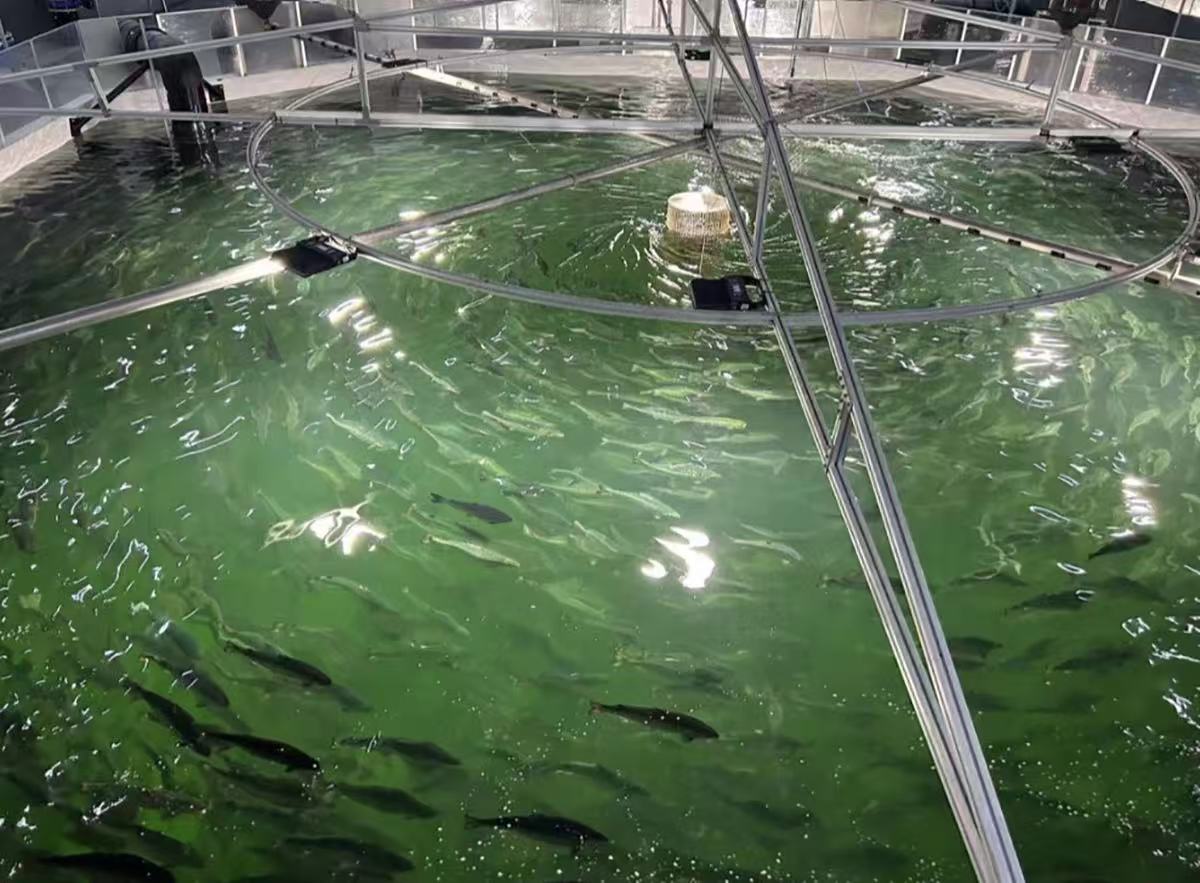
The Recirculating Aquaculture System inside the farm.
Overcoming these technical challenges was essential—not just for the fish's survival, but for realizing the vision of ultra-fresh, locally farmed salmon.
By 2024, Icelandic salmon hatched and raised in Xiangshan had reached maturity, reaching on average 5.7 kilograms each and achieving sushi-grade quality. Local production slashed supply-chain times dramatically. Previously, imported salmon took about a week to reach Chinese consumers, but Xiangshan salmon can now arrive in major Yangtze River Delta cities within five hours and anywhere nationwide within 24 hours.
Tong's faith in Xiangshan paid off—the first harvest sold out almost immediately.
When Nordic Aquaculture planned its second-phase expansion in early 2025, the island's 10kV power line could no longer provide enough voltage. Tong, aware that similar projects in Norway would take over a year due to complex terrain and inter-departmental coordination, braced for delays—but the project unfolded with the famed "China Speed."
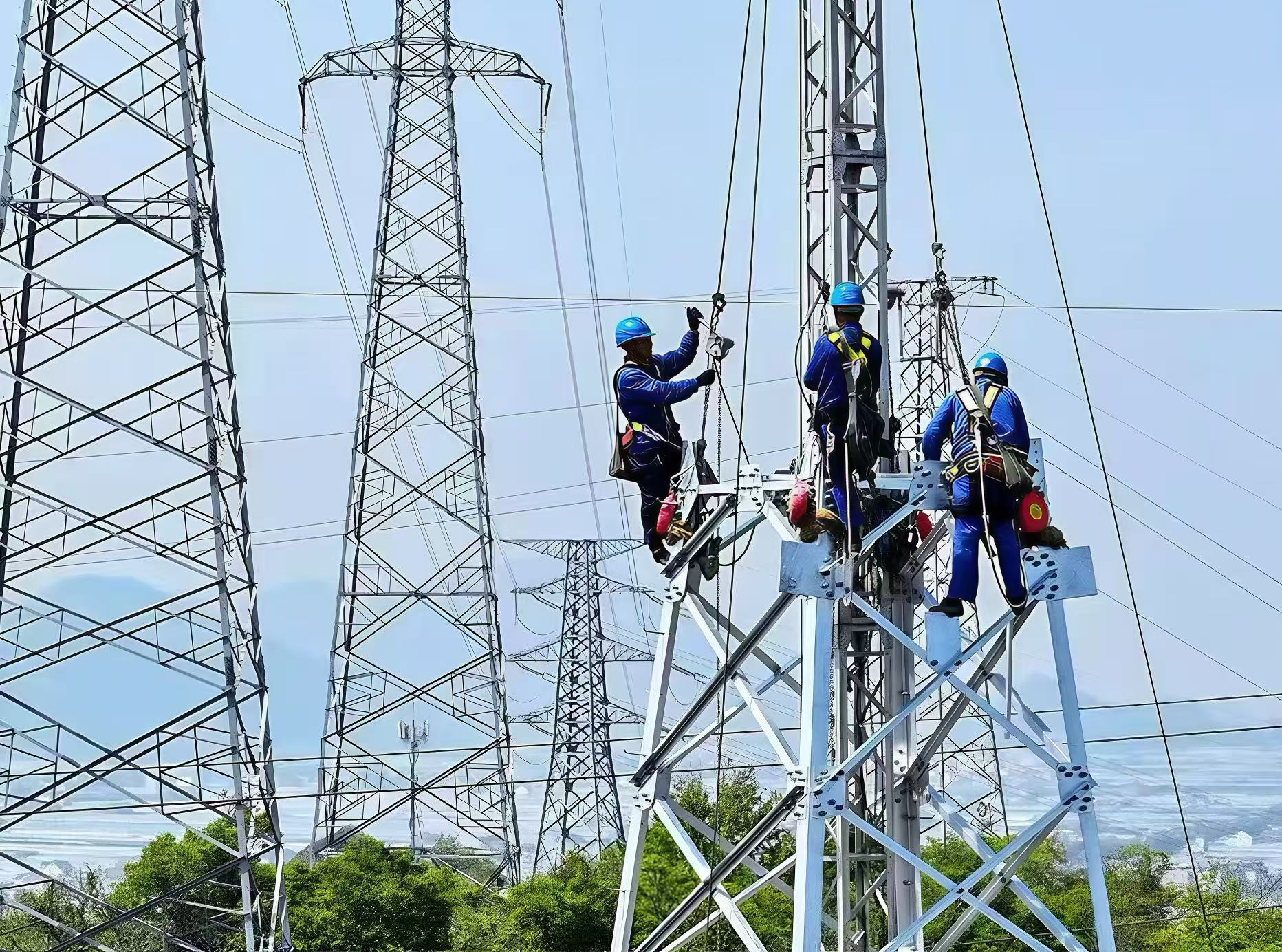
Electricity workers at the transmission tower during construction.
China Speed in Action
Local support jumped into action immediately.
A dedicated team upgraded the infrastructure, constructing a 35kV substation and a 13.9-kilometer cross-island line in just six months. Daily inspections, 24-hour emergency response, real-time load monitoring, and guidance on optimizing power use saved the company altogether nearly three million yuan annually.
Li Yongjun, who has served on Hepu Island in Xiangshan as the local power station chief for more than 20 years, knows the salmon's delicate nature. He monitors a critical voltage threshold of 9.7kV. "Previously, Hepu Island relied on a single 10kV line," he explains. "During typhoon season, we were more fearful for the fish's lives than the fish themselves."
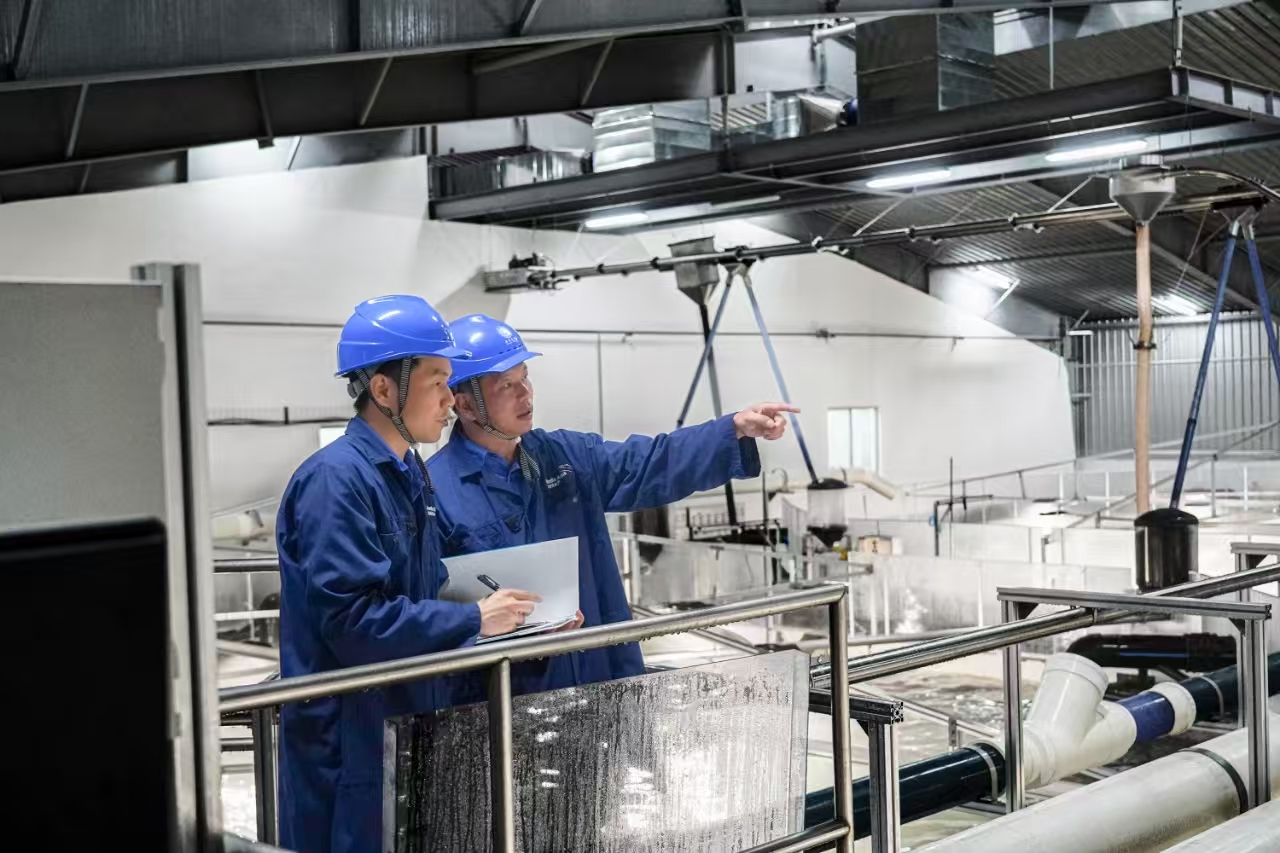
Li Yongjun and his colleague inspect the salmon farm's power supply.
When the farm's expansion demanded more power, Li led his powerline construction team through strong winds and freezing cold, often starting work before sunrise and continuing until nightfall.
Tong recalls a moment when voltage fluctuations threatened the facility: he called Li, who arrived with technicians within 20 minutes. "We understand these fish are delicate, and the power supply must be stable." Li's words stayed with Tong to this day.
The farm's staff now enjoy ongoing support—from routine inspections to rooftop solar panel installation guidance—ensuring stable operations and reduced costs.
"They don't just build and leave—they grow with us," Tong emphasizes.
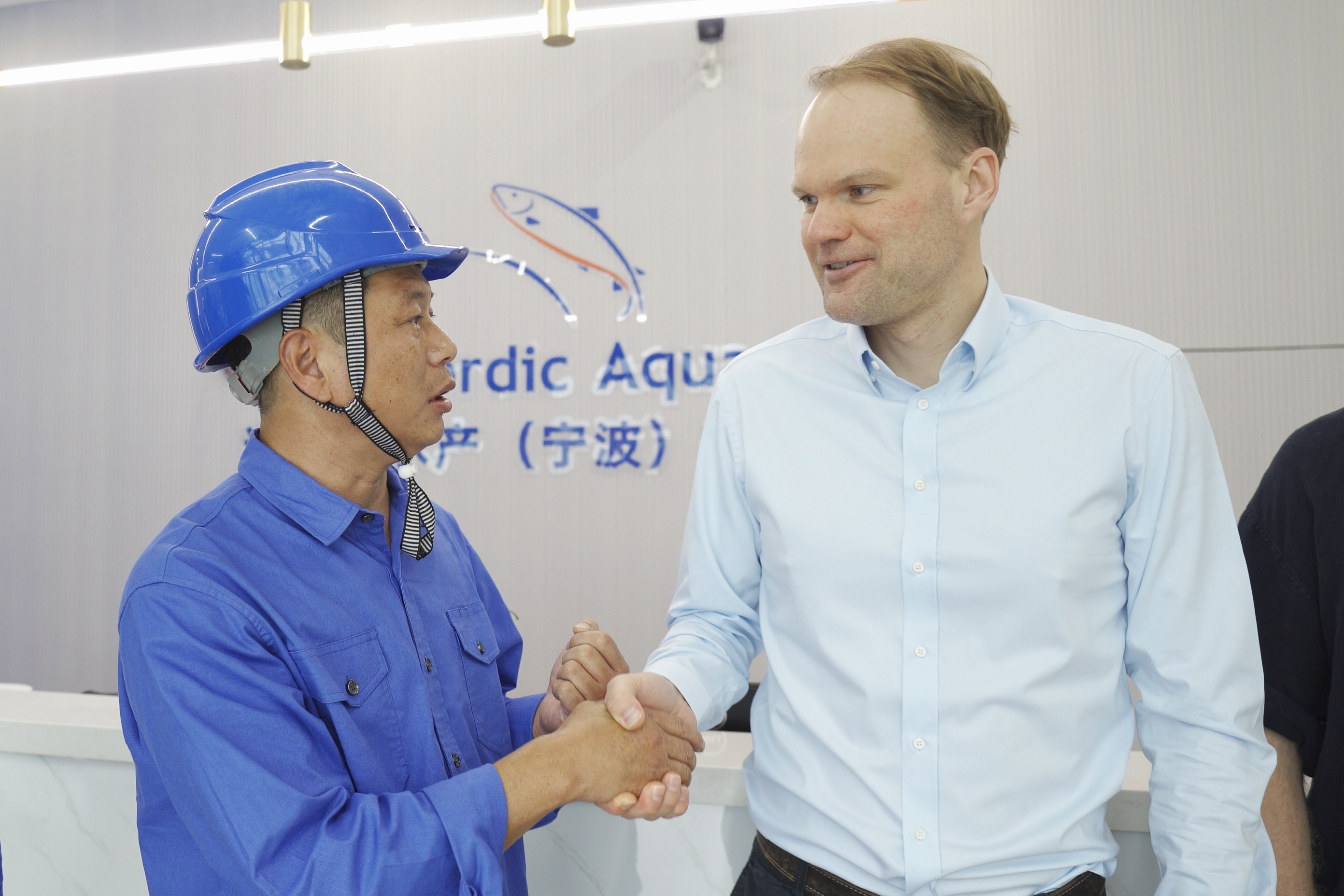
Li Yongjun (L) and Tong Anrui (R). Photo by Chai Zheng
From Fish to Future
Today, Nordic Aquaculture's first-phase facility's annual output is 4,000 tons. The second-phase facility doubled capacity to 8,000 tons, and the planned third phase will bring the farm beyond the 20,000-ton mark, reducing China's reliance on imported salmon. Xiangshan salmon is making its way into Ningbo restaurants and supermarkets.
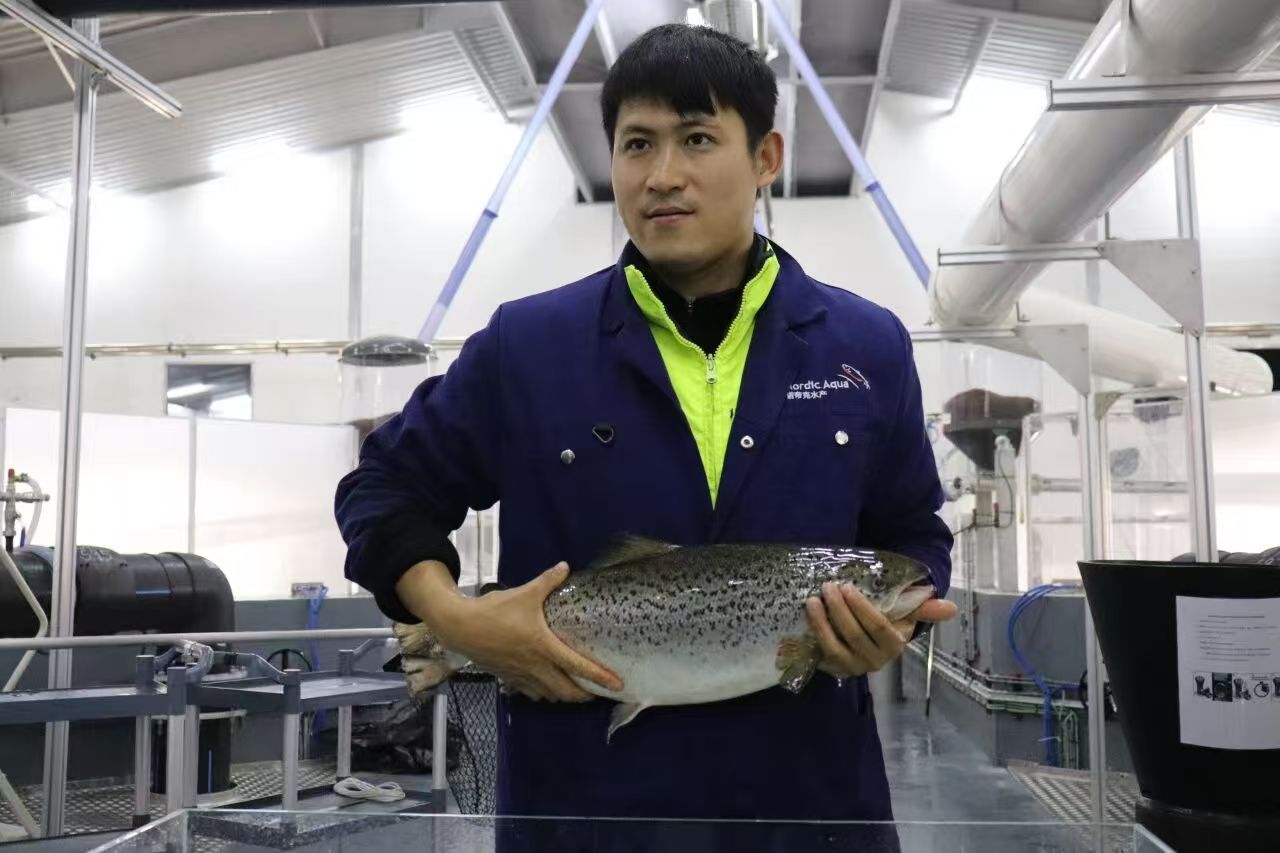
Salmon farmed by Nordic Aquaculture in Xiangshan.
Kristoffersen's letter highlights the project as a testament to China's open market and efficient business environment, reflecting the strong willingness of Norwegian businesses to invest in the country. From Fan Li's ancient aquaculture methods to modern Nordic technology on the East China coast, the salmon project represents practical collaboration, cultural exchange, and shared growth.
These fish—and the people who raise them—demonstrate how collaboration across borders benefits not just companies, but individuals, communities, and the world. China's development, paired with "China Speed," creates opportunities that extend far beyond its shores.