


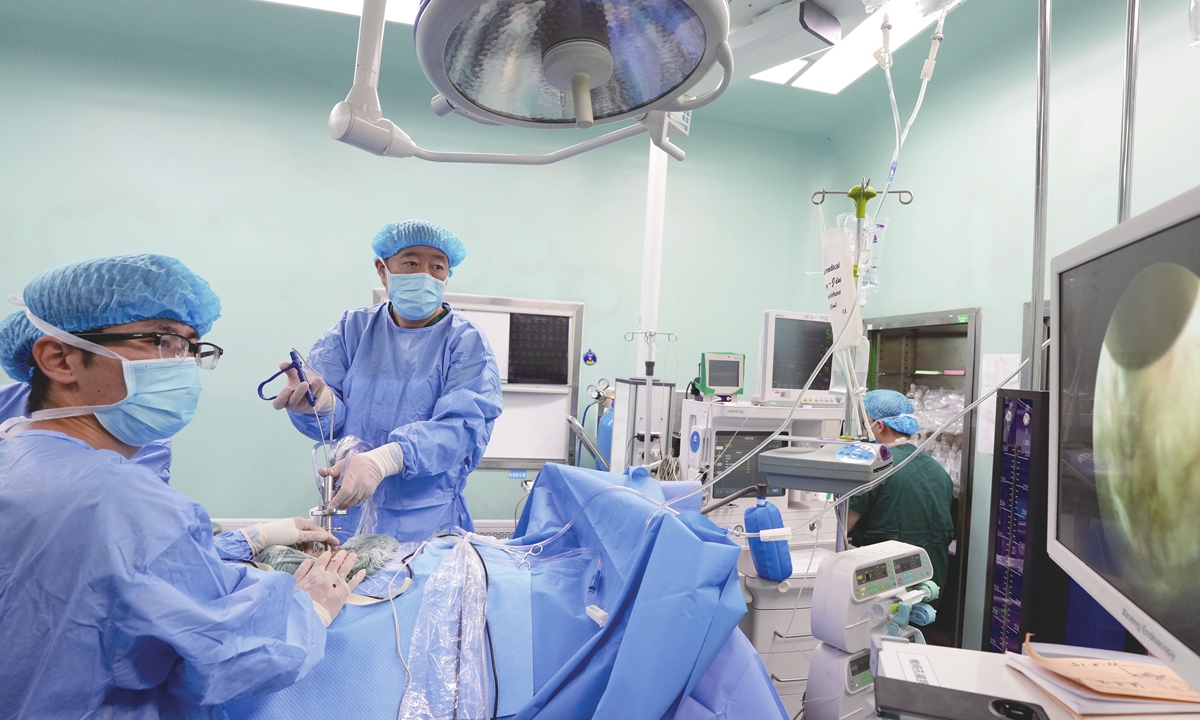
Doctors from Beijing perform spinal surgery on a Tibetan patient in Southwest Sichuan Province. (Photo: VCG)
Many Chinese patients facing life-threatening illnesses have long been traveling hundreds or even thousands of kilometers to seek treatment at top hospitals in big cities like Beijing or Shanghai. Yet for Li Yingshan from Qujing in Southwest China's Yunnan Province whose mother was up to an as urgent situation, the journey has become shorter and easier.
In early February 2025, Li's mother was diagnosed with a type A aortic dissection, one of the most dangerous cardiovascular diseases. Local hospitals in Qujing could not perform the surgery, so an ambulance rushed her to Fuwai Yunnan Hospital, a national regional treatment center established with targeted assistance from Beijing Fuwai Hospital of cardiovascular diseases, in provincial capital Kunming. There she was admitted to the emergency department and transferred to the intensive care unit (ICU).
Two days later, on February 4, surgeons carried out a six-hour operation to replace a section of her aorta. She was recovered later.
"I'm truly grateful to this hospital, the doctors" Li told the Global Times. "Without them, I might have lost my mother."
Li's experience reflects a shift taking place across China. In recent years, with the advancement of the national regional medical center initiative, as well as the development of medical alliances and paired assistance programs, top-tier medical resources concentrated in metropolises have been extended to localities: The Fuwai Hospital has established a cardiovascular center in Yunnan, Peking Union Medical College Hospital has participated in building a regional medical center in Southwest China's Chongqing and Huashan Hospital in Shanghai has provided assistance to the People's Hospital of the Xizang Autonomous Region.
Behind these developments is a broader policy push to expand high-quality healthcare resources beyond major metropolitan hubs by establishing national regional medical centers across the country, Luo Chaofan, a specialist from China's National Health Commission, told the Global Times.
Race against timeFor Li's family, the policy translated into a race against time that ended in relief.
"The doctor told me the situation was extremely critical, and it was very likely that my mother might not even survive long enough to make it to the operating room," Li said. Li's mother was admitted to the ICU as soon as she was sent to the hospital in Kunming, and the surgery was arranged just two days later.
Li was not only impressed by the speed and expertise of the treatment, but also the cost of the surgery. The family's total medical bill originally exceeded 160,000 yuan ($22,000), but more than 100,000 yuan was reimbursed through Yunnan's resident medical insurance program.
After weeks of recovery, Li's mother returned home and has since regained the ability to manage daily life independently, only to avoid strenuous physical activities.
Doctors at Fuwai Hospital in Yunnan told the Global Times that after the regional center was established, emergency transfers from Yunnan to Beijing have been rare. Patients can receive prompt and effective treatment from top-tier medical resources locally, which greatly increases their chances of recovery.
A cardiac surgeon surnamed Zhang said the hospital has handled more than one million patient visits since its establishment in 2023. Many of the most critical cases came from surrounding plateau regions.
"In places like Yunnan or Xizang, heart-related emergencies often progress very quickly," Zhang said. "Compared with major cities like Beijing, the condition of the patients is often more serious. This is related not only to the high-altitude environment, but also to differences in public awareness of preventive healthcare."
As a result, many patients seek treatment only when their conditions become acute or life-threatening.
Zhang said that was precisely why the establishment of regional medical centers is so important. Unlike traditional teaching assistance programs, where doctors perform complex surgeries in local hospitals and leave after just a few months, hundreds of specialists from Beijing stay here for several years. They train local doctors on a daily basis, with the goal of building what Zhang described as "a medical team that cannot be taken away."
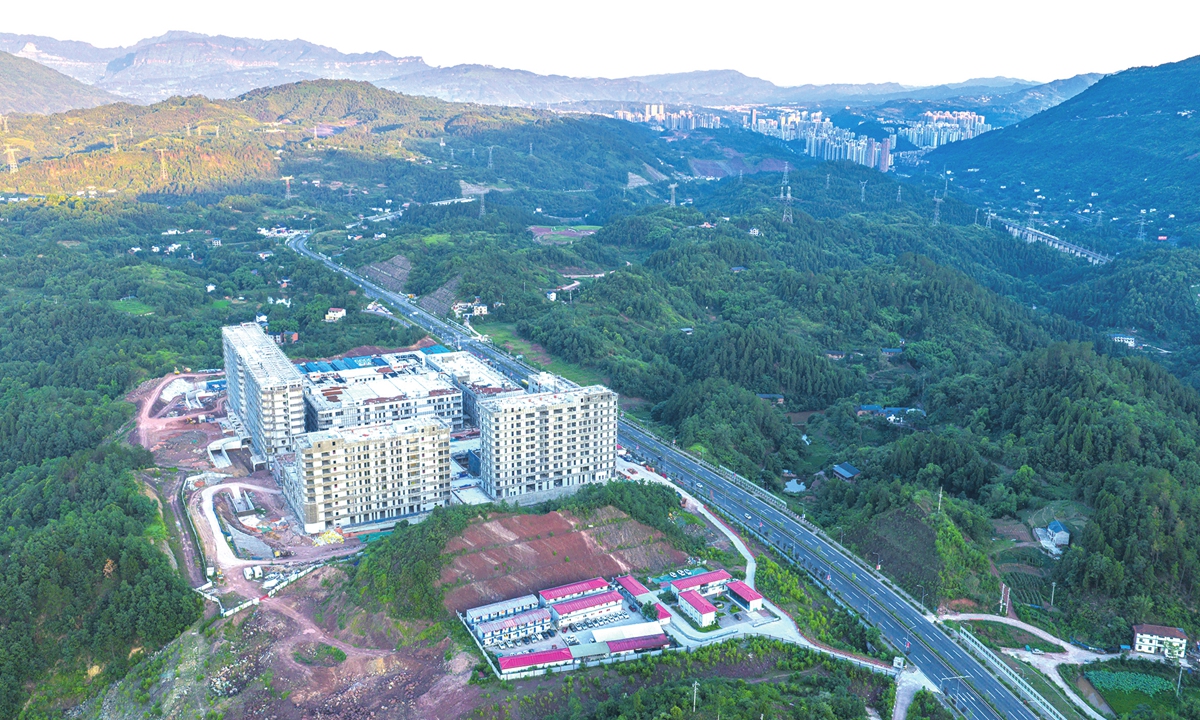
The Chongqing Hospital of Jiangsu Province Hospital is under construction on July 4, 2025. (Photo: VCG)
According to Luo, the establishment of national regional medical centers aims not only to bring high-level medical treatment closer to patients, but also to build long-term local capacity and improve public health awareness.
"Top hospitals in major cities cannot accommodate the medical demand of the entire country," Luo said. "At the same time, critically ill patients often cannot afford the time or cost of traveling that distance for treatment."
Another example is Baoding Hospital of Guang'anmen Hospital, which officially launched its international medical campus in September 2025 as part of the regional medical center initiative.
Ai Han, a staff member from the Guang'anmen Hospital in Beijing, which is known for its traditional Chinese medicine(TCM) treatment, told the Global Times that more than 130 specialists from the Beijing headquarters have been dispatched to Baoding in North China's Hebei to provide outpatient services, surgeries and academic training, while nearly 166 local doctors have come to Beijing for further study.
Regarding public awareness, Luo said traditional Chinese medicine (TCM) institutions, a relatively gentle diagnostic and therapeutic system that people find easier to accept, provide an effective entry point for fostering greater public awareness of health maintenance at local level.
Ai noted that TCM institutions also have an advantage in promoting long-term health awareness through community outreach, education and preventive care.
The results have already been notable as more patients have come for medical consultancy rather than postponing until it is too late. Between January and August 2025, the hospital's outpatient and emergency visits increased by 80.52 percent compared with the same period in 2022, while discharged patients rose by 45.13 percent.
According to NHC data, China has established 13 categories of national medical centers and was building 125 national regional medical centers along with 114 provincial-level regional centers.
Authorities have also launched pilot programs for closely integrated urban medical groups in 81 cities and expanded county-level medical alliances to provide more continuous services ranging from prevention and treatment to rehabilitation and health promotion.
Authorities have also been promoting multidisciplinary diagnosis and treatment and mutual recognition of medical check results to provide more convenience for the people.
For patients like Li's mother, these changes mean that life-saving expertise is no longer hundreds or even thousands of kilometers away, but within reach, accessible and affordable.