


BEIJING, March 14 (Xinhua) -- China's General Administration of Customs (GAC) has announced a new policy to expand a cross-customs-district return model for retail export goods from cross-border e-commerce.
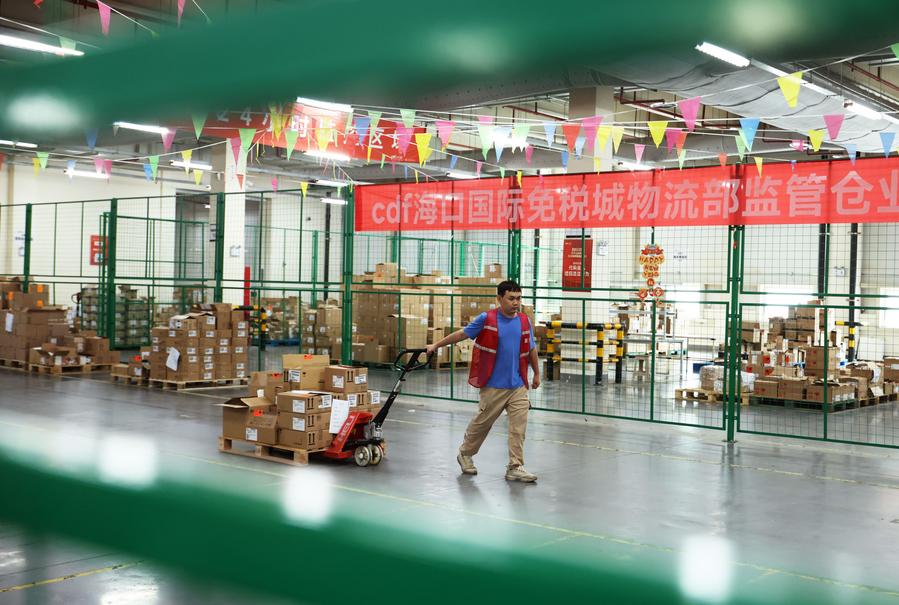
A staff member works at China Duty Free Group Hainan International Logistics Center in Haikou, south China's Hainan Province, May 26, 2025. (Photo: Xinhua)
Starting April 1, 2026, cross-border e-commerce retail export goods returned from overseas will no longer be required to go back to the original customs office through which they were exported.
Instead, companies may choose any customs port across the country to handle the return entry procedures, which will provide greater flexibility for businesses.
The policy, as part of efforts to boost e-commerce exports, builds on a pilot program launched by the GAC in late 2024, which was carried out at 20 customs offices, including those in Beijing, Tianjin, Dalian, Harbin, Shanghai, Nanjing, Hangzhou, Chengdu, and Urumqi.
After a year of testing, authorities have concluded that the necessary conditions are in place to roll out the model on a national scale.
According to the GAC announcement, the cross-customs return policy applies only to cross-border e-commerce retail export goods. While returned goods may re-enter China through a different customs district, they must be sent back to customs-supervised operation sites or facilities authorized to handle cross-border e-commerce retail export business.
Cross-border e-commerce has become one of the fastest-growing segments of international trade in recent years and an important driver of China's foreign trade growth. However, the difficulty, high cost and long processing time associated with cross-border returns have long been a major challenge for the industry.
The new policy is expected to work in synergy with tax incentive measures for returned cross-border e-commerce export goods jointly released in February by the Ministry of Finance and two other government departments, helping companies reduce costs and improve operational efficiency, according to the GAC.