


The Boao mandate: How China is weaving a shared future for the Asia-Pacific
As the 2026 Boao Forum for Asia (BFA) prepares to drop anchor in southern China's Hainan Province, the theme "Shaping a Shared Future: New Contexts, New Opportunities, New Cooperation" feels less like a slogan and more like an urgent mandate.
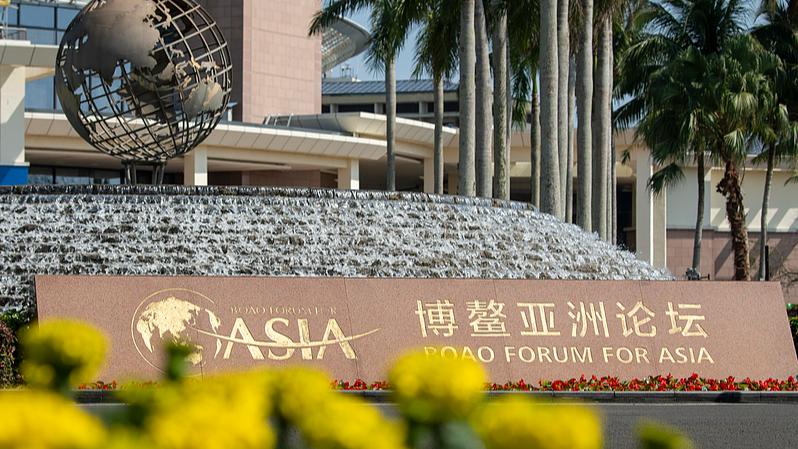
Logo of Boao Forum for Asia in Qionghai, south China's Hainan Province, March 17, 2026. (Photo: VCG)
The region stands at a critical juncture – protectionism is hardening, geopolitical divisions are widening, and the twin shifts toward digital and green economies are moving so fast they risk leaving the unprepared behind.
For the Asia-Pacific, the defining challenge of 2026 is no longer just about maintaining growth; it is about building resilience. The question is how to find certainty in a volatile global landscape and maintain cohesion as the world fragments. In response, China's Global Development Initiative (GDI), Global Security Initiative (GSI) and Global Civilization Initiative (GCI) are moving beyond high-level theory to become a practical framework for a region looking for a sense of direction.
The Asia-Pacific is currently navigating a polycrisis. Externally, the global governance architecture is being stress-tested by unilateralism and the lingering shadows of de-coupling or de-risking strategies. While the Asian Development Bank notes the region's inherent trade resilience, the fragility of supply chains remains a clear weakness.
Internally, the region faces a paradox of progress. The digital revolution offers unprecedented growth, yet it creates new barriers to entry. Simultaneously, traditional frictions, such as the recent border tensions between Cambodia and Thailand persist alongside modern borderless threats like cyber-scams. The reality in 2026 is that no economy can thrive in isolation. Stability requires a regional framework that is open and inclusive enough to accommodate everyone.
China's "Three Initiatives" have gained traction in the Asia-Pacific Region because they speak directly to these anxieties. They offer a systemic answer to the needs for growth, stability and mutual trust.
The GDI centers on a simple but powerful premise: leaving no one behind. In a region where world-class financial hubs sit adjacent to developing nations, inclusive growth is not just a moral goal – it is a stabilizing force.
China has moved beyond mere investment to a mix of "hard connectivity" (infrastructure) and "soft connectivity" (regulatory alignment). The China-Laos Railway serves as the definitive case study. By transforming a land-locked nation into a regional hub, the railway has moved over 10 million passengers and millions of tons of cargo, fundamentally changing the economic landscape of Laos and integrating it into the broader regional supply chain. As China-ASEAN relations enter the 3.0 era, the focus is shifting toward digital and green corridors, turning what could be competitive pressures into shared economic gains.
The GSI offers an alternative to the zero-sum logic of traditional alliances. It prioritizes dialogue and mediation over confrontation. A notable success of this philosophy was the Fuxian Meeting in late 2025. When border tensions between Cambodia and Thailand threatened to escalate, China acted as a mediator, facilitating the high-level talks that led to normal exchanges. This was an exercise in the Asian Way – resolving sensitive disputes through quiet diplomacy and mutual respect rather than external pressure.
If development and security initiatives provide the structure, the Global Civilization Initiative provides the foundation for cooperation. The Asia-Pacific is a tapestry of civilizations – Chinese, Indian, Islamic and Western. Diversities can be friction points or assets.
The GCI seeks to turn diversity into a resource for cooperation. For instance, the "International Day of Dialogue among Civilizations" in Bangkok illustrated this shift. Rather than a dry diplomatic summit, it focused on cultural exchange, bringing together representatives from over 20 countries. These soft interactions are essential because they build the baseline of human trust that allows economic and security agreements to withstand political shifts.
As the BFA celebrates its 25th anniversary in 2026, it coincides with the first full year of Hainan's independent customs operations as a Free Trade Port. This gives the forum a unique weight. We could expect the Boao Forum to move the needle in two critical areas. Firstly, it will help align the region's goals ahead of APEC 2026, which China will host in November under the theme of "Building an Asia-Pacific Community." Boao will likely serve as the testing ground for the "Openness, Innovation, and Cooperation" agenda. Secondly, the dialogue is becoming more technical. The conversation has moved past the "why" of cooperation to the "how" – we are no longer discussing digital trade, we are debating the governance of cross-border data flows.
As the world enters another period of turbulence and transformation, whether the Asia-Pacific can remain a driver of global growth and an anchor of stability will depend on the choices its economies make now. The "shared future" is not a political slogan; it is reflected in the rail lines connecting neighbors, the diplomacy that prevents conflict and the dialogue that bridges cultural gaps. The spring breeze is once again moving across Boao. The region has an opportunity not merely to discuss its future, but to shape it together.