


Transformers—seemingly ordinary devices—have become highly sought-after worldwide.
According to China's General Administration of Customs, transformer exports reached 64.6 billion yuan (about $9.29 billion) in 2025, up nearly 36 percent year-on-year. The average export price per unit hit about 205,000 yuan—roughly one-third higher than the previous year. Many manufacturers report full order books, with data-center orders extending through 2027.
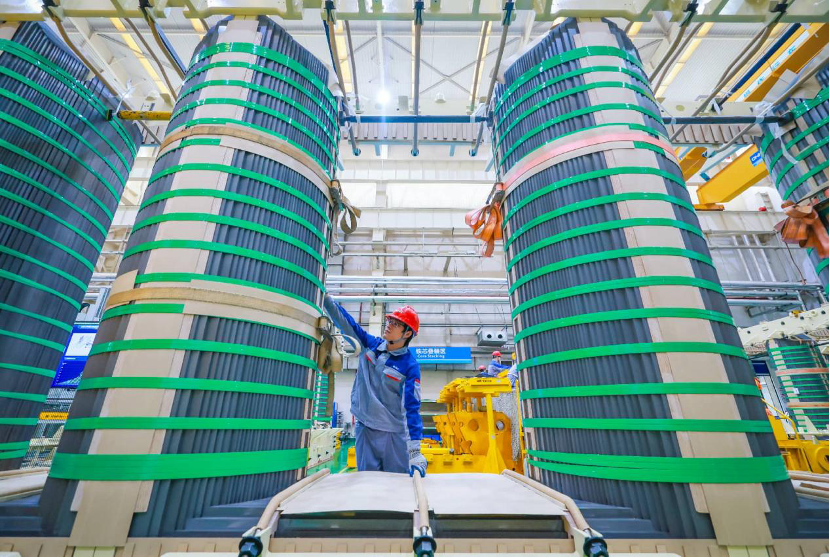
A technician inspects transformer cores at a Chint workshop in Shanghai, a global leader in smart energy solutions. (Photo: Cai Bin)
What explains this surge in global demand for Chinese transformers? The answer lies in pressing international needs.
Developed economies like Europe and the United States are upgrading aging power grids. Emerging markets face rising electricity consumption and greater integration of clean energy, spurring investment in grid infrastructure. Meanwhile, overseas data center expansion adds further pressure. These converging trends have propelled China's transformer exports.
With global competition heating up, why has China become the world's leading producer? Three key strengths provide the answer—not just for transformers, but for Chinese manufacturing's broader global competitiveness.
First, "speed," enabled by a highly integrated industrial chain.
A product’s success depends not only on its quality but also on the ecosystem supporting it. China has built the world's most comprehensive transformer manufacturing system, covering everything from raw materials like copper and aluminum to critical components such as transformer cores and on-load tap changers. This system accounts for roughly 60 percent of global production capacity.
Close coordination between upstream and downstream industries, coupled with reliable supply chains, enables Chinese companies to meet demand much more quickly than European and American competitors, whose lead times often stretch from 18 months to two years.
The advantages extend beyond transformers. In robotics, for instance, China has developed a complete supporting ecosystem, from high-precision reducers and servo systems to intelligent controllers. In the Yangtze River Delta, some robots now use 100 percent domestic core components, reducing costs by about 40 percent. In 2025, China's industrial robot exports surpassed imports for the first time.
Second, "adaptability"—the ability to read and respond to market needs.
True innovation creates products that solve real customer problems. Chinese companies have developed vegetable-oil transformers to meet European and US environmental standards, as well as compact, high-efficiency solid-state transformers for data centers. By focusing on specific market requirements and offering customized solutions, China's transformer industry has grown rapidly.
Foreign businesspeople often marvel at Chinese entrepreneurs' knack for spotting opportunities: wherever demand emerges, Chinese suppliers are typically first to respond. Multifunctional heaters that warm rooms while boiling tea have become popular in Japan and South Korea. Desert-adapted cranes with special fire-extinguishing systems have gained traction in Middle Eastern markets.
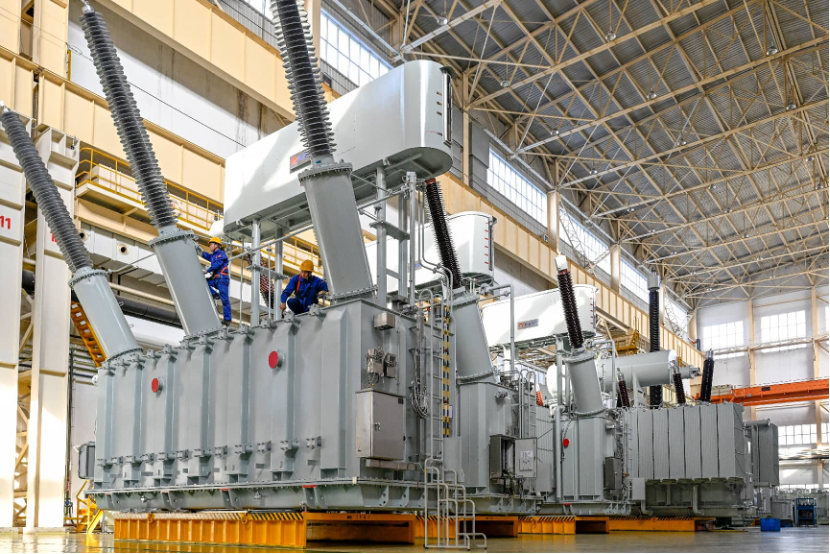
Technicians test new energy transformers at a workshop in Hefei, Anhui Province, East China, before delivery to customers. (Photo: Zhao Ming)
Third, "reliability," forged in China’s vast domestic testing ground.
China's massive projects—from power grid modernization to data center construction—serve as real-world laboratories. Over the past five years, the State Grid Corporation of China has completed multiple ultra-high-voltage (UHV) transmission projects, establishing global leadership in UHV technology and intelligent transformers.
Diverse domestic scenarios, from urban governance to logistics networks, drive innovation across sectors. Challenging environments—high-altitude regions, deserts, Gobi areas and low-wind zones—have forced wind power companies to develop customized solutions.
China's enormous market and rich application scenarios enable products to undergo extensive testing at home before entering international markets, ensuring both reliability and practicality.
In today's rapidly changing global environment, these strengths—deep industrial foundations, market responsiveness and proven reliability—give Chinese companies strong confidence to compete worldwide. They also underscore a universal lesson: companies that build real capabilities, sharpen their competitive edge, and pursue continuous industrial upgrading will succeed in the long run.