


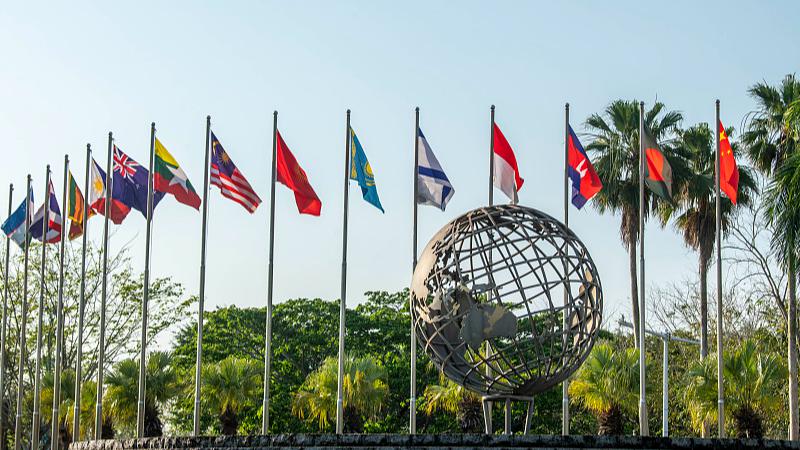
Scene from the Boao Forum for Asia venue in Qionghai City, south China's Hainan Province, March 19, 2026. /VCG
The Boao Forum for Asia (BFA) Annual Conference 2026 will be held from March 24 to 27 in Boao, south China's Hainan Province, marking the forum's 25th anniversary. Against a backdrop of rising geopolitical tensions, economic fragmentation and technological transformation, the event is widely expected to provide forward-looking insights and "Boao solutions" for a world in search of certainty.
Under the theme "Shaping the Future Together: New Trends, New Opportunities and New Cooperation," this year's conference will focus on four key areas and host nearly 50 events, including sub-forums, roundtables and dialogue sessions.
Multilateralism to anchor certainty
As global uncertainty becomes a defining feature of today's world, restoring confidence in multilateralism and global governance has become a central topic.
At the BFA New Year Outlook 2026 event, chairman of the forum and former UN Secretary-General Ban Ki-moon warned that the world is becoming "more divided, more dangerous and less predictable," yet emphasized that most countries still believe multilateralism and international cooperation remain the right path.
Echoing this, discussions at the annual conference will focus on rebuilding trust, strengthening global governance, enhancing policy coordination, advancing China's high-quality development and elevating the role of the Global South. These efforts aim to inject stability into an increasingly volatile global landscape.
Regional cooperation as a stabilizing force
Amid global economic headwinds, Asia continues to demonstrate resilience and vitality, reinforcing its role as a key engine of global growth.
With the full implementation of the Regional Comprehensive Economic Partnership (RCEP) and the upgrading of China-ASEAN Free Trade Area cooperation, regional integration has gained further momentum. Topics such as revitalizing APEC, enhancing cross-border payment systems and strengthening financial security reflect a shared determination to build regional "shock absorbers."
Forum council member and former Slovenian President Danilo Turk noted at the BFA New Year Outlook 2026 that in a world where uncertainty has become the "new normal," stronger international cooperation and coordinated policies are essential to safeguard economic resilience.
Innovation and AI unlocking new growth drivers
Technological innovation, particularly artificial intelligence, is emerging as a hot topic of this year's forum.
From "AI+ industrial transformation" to "AI-powered healthcare," discussions will highlight how digital technologies are reshaping industries and driving high-quality development. The rapid rise of AI is not only creating new economic opportunities but also raising important questions about governance, ethics and employment.
"New opportunities lie in the wave of high-quality development and technological innovation," said Yan Hongping, a professor at the International Business School of Hainan University.
"The rapid growth of the digital economy, the expansion of strategic emerging industries and the forward-looking development of future industries, breakthroughs in AI, and the acceleration of green and low-carbon transformation all point to new growth drivers and broader space for cooperation, providing a vast stage for countries to achieve mutual benefit and win-win outcomes," the expert noted.
Openness and inclusive development for a shared future
The forum will also emphasize inclusive growth through topics such as ESG, corporate transformation and sustainable development.
China's commitment to high-level opening up is expected to provide long-term certainty to the global economy. The Hainan Free Trade Port, in particular, has become a focal point. With its island-wide independent customs operation advancing steadily, it is emerging as a new gateway for international investment and cooperation.
A series of events, including the Global Free Trade Port Development Forum, will showcase Hainan's role in promoting institutional opening up and facilitating global connectivity.
Wu Shicun, chairman of the Huayang Center for Maritime Cooperation and Ocean Governance and founding president of the National Institute for South China Sea Studies, said that Asian countries are increasingly moving from "passive response" to "active shaping" in addressing global challenges.
"At the annual conference, Asian countries will demonstrate both the capacity and wisdom to propose solutions for addressing risks, strengthening cooperation and achieving shared prosperity, ranging from green transition and the digital economy to AI security, as well as from regional integration to advancing global governance initiatives, thereby injecting greater certainty into an uncertain world," Wu noted.