


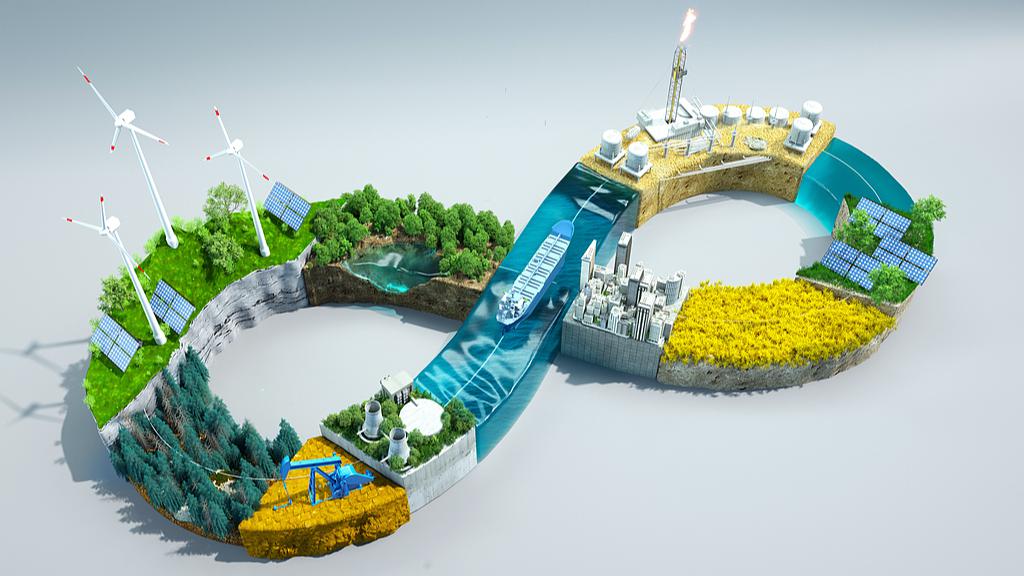
(Photo: VCG)
The development of the new energy industry and international cooperation has taken center stage at the China Development Forum 2026, held in Beijing from March 22 to 23. As the country enters its 15th Five-Year Plan period (2026–2030), policymakers and industry leaders highlighted China's growing role in supporting a steady and inclusive global energy transition.
Themed "China in its 15th Five-Year Plan period: advancing high-quality development and creating new opportunities together," the forum underscores China's role as a major engine of global growth as it enters the 15th Five-Year Plan period.
A joint report released by the International Institute of Green Finance and the Institute of Development Studies shows that between October 2022 and June 2025, Chinese companies participated in more than 500 overseas renewable energy projects. Among them, solar power dominated, accounting for 133.8 gigawatts of installed capacity.
Regionally, Asia remains the primary destination for China's overseas renewable investments, hosting 354 projects, exceeding Africa's 126 and Europe's 42. Around 70% of total contracted capacity is concentrated in 10 key markets, including Uzbekistan, Saudi Arabia and the United Arab Emirates. This geographic clustering reflects both strong demand for clean energy and deepening energy partnerships under evolving global supply chains.
Beyond sheer scale, Chinese projects are increasingly defined by integrated solutions that enhance grid stability. A notable example is the Oya Energy Hybrid Facility located between the Western Cape and Northern Cape provinces of South Africa. Built by Power Construction Corporation of China, it is the world's largest wind-solar-storage hybrid power plant currently under construction. Combining 155 MW of solar, 86.4 MW of wind and a 94 MW/242 MWh energy storage system, the project is designed to deliver a stable output of 128 MW. Once operational, it is expected to generate around 570 million kWh of clean electricity annually, supplying power to up to 320,000 households.
Equally important is its local impact. The project has engaged 15 South African small and medium-sized contractors, created over 3,000 direct jobs, and provided technical training to more than 200 local workers – demonstrating how clean energy investments can also drive inclusive development.
Similar momentum can be seen in Southeast Asia. The Binh Dai offshore wind power project in southern Vietnam marks the first overseas offshore wind EPC project undertaken by Chinese firms. With 141 MW already connected to the grid, it is expected to save 38,600 tonnes of standard coal annually and reduce carbon dioxide emissions by 26,200 tonnes. Local stakeholders view it as a milestone in Vietnam's offshore wind development. Meanwhile, technology transfer and training efforts have helped cultivate a new generation of local engineers and managers, laying the groundwork for long-term sector growth.
At the Battery Show Asia held from March 10 to 12, more than 30 companies from east China's Zhejiang Province showcased their latest innovations and connected with over 200 international buyers. The event highlighted how regional industrial clusters in China are actively integrating into global supply chains, particularly in battery and energy storage technologies.
Experts say China's approach is also evolving. According to Shen Wei, a researcher at the Institute of Development Studies, Chinese companies are shifting from a resource-driven model to integrated solutions such as "solar-plus-storage." Looking ahead, he noted, strengthening "soft capabilities," including policy design in host countries and carbon market development, will be essential to maximize the long-term impact of these investments.