


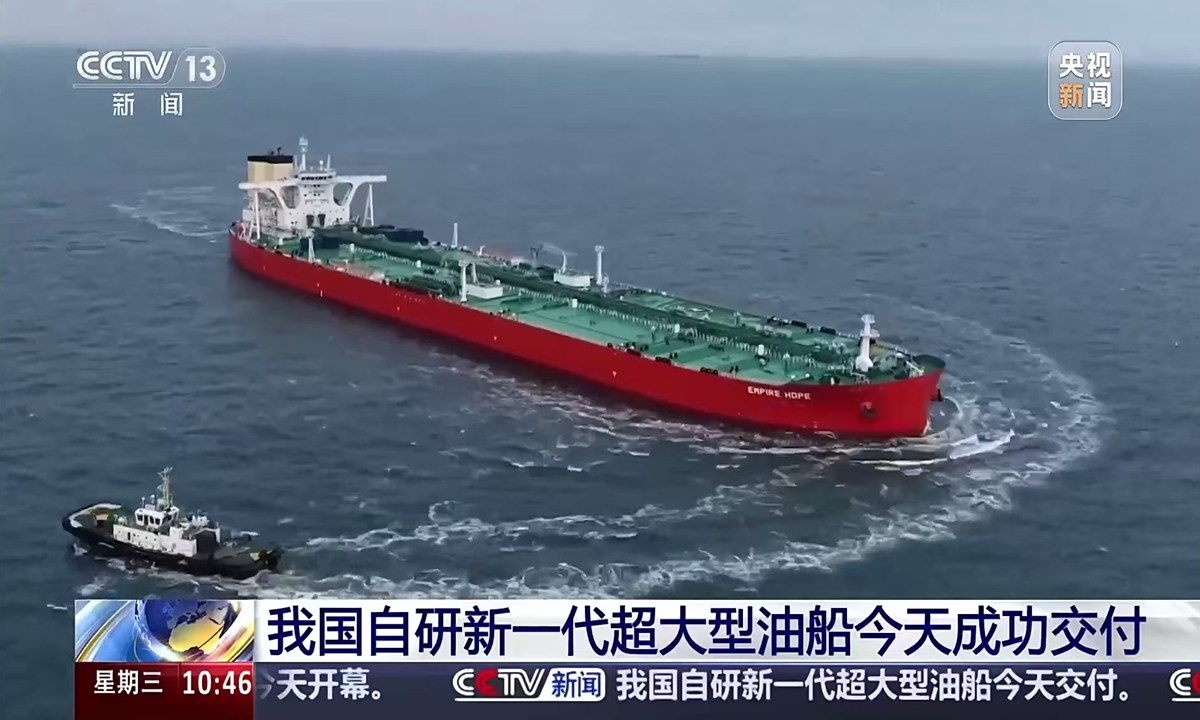
China's new-generation very large crude carrier Empire Hope delivers in Dalian, Northeast China's Liaoning Province, on March 25, 2026. (Photo: Screenshot from CCTV)
China's 307,000-ton new-generation very large crude carrier (VLCC) Empire Hope, independently researched, developed and designed by China, was delivered in Dalian, Northeast China's Liaoning Province, on Wednesday. With indicators of performance reaching world-class standards, the vessel has further boosted China's global competitiveness in the construction of VLCC, CCTV reported on Wednesday.
The vessel measures approximately 333 meters in length and 60 meters in width. Innovative technologies adopted on board include a six-cylinder main engine and an exhaust gas desulfurization system, which can significantly enhance its overall energy efficiency and make it more environmentally friendly, per the report.
With a deck area of 18,000 square meters and a molded depth of 30 meters, the vessel stands nearly 20 stories high from the keel to the navigation bridge. Its total coating area exceeds 540,000 square meters, equivalent to the size of 76 standard football fields, making it a true "giant" on the sea, per a report from the China News Service.
The vessel also features an optimized hull form and better engine-propeller matching. It boasts excellent adaptability to ports and waterways, and can carry more than 2 million barrels of crude oil to navigate the Strait of Malacca at its design draft of 20.5 meters, the report said.
The vessel is energy-saving and green with a high-efficiency propeller, a pre-propeller energy-saving device and a vortex-eliminating fin. Equipped with the exhaust gas desulfurization system, it meets the strictest international convention requirements for nitrogen oxide emissions and the most advanced Energy Efficiency Design Index standards, saving approximately 35 million yuan ($5 million) in fuel costs each year.
China's VLCC technology is evolving, and in the future, new green fuels and third-generation wind sail technology will be adopted to meet the latest international environmental requirements, the report said.