


ICRC: China's tech advances critical to greater humanitarian impact
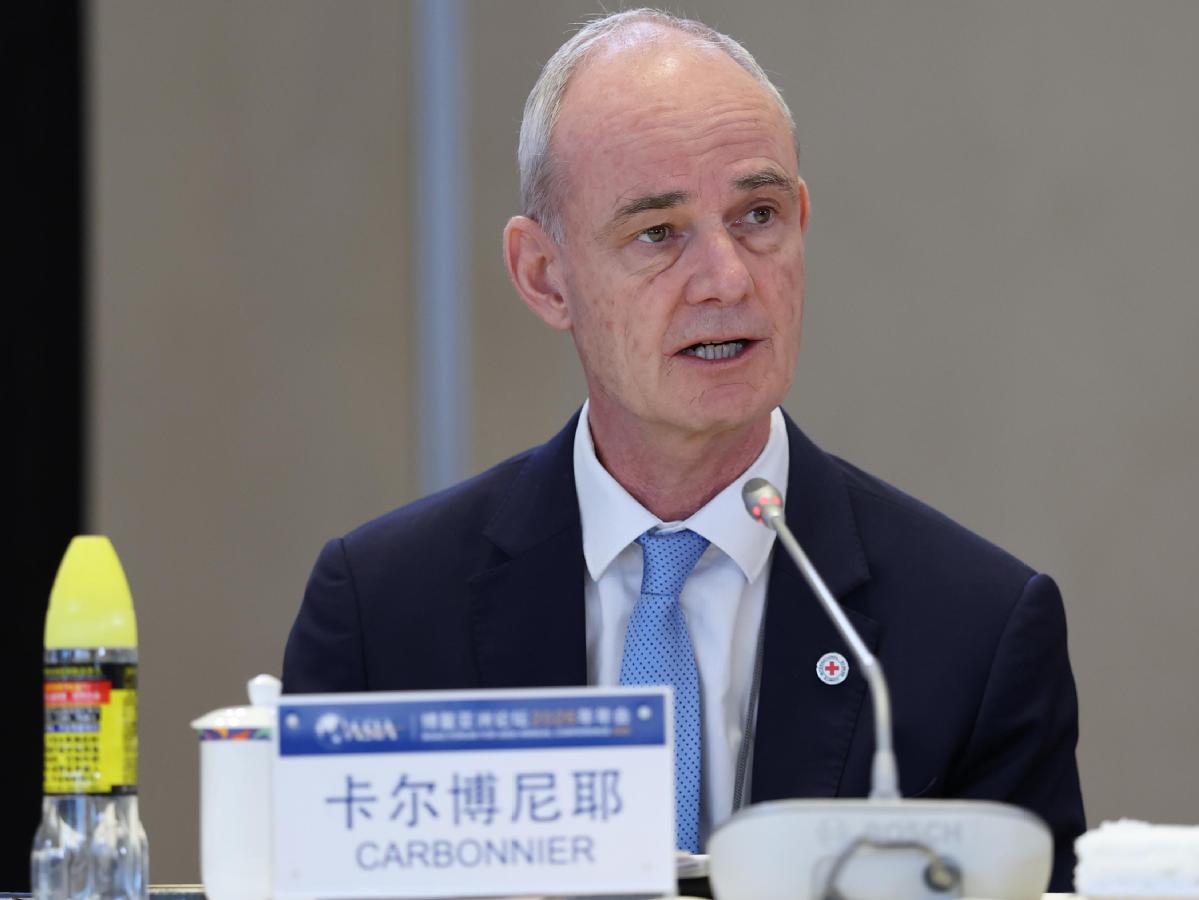
Gilles Carbonnier, vice-president of the International Committee of the Red Cross (ICRC), speaks at a panel discussion themed on "Advancing the SDGs: Actions beyond Commitments" during the Boao Forum for Asia (BFA) Annual Conference 2026 in Boao, South China's Hainan province, March 25, 2026. (Photo: Xinhua)
China's leadership role in technological innovation, especially in the fields of digital and energy transition, can increase the resilience of societies in the face of crises, said a senior official with the International Committee of the Red Cross on Wednesday.
Gilles Carbonnier, vice-president of the ICRC, made the remarks during an exclusive interview with Xinhua News Agency on the sidelines of the ongoing Boao Forum for Asia Annual Conference 2026 running from Tuesday to Friday in South China's Hainan province.
China is playing an important role in advancing the global humanitarian cause, particularly at the intersection of technology and humanitarian work, Carbonnier said.
"Humanitarian crises often last decades, affecting generations. We cannot wait for the end of a crisis to begin working on development," he said.
In this context, China's tech advances are helping bridge the gap between emergency relief and long-term development, enabling more efficient and scalable solutions.
"This is why we are partnering with Chinese counterparts to try to bring innovations to fruition for greater humanitarian impact," Carbonnier said, adding that such cooperation will continue with stakeholders attending the forum in Hainan.
The ICRC is deepening its engagement with Chinese research institutions to better harness emerging technologies while assessing their risks, he said, citing a recent exchange with Tsinghua University in Beijing on how innovation could improve the effectiveness of humanitarian endeavors.
The high-ranking official also welcomed a growing international push to boost respect for international humanitarian law as a political priority. The initiative, launched about 18 months ago by China together with Brazil, France, Kazakhstan, Jordan and South Africa, has since drawn broad participation.