


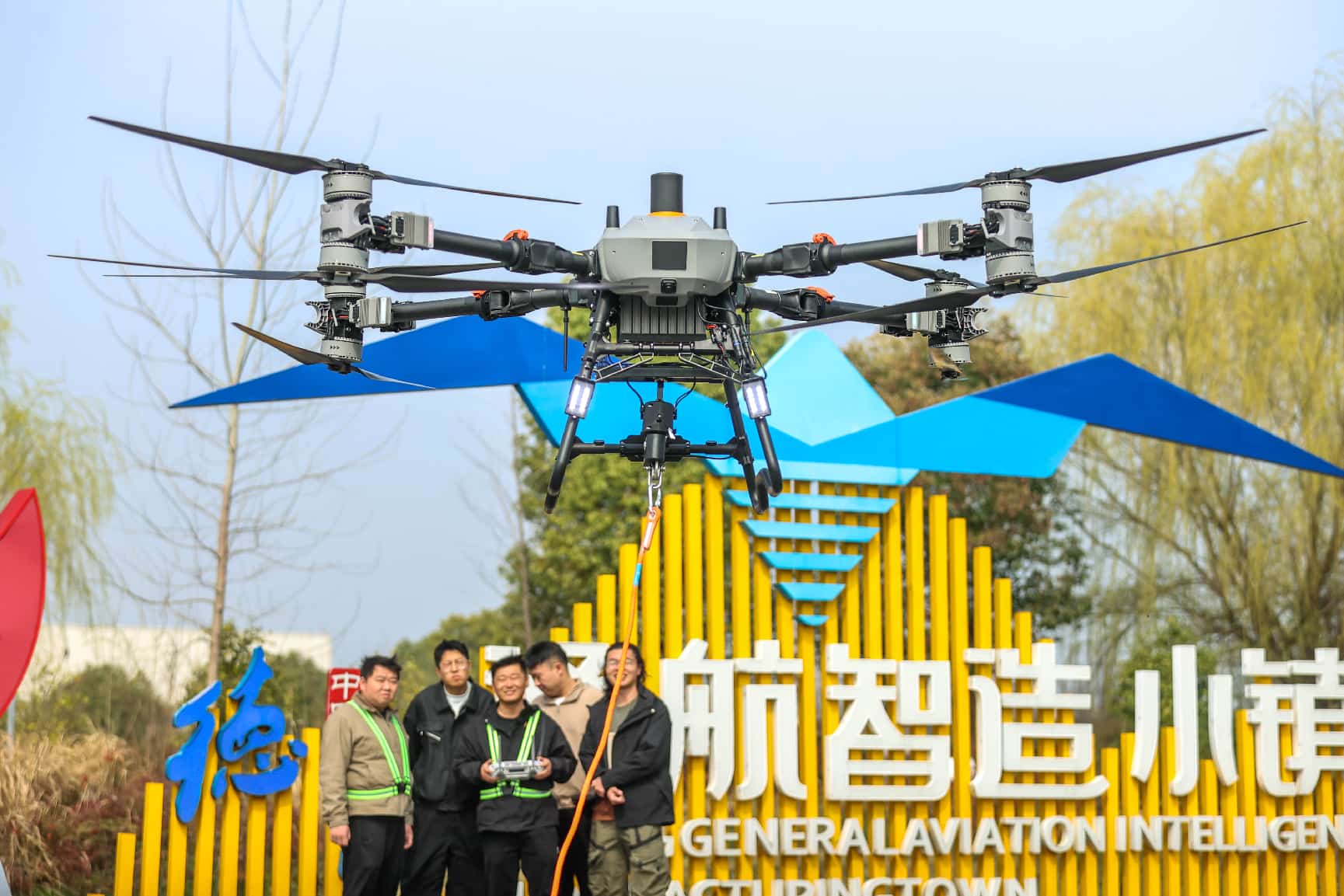
Trainees learn to operate a multi-rotor drone at a drone training base in Huzhou, east China's Zhejiang province. (Photo: Yao Haixiang)
Emerging technologies such as artificial intelligence (AI) and drones are rapidly reshaping the employment landscape.
In China, new professions ranging from drone route planners and robot product managers to agricultural solutions engineers are continuously emerging. These shifts in technological paradigms are creating fresh employment opportunities and opening up new possibilities.
On the rooftop of a logistics hub in Bao'an district, Shenzhen, Guangdong province, drones loaded with goods take off in succession, navigating between high-rise buildings along preset routes.
Ensuring their safe and orderly flight is Xue Haoran, a 24-year-old drone route planner at Chinese logistics giant SF Express. Despite just two years in the field, he is already a core team member, traversing the city daily with surveying equipment to map terrain and chart flight paths.
Drones represent one of the fastest-growing segments within China's burgeoning low-altitude economy (airspace below 1,000 meters). As drone deployment scales up and applications diversify, demand for specialized roles like Xue's continues to rise.
"Our role is to design safe and efficient routes for drone operators," Xue explained. "We inspect takeoff and landing sites, assess environmental risks, and use mapping tools to plan paths between points, avoiding densely populated areas and hazards."
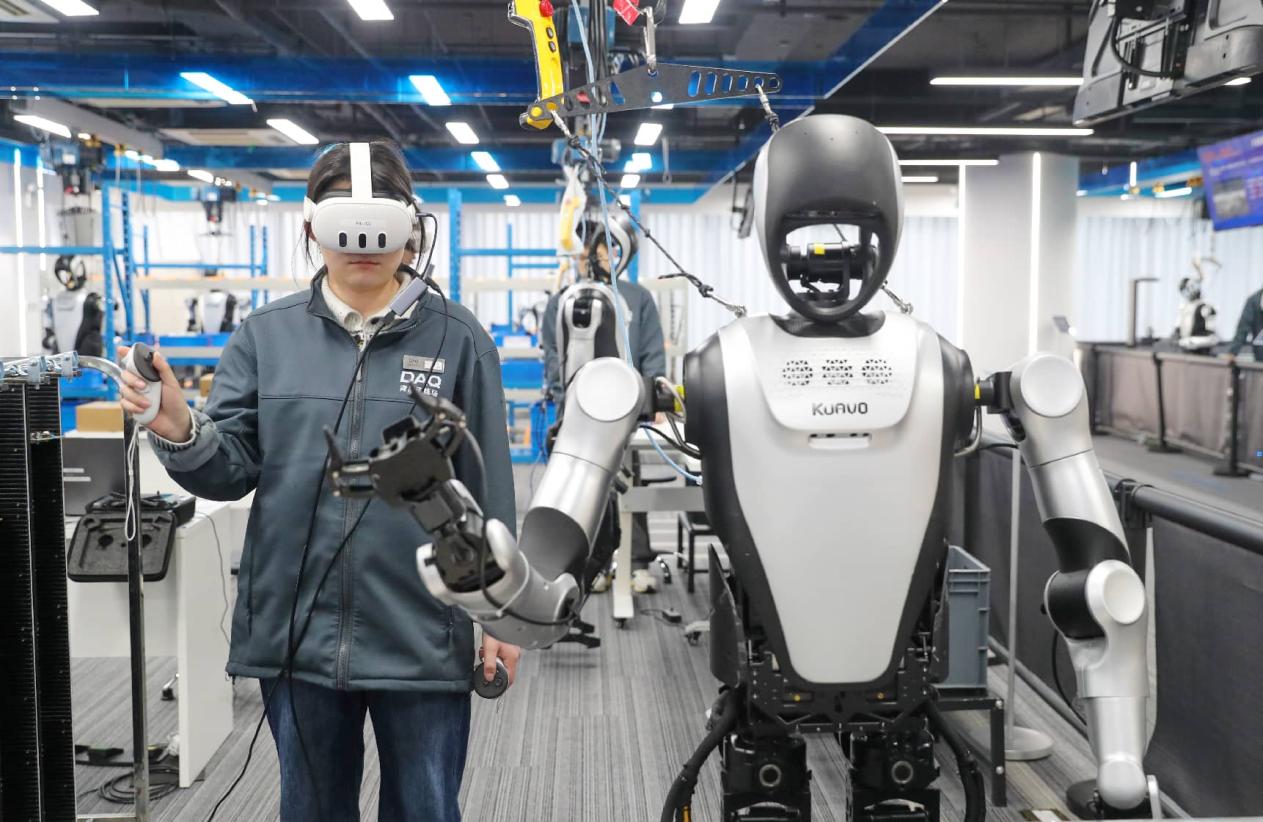
At a humanoid robot data collection training site in Qingdao, east China's Shandong province, a data collection specialist guides a robot as it simulates loading printed circuit board onto a production line in a factory setting. (Photo: Zhang Jingang)
Meanwhile, in robotics, embodied intelligence is advancing humanoid robots towards greater autonomy and enhanced human-machine collaboration, bringing them closer to real-world deployment. In Shenzhen, Wang Hongyang works as a robot product manager at Elephant Robotics, a Chinese tech firm specializing in robotic arms, kits, and parts.
"Our core task is to turn complex embodied intelligence technologies into tools that ordinary users can easily operate, combine, and innovate with," Wang said.
To ensure a product's successful development, Wang and his colleagues coordinate every stage of the process -- from structural design and electronic engineering to front-end interface design -- making sure that each step, from blueprint to mass production, meets expectations.
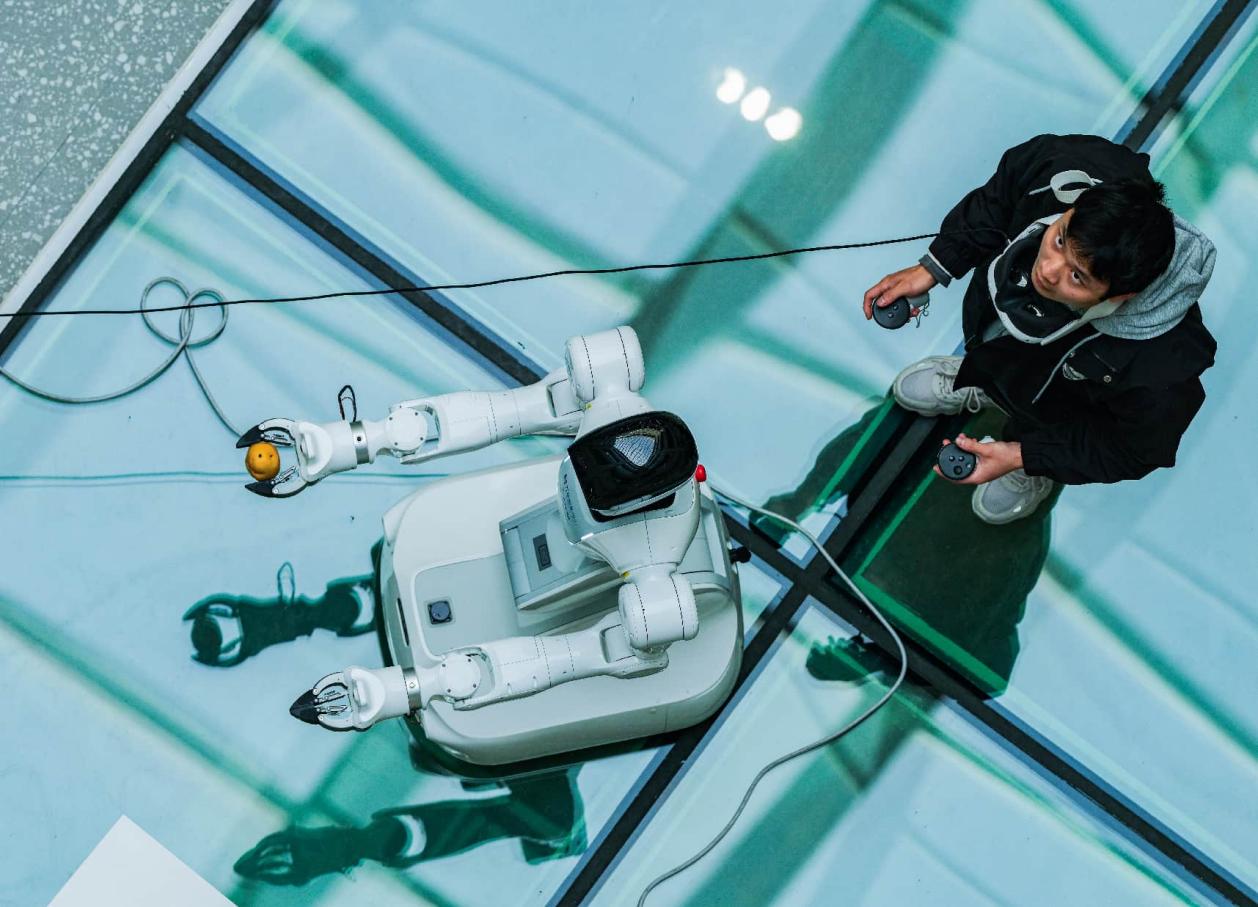
At a robotics training and innovation center in Chengdu, southwest China's Sichuan province, a robot trainer instructs a supermarket robot on how to grab items. (Photo: Wang Xiwei)
Qu Hongtao works as a humanoid robot data collection specialist at Beijing-based Zhongke Huiling Robot Technology.
Unlike earlier AI systems, which mainly processed text and images, humanoid robots operate in the physical world, which requires understanding complex physical rules, changes in light and shadow, and human movements. This, in turn, demands vast amounts of high-quality real-world data. Qu's job is to "translate" the real world into data that machines can understand.
Speaking of how to translate abstract algorithm requirements into concrete data tasks, Qu said, "We think from the machine's perspective. If the algorithm needs 'stable walking,' we have to consider what kind of surfaces to walk on, how long the stride should be, and how to shift the center of gravity. Turning these abstract terms into executable physical actions is fascinating creative work."
Cheng Zhongyi, 41, is a senior agricultural solutions engineer at DJI, a Chinese manufacturer of commercial unmanned aerial vehicles. Unlike traditional agricultural technicians, whose work relies heavily on experience and manual labor on fixed plots of land, Cheng's role revolves around data and systems. His goal is to enable drones, acting as intelligent terminals, to perform agricultural tasks with enhanced precision and automation.
"This job gives me a strong sense of achievement, as I can see how technology is transforming a traditional industry," Cheng said. "By analyzing large volumes of operational data and identifying common needs across different crops and regions, we design standardized intelligent solutions."
"Last year alone, I traveled 57,000 kilometers across the country, looking for more agricultural processes that drones can improve," he added.
Today, professionals in these emerging fields can be found across China. Last year, the Ministry of Human Resources and Social Security officially recognized 17 new professions and 42 new job categories -- the highest number ever added at one time.
Looking ahead, as industries such as commercial spaceflight, low-altitude economy, and deep-sea technology continue to grow, and as future sectors like bio-manufacturing, quantum technology, embodied intelligence, and 6G develop, the range of new careers will keep expanding.
Wang is optimistic about the future. "The robotics industry is on the verge of rapid growth. New AI models and sensor technologies are emerging every day," he said. "This field is full of uncertainty and challenges -- but that's exactly what makes it so exciting."