


China's "No. 1 central document" for 2026 called for cultivating new consumption models and scenarios, including harvest markets, intangible cultural heritage (ICH) workshops, and leisure and camping sites. In recent years, ICH workshops across the country have increasingly brought several ICH items and time-honored crafts into contemporary life.
Data from the Ministry of Culture and Tourism show that there are more than 12,900 ICH workshops nationwide, distributed across 2,138 county-level administrative areas, including 693 formerly impoverished counties and 135 key counties designated to receive rural revitalization assistance. These workshops have generated employment for more than 1.2 million people in related industries, preserving traditional craftsmanship while contributing to comprehensive rural revitalization.
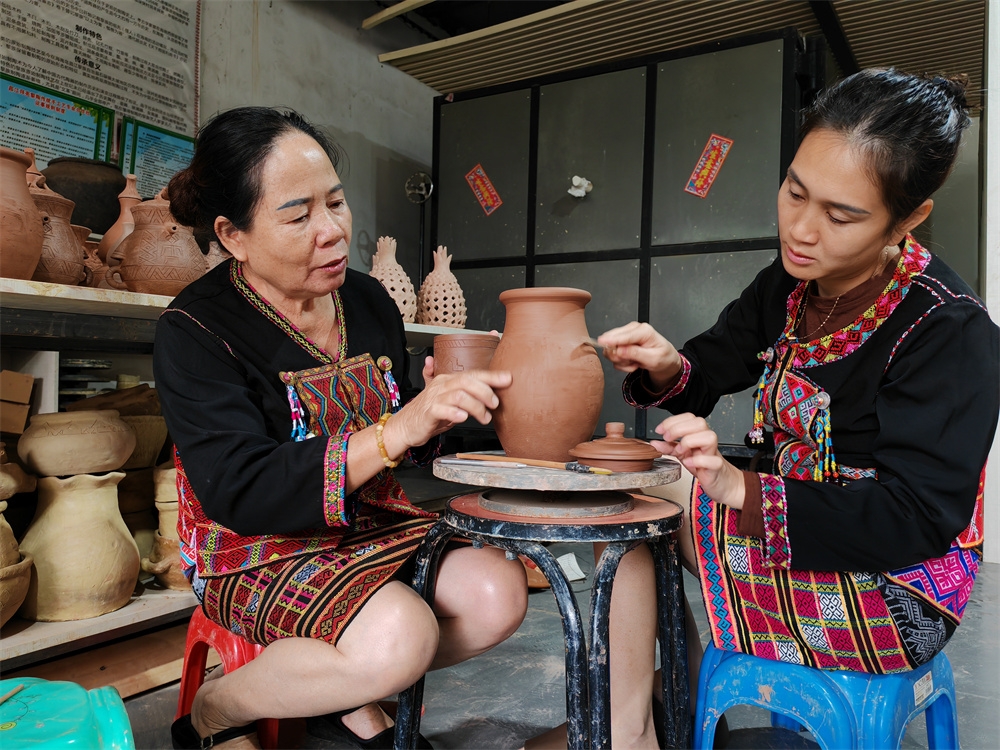
Two women make a piece of pottery work of Li ethnic group at Baolao village, Shilu town, Changjiang Li Autonomous County, south China's Hainan Province. (Photo: Huang Hailing)
At an ICH pottery workshop in Baotu village, Shilu town, Changjiang Li Autonomous County, south China's Hainan Province, Liu Meizhen, a representative inheritor of the national ICH of the Li ethnic group's primitive pottery-making craft, was shaping an unfired clay piece. A tourist surnamed Cui from northeast China's Heilongjiang Province looked on with undisguised curiosity.
"The craft is so distinctive. I'd love to give it a try," Cui said.
Handed a bamboo stylus by Liu, Cui began carving patterns into the clay surface. "In the old days, it was just villagers making pottery for themselves," Liu said. "Now tourists and students are joining us, and more and more people are taking an interest in this ancient craft."
Liu's rediscovery of her roots began in 2010, when she returned to Baotu village. She was concerned to find that practical ceramic and glass items had largely replaced traditional Li pottery in everyday life, and only a few elderly villagers still knew how to craft it.
Unwilling to let the skill disappear, and seeing its commercial potential, Liu partnered with several Li women from the village to found the Changjiang Baotu Li Pottery Professional Cooperative. In 2022, the cooperative established a dedicated ICH pottery workshop to revive the Li pottery craft, creating a distinctive attraction for rural tourism.
"The workshop is equipped with modern gas-fired kilns and can produce 50,000 pieces of Li pottery a year, with annual sales exceeding 40,000," Liu said. Traditional techniques have been selectively refined, while the craft's defining character has been carefully preserved, she added.
Li Mingzhong is the cooperative's manager and part of the post-1995 generation, who also works as a tour guide. "We've partnered with travel agencies and study-tour organizations to develop the workshop into a hands-on learning base," Li said. In 2025, the workshop hosted 26 educational tour sessions, welcomed around 16,000 visitors, and generated a revenue in excess of 200,000 yuan (almost $29,000).
Anchored by ICH workshops, the cooperative generates annual sales of around 1 million yuan and provides jobs for more than 150 villagers.
"We will keep refining our model, combining ICH preservation, educational tours, and rural tourism, so that Li pottery can play a bigger role in all-around rural revitalization and better find its place in modern life," said Guo Hongming, director of the county's cultural center.
Inside the Yushe Architectural Painting Intangible Cultural Heritage Workshop in Yushe county, Jinzhong city, north China's Shanxi Province, vivid architectural paintings line the walls of the exhibition hall.
Yushe has a millennium-old tradition of classical architectural craftsmanship, earning it the informal title: "hometown of ancient architecture." These works are used to adorn the structural elements of traditional buildings, said Lu Song, an ancient architectural painter from Shanxi Yushe County Gujian Group Co., Ltd., adding that Yushe's ancient architectural painting techniques are a provincial ICH, known for their brilliant colors, intricate patterns, and refined elegance.
A few years ago, Lu was an ordinary construction worker. "Back then, I was finding my own work and earning over 2,000 yuan a month," he recalled. "Now, ancient architectural painting has more than doubled my income."
In recent years, the county has developed the "Yushe Ancient Architectural Craftsmen" labor service by pursuing a development path that combines government-enterprise collaboration, ICH revitalization, and vocational training, thereby creating opportunities for both heritage preservation and industrial growth.
In 2023, the county established the Yushe Architectural Painting Intangible Cultural Heritage Workshop, which has since become an important platform for ICH protection, utilization, and employment.
Lu signed up for a free government-sponsored training course, learning the craft at the workshop while gaining experience on active restoration sites alongside construction teams.
The county's ancient architecture sector has generated output exceeding 200 million yuan, with more than 200 ancient buildings saved and restored. Twelve provincial-level ICH representative inheritors have also been trained.
Today, Yushe county has formed a complete industrial chain spanning timber component production, ancient building restoration, and the development of cultural and creative products, helping over 7,000 residents secure employment and generating an average annual labor income of 300 million yuan, according to a local official. The county has also organized construction teams to participate in more than 20 rural homestay renovation projects, driving a 20 percent increase in tourism revenue.