


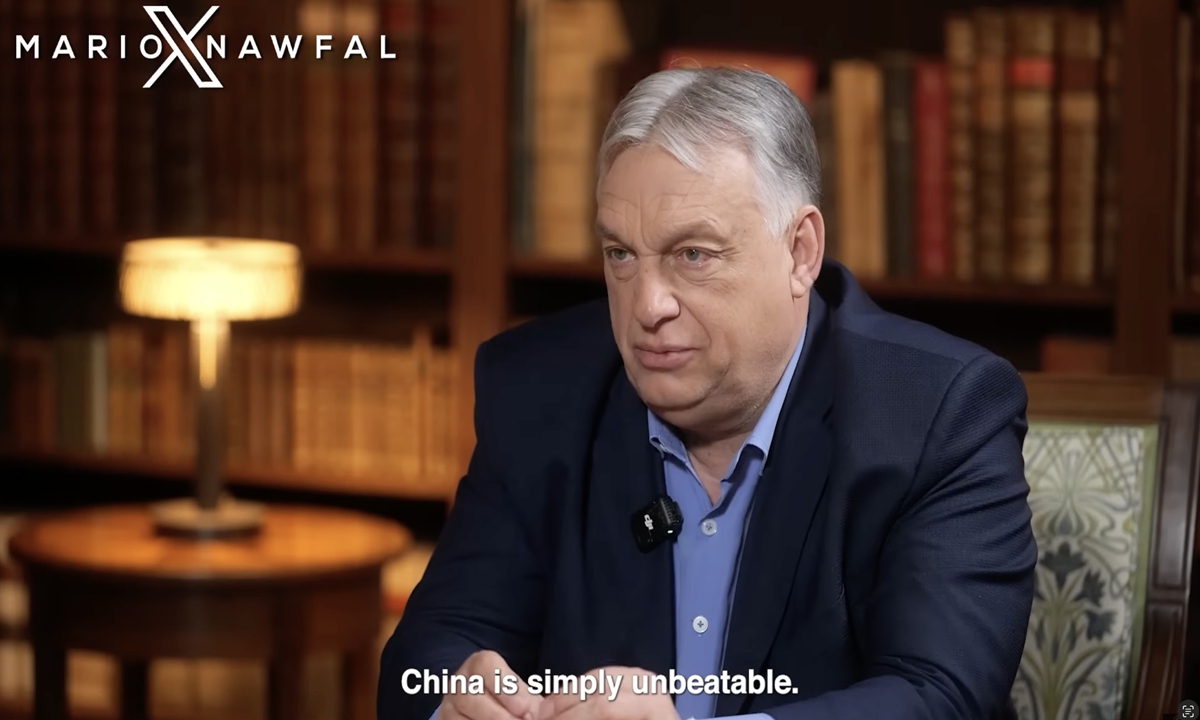
Screenshot of Hungarian Prime Minister Viktor Orban’s interview with host Mario Nawfal
“I think it's failure to think that anybody can beat China. It's impossible. China is simply unbeatable,” Hungarian Prime Minister Viktor Orban said in an interview released on YouTube on Wednesday.
Orban made the remarks in an interview primarily focused on the Iran war with media host Mario Nawfal. Nawfal has 3.2 million followers on X and 226,000 subscribers on YouTube, and has interviewed a number of prominent figures in politics and business, including Hunter Biden and Elon Musk.
To gain deeper insight into what may happen and what should happen next in Iran, as well as into the thinking of the US government, Nawfal conducted an approximately one-hour interview in English with Prime Minister Orban, whom Nawfal described as “one of the EU’s most respected and powerful voices.” The interview covered topics such as the ongoing war in the Middle East, the Russia-Ukraine conflict and the new world situation.
After emphasizing current state in the US-China AI race, as well as in renewable energy — especially nuclear energy — and noting that China is “scary” in how fast it is growing, Nawfal asked Orban how Europe should position itself in a power struggle between the US and China. Orban replied: “If you are thinking in the frame that there could be only one sun on the sky, we misunderstand the situation. China will be as one of the two main parties of world politics.”
At this point, Nawfal asked whether Europe is involved as well, but Orban said that Europe is “out of that concept.” He added: “They [China] will hear, they will present, they will influence the world.”
Orban further elaborated on how the West should live with China’s rise, noting that if Western countries believe they can destroy or beat China, they misunderstand the situation, as China’s strength lies in its strong energy and culture.
“So they are back, as they were 500 years ago. Because prior to the dominating period of the West, China was always the most ancient and most successful civilization. And now they are simply back,” said Orban.
During the interview, Orban also stressed the need for coexistence, saying: “We have to find a way how to live on the same globe. For us Westerners, we have to understand that there will be at least two suns on the sky.”
On the topic of competition, Orban acknowledged that it is part of China-EU relations. “But competition is not the only element how we can imagine the future of the globe; cooperation is also,” said Orban.
Once the interview was released, it sparked widespread discussion among netizens both in China and the international community. A YouTube user @ilovethisworld3059 commented, “The way he talks about China I see as spot on. I like how he speaks about competition versus cooperation!”
On Sina Weibo, some Chinese netizens praised Orban as a rare clear-headed politician in Europe, with some commenting that Orban’s long tenure demonstrates his exceptional ability and vision.
Some others said that Orban’s positive assessment of China reflects recognition of China’s development achievements and shows his confidence in China’s strength and potential.
Meanwhile, some netizens noted that peaceful coexistence and joint development between China and Europe is the right path. “Some Western countries still adhere to the exclusive, survival-of-the-fittest, zero-sum, win-at-all-costs jungle law as their core values and cannot truly embrace peace, tolerance, and win-win cooperation,” read a popular comment.
China-Hungary relations are widely seen as playing a leading role in China-EU ties. Under the administration of Orban, Hungary and China have been actively strengthening their all-weather comprehensive strategic partnership. When meeting Chinese Foreign Minister Wang Yi on February 12, Orban said that Hungary will continue to actively promote dialogue and cooperation between Europe and China, according to a report by the Xinhua News Agency.
The instability stemming from Washington has made it increasingly important for European countries to diversify partnerships and shore up political and economic stability, while internal debates over China policy continue in the continent.
A European Parliament delegation will travel to China from March 31 to April 2, marking the first such visit in eight years, according to a release from the European Parliament website on Friday.
Some Chinese experts believed that one visit alone is unlikely to fundamentally shift the European Parliament's entrenched biases of China, but such direct contact may help some European politicians view China's development more objectively.