


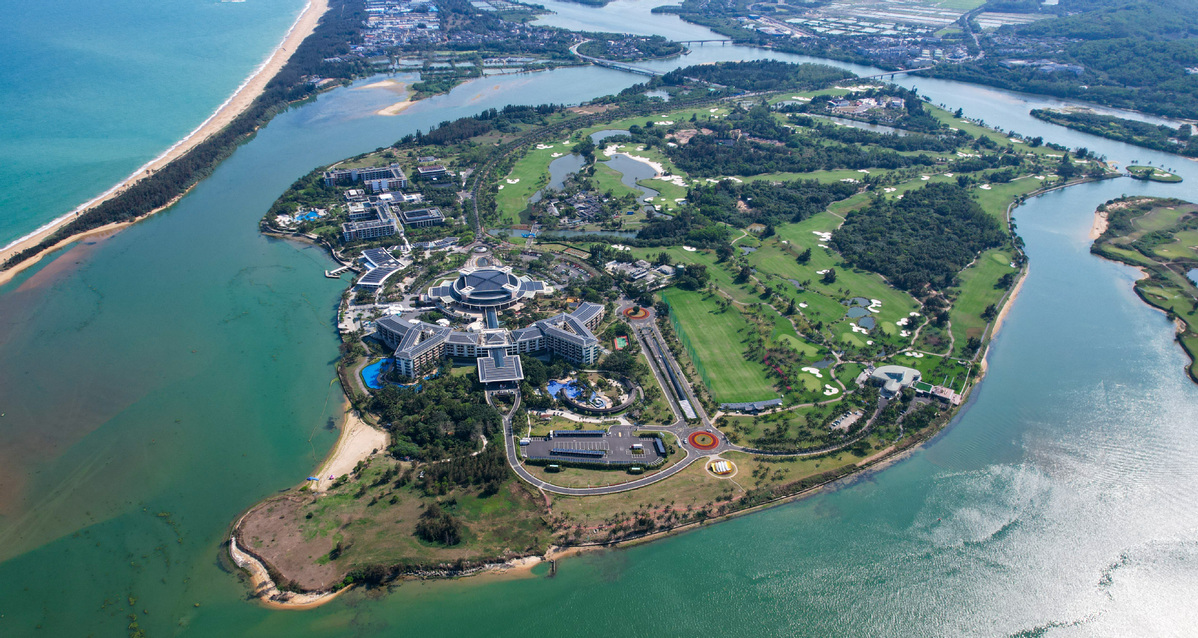
An aerial drone photo taken on March 19, 2026 shows the Boao zero-carbon demonstration zone in Boao, South China's Hainan Province. (Photo: Xinhua)
A seaside breeze carries the scent of blossoms across the flower fields in a village in the coastal town of Boao, south China's Hainan Province. Amid a "sea" of flowers, tourists are posing for pictures and sharing the stunning view with family and friends.
Around the spring season, the vast expanse of flower fields in Nanqiang Village, located in Boao Township, Qionghai City, comes into full bloom to welcome a major event: the Boao Forum for Asia (BFA), held in Boao annually.
Beyond fostering discussions and pooling wisdom on key issues, the global gathering has also injected vitality into the rural economies of the surrounding villages of its venue, as the high-profile event brings conference guests, curious tourists, and other resources to the location.
Nanqiang's flower fields have become an online sensation, even before this year's BFA, which ran from March 24 to 27. "It is a premier flower-viewing period lately, and the area now draws thousands of visitors a day -- so much so that a villager told me over 800 coconuts were sold in a single day," said Fu Cui, Party chief of the village.
Thanks to the forum's appeal in drawing tourists to Boao even outside the conference period, many villagers have started homestays and agritainment businesses, boosting their income from tourism, according to Fu.
On both banks of the Wanquan River, villages such as Nanqiang have taken on a new look, each preparing in its own way to greet guests from home and abroad.
Downstream along the river, Liuke Village, located at a key land-and-water junction with rich culture, has been busy upgrading tourist amenities lately.
To tap into business opportunities created by the BFA, Liuke has built a new "reception hall," a rural tourism attraction inspired by Qionghai's idea of turning nearby villages around the BFA venue into unofficial meeting spaces for conference attendees with idyllic views.
Nearly half of Qionghai's over 500,000 permanent residents live in rural areas. An invigorated rural economy is vital to their well-being.
Promoting rural revitalization has remained one of China's policy priorities. China unveiled its "No. 1 central document" for 2026 in February, outlining plans to advance agricultural and rural modernization and promote all-around rural revitalization. The newly released 15th Five-Year Plan (2026-2030) also calls for increased investment in rural revitalization.
Not far from the BFA venue, another attraction has recently come into the spotlight: the "Window of World Tropical Fruits," a comprehensive agricultural science and technology demonstration project developed by Grand Agriculture, an agribusiness company. The site, located in Dalu Township of Qionghai, integrates the cultivation and exhibition of new tropical fruit varieties from around the world.
As Boao has earned its international fame, the company has also aspired to build a world-class reservoir of tropical fruits, as the name "Window of World Tropical Fruits" suggests.
Visitors at the site can find rarely-seen fruits, including a finger-sized lime with pulp beads that resemble caviar and a peanut-sized "miracle fruit" that can temporarily alter the taste of food.
Dubbed China's gene bank of tropical fruits, the company has collected more than 700 germplasm varieties of rare tropical fruits, successfully cultivated over 450 of them in trial runs, and brought over 50 fruit varieties to market shelves, according to Chen Bing, the company's chief agronomist.
The company works with nearby villages, providing seedlings, technology, and marketing support, while rural cooperatives and farmers grow fruit in line with the company's technical protocols. The company then buys back, packages, labels and sells the produce.
So far, more than 40 varieties of tropical fruits have been launched in markets through this cooperation. Villagers also fill the company's job vacancies, ranging from seedling cultivation to service and security roles.
Chen expressed his hope that the annual BFA conferences could bring more opportunities for international exchange -- to promote China's agricultural varieties, technologies, and industry practices to the world, while also introducing high-quality foreign varieties and technologies.