


China's manufacturing PMI reaches 50.4 in March, indicating improved economic momentum: NBS
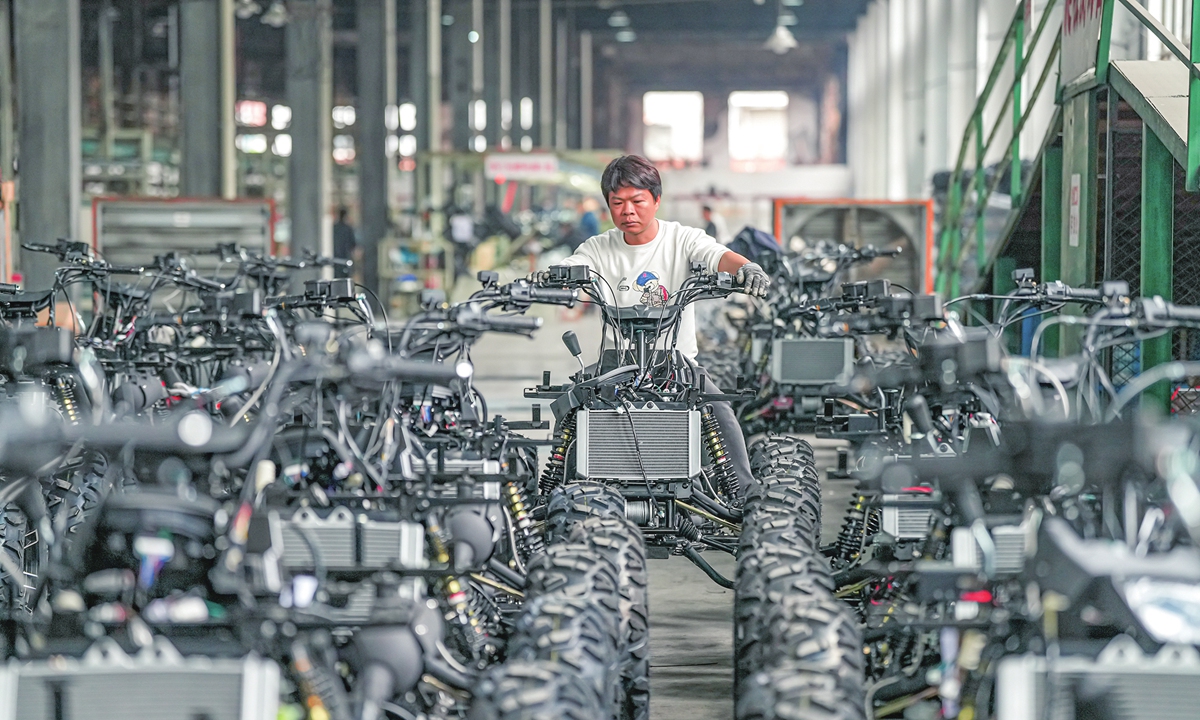
A worker assembles motorcycles on a production line at a manufacturing company in Jinhua, East China’s Zhejiang Province, on March 30, 2026. The company is ramping up production to fulfill orders and meet its annual targets. (Photo: VCG)
China's Manufacturing Purchasing Managers' Index (PMI) rose to 50.4 in March, up 1.4 percentage points from February, after staying below the mark of 50 for two months, according to data released by the National Bureau of Statistics (NBS) on Tuesday. The increase points to the country's recovering economic activity levels.
The March reading followed 49.3 in January and 49.0 in February. In December 2025, the reading was 50.1.
Huo Lihui, chief statistician at the bureau, attributed the increase to expansion in both production and demand; a rebound in PMI reading in large, medium and small-sized enterprises; and the fast expansion in three key sectors: high-tech manufacturing, equipment manufacturing and consumer goods industries, and energy intensive industries.
Affected by factors such as the recent continuous rise in prices of some bulk commodities and accelerated corporate procurement activities, the main raw material purchase price index and the factory gate price index were up significantly from the previous month, indicating a notable rebound in overall manufacturing prices, according to Huo.
By industry, both price indices for petroleum, coal and other fuel processing, and chemical raw materials and chemical products have seen notable increases in purchase and selling prices.
Among the key sub-indexes, the production index rose to 51.4, up 1.8 percentage points from the previous month, while the new order index reached 51.6, up 3.0 percentage points from February, indicating significantly improving market demand.
The survey results also showed that, affected by factors such as the current geopolitical conflicts in the Middle East, prices of raw materials such as oil and chemicals have risen sharply. Coupled with the increase in logistics freight rates, the proportion of enterprises reporting high raw material and logistics costs has increased compared with the previous month.
China's non-manufacturing PMI rose by 0.6 percentage points to 50.1, and the composite PMI climbed to 50.5, up 1 percentage point from the previous month.
With all three gauges returning to expansion territory, which suggests the overall economic activity level is improving, Huo said.
The rebound in manufacturing PMI came as China posted strong industrial data recently.
On March 27, NBS data showed that the profits of China's major industrial firms increased 15.2 percent year-on-year in the first two months of 2026, with equipment manufacturing and high-tech manufacturing serving as major growth drivers.
On March 4, according to a survey published by RatingDog, a Chinese consulting firm, China's services activity gained pace in February, with the services purchasing managers' index (PMI) reaching 56.7, the highest reading in 33 months.