


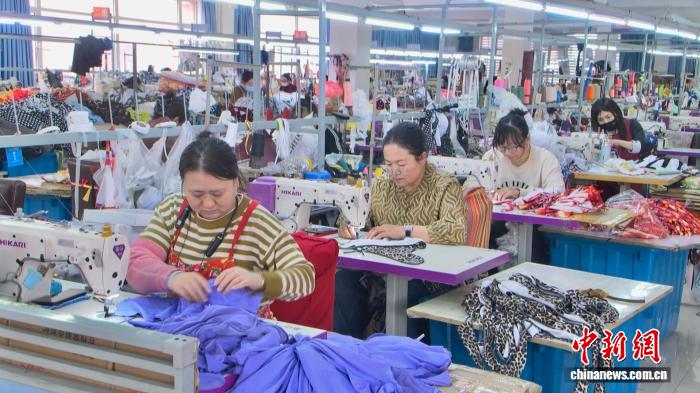
Workers produce swimwear at a workshop in Xingcheng, northeast China's Liaoning Province. (Photo: Ma Dongxu)
Orders for swimwear have been flooding in since the Chinese New Year holiday in Xingcheng, northeast China's Liaoning Province, and the city is now in its peak production season. More than 1,000 local swimwear manufacturers are running at full tilt to fulfill orders from home and abroad.
At Xingcheng Xinhui Garment Co., Ltd., production lines are operating at full speed to meet multiple batches of overseas orders. General manager Yan Han said orders have risen 35 percent year on year so far in 2026, with overseas orders accounting for more than 40 percent of the total. The company sells to markets including Spain, Russia, the U.S., Japan, South Korea, the Middle East and Southeast Asia.
Xingcheng Kaisheng Garment Co., Ltd. is similarly swamped. General manager Liang Bing said the company expects total domestic and overseas orders to reach 3.5 million swimwear pieces this year, with orders from the U.S. alone accounting for 70 percent of that volume.
Of the more than 30,000 swimwear production machines currently in operation across Xingcheng, over 30 percent are advanced imported equipment. Among swimwear enterprises above the designated size, the adoption rate of smart devices exceeds 90 percent, and some companies have achieved fully digitalized production management. AI-assisted design has also become a core driver of industrial upgrading, with more than 800 enterprises across the industry now using AI design tools, significantly shortening design cycles and accelerating new product launches.
Cross-border e-commerce has emerged as another powerful engine of growth. Leading local companies have opened stores on major platforms, including Shein, Temu, TikTok and Amazon, with daily online sales reaching 4,000 to 5,000 pieces and monthly shipments holding steady at around 100,000 pieces.
Xingcheng's cross-border e-commerce shipments account for more than 80 percent of the country's total cross-border swimwear sales. As of 2025, the city had more than 10,000 registered cross-border e-commerce accounts and over 20,000 online stores, with annual swimwear shipments reaching 130 million pieces and transaction volumes approaching 5 billion yuan ($723.4 million).
The swimwear industrial cluster in the city generates an annual output of around 15 billion yuan, with products commanding a domestic market share of over 40 percent and an international market share of over 25 percent. Its products are sold to more than 140 countries and regions.
The city's thriving swimwear industry has brought tangible benefits to the local workforce as well. It now supports 80,000 local workers spanning different age groups, not only providing jobs for local laborers but also attracting workers from nearby areas.