


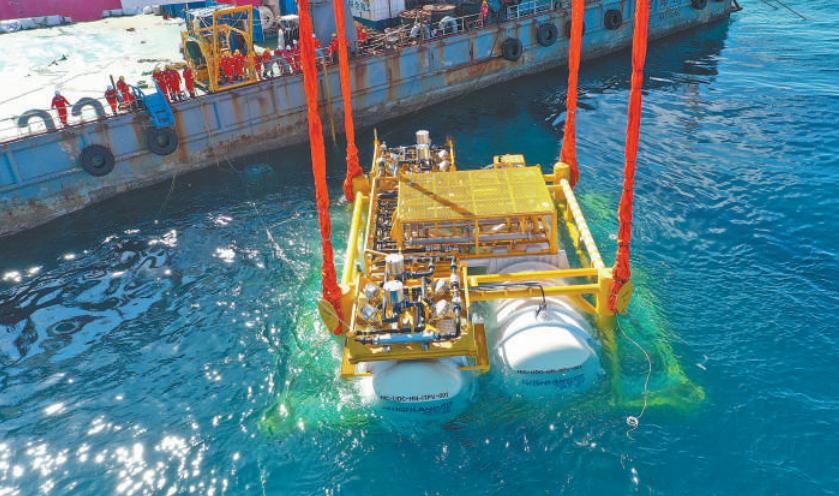
A module of the underwater data center is put into the sea in Lingshui Li autonomous county, south China's Hainan province. (Photo provided by interviewees)
Beneath the tropical waters of Qingshui Bay, south China's Hainan province, lies the world's first commercial underwater data center -- a cluster of capsule-like modules operating steadily at 35-meter depths for nearly three years. This innovation addresses critical challenges facing Hainan's digital expansion: limited land resources, freshwater scarcity, and energy-intensive cooling demands in its humid climate.
"The development of the Hainan Free Trade Port, especially in digitalization and cross-border data services, requires a large number of servers," said Pu Ding, general manager of the underwater data center, which is partly contracted by Shenzhen HiCloud Data Center Technology Co., Ltd.
"But as a tropical island, Hainan faces constraints such as limited freshwater and land resources, as well as a hot and humid climate year-round, making it challenging to build traditional data centers," Pu added.
To leverage its abundant marine resources, Hainan partnered with Shenzhen HiCloud Data Center Technology Co., Ltd. at the end of 2021 to introduce this commercial underwater data center project, which is scheduled to be developed in three phases in Lingshui.
"Our research showed that Lingshui hosts landing stations for international submarine cables operated by major telecom companies. The underwater data center can make use of these existing connections and is well positioned to handle more cross-border data services in the future," Pu explained.
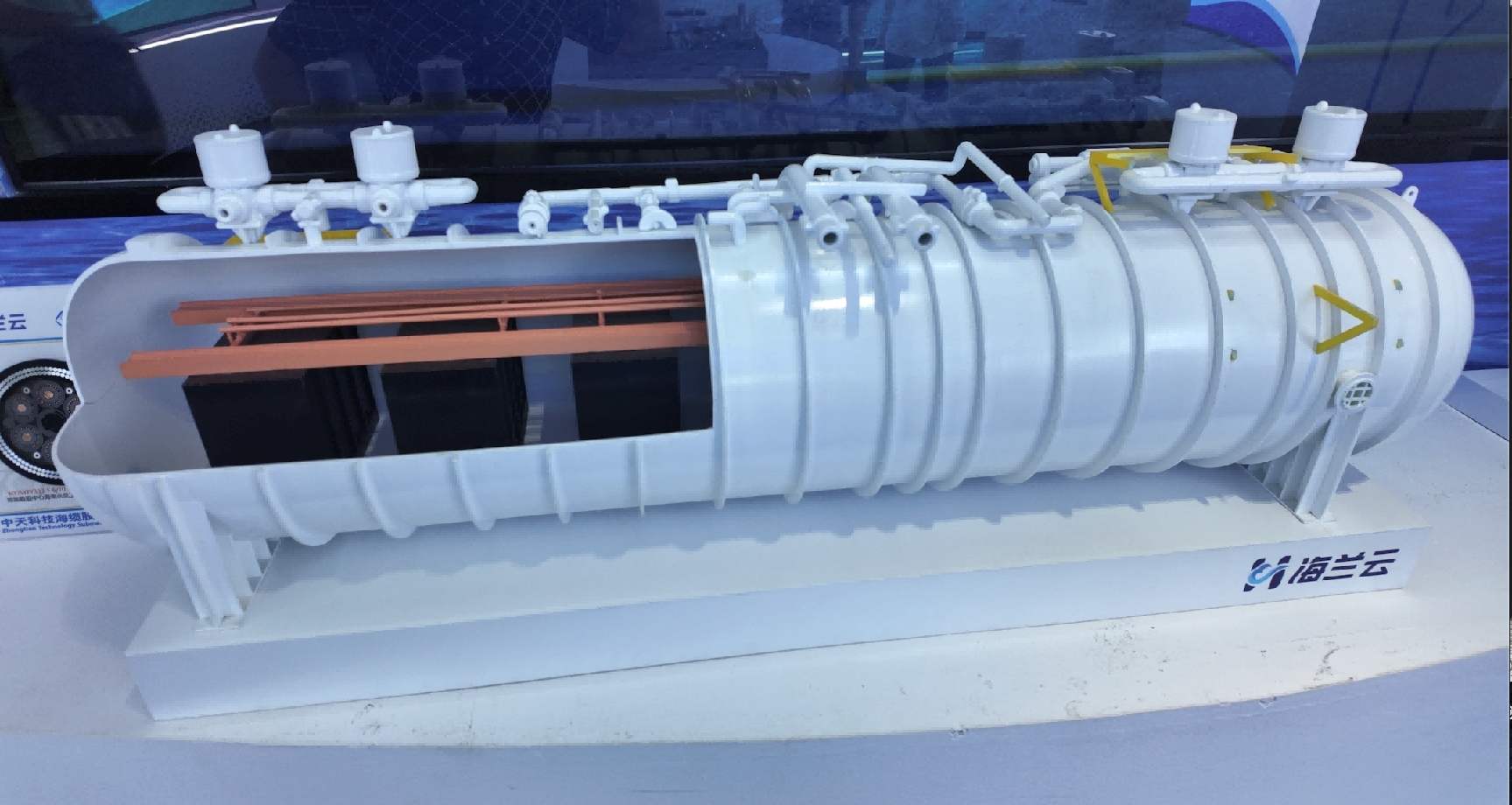
Photo shows a model of a module of the underwater data center in Lingshui Li autonomous county, south China's Hainan province. (Photo: Sun Shuang)
But how do servers function underwater? "Submerging them is like a refreshing plunge on a sweltering day," Pu analogized. Servers require continuous cooling, which on land consumes large amounts of electricity or freshwater. Underwater, however, the natural flow of seawater provides efficient cooling.
The coastal waters of Qingshui Bay lie within an upwelling zone in eastern Hainan, where temperatures remain below 24.5 degrees Celsius year-round, making it an ideal natural cooling environment that saves energy, water, and land.
How significant are the savings? Li Jiawen, deputy general manager of Shenzhen HiCloud Data Center Technology Co., Ltd., offered an example from the project's first phase: "At full capacity, compared with a traditional land-based data center of the same size, it can save 26,000 tons of water and 3.4 million kilowatt-hours of electricity annually, reducing carbon emissions by about 2,720 tons, the equivalent of planting nearly 150,000 trees."
Waterproofing and sealing are critical, as servers are highly sensitive to moisture. "When sealing the data modules, every bolt must be tightened in a precise sequence and direction. We developed strict operating procedures to ensure this," Pu said.
During the research and development phase, the team overcame a series of technical challenges to create a stable operating environment underwater, featuring constant humidity, stable pressure, and a dust-free, oxygen-free setting.
The underwater data center consists of sub-sea data modules, power distribution stations, optoelectronic composite cables, and an onshore control station. The onshore control station acts as the system's "brain."
"With intelligent remote control systems, daily operations can be managed from land, which greatly reduces the need for on-site inspections and lowers operating costs," Pu explained, adding that fewer than 10 staff members are needed at the station.
While human interaction is minimal, marine life thrives around the modules. Monitoring systems show schools of fish gathering and swimming around them. Tests indicate that after heat exchange with seawater, the temperature within a two-meter radius rises by less than 1 degree Celsius -- less than what would be caused by an hour of midday sunlight. The slightly warmer water and reduced currents actually make the modules a kind of "shelter" for marine life.
"As AI and related infrastructure develop rapidly, energy consumption for computing power is becoming an increasingly pressing issue. Green development is now a key priority for data centers," Li said.
The Lingshui underwater data center has been operating smoothly, achieving over 30 percent higher overall energy efficiency compared with conventional facilities of the same scale. With AI computing modules and advanced systems rolling out, it is evolving into a high-efficiency, energy-saving green computing cluster.