


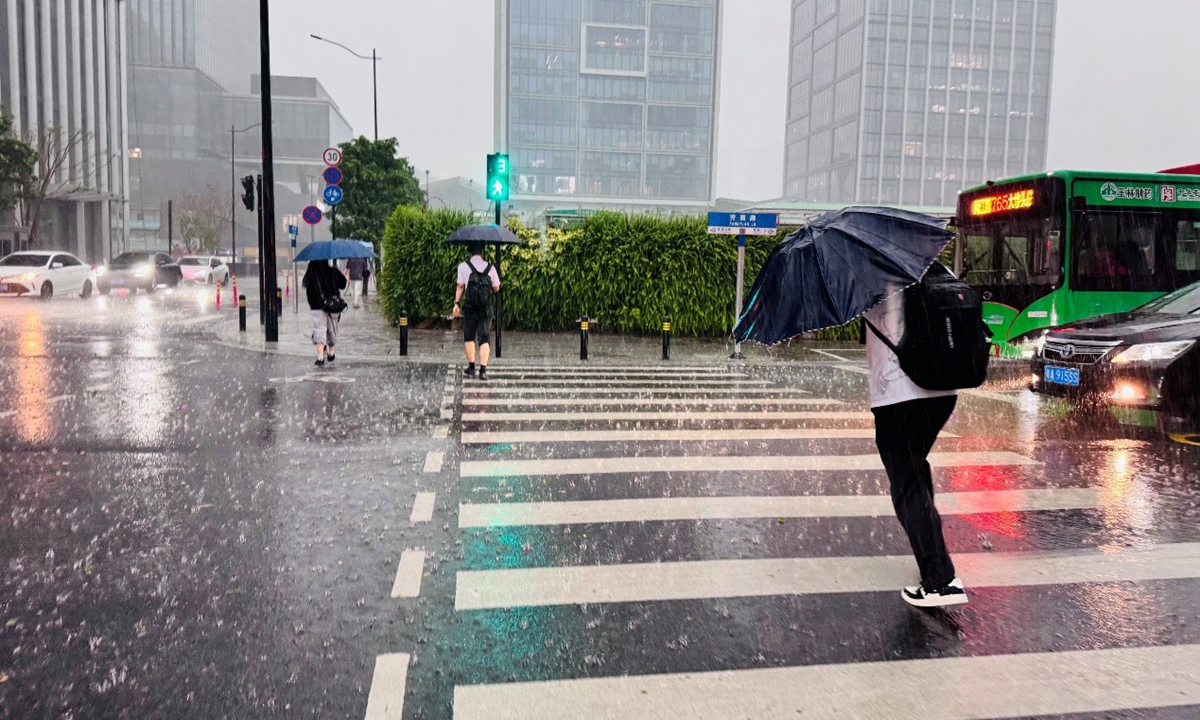
Citizens wade through the heavy rain in Guangzhou, South China's Guangdong Province on March 30, 2026. (Photo: VCG)
Two neighboring southern Chinese provinces - Guangdong and Hainan - are currently experiencing dramatically different weather conditions. On Tuesday, cities across Guangdong were hit by severe convective weather, including hailstorms and even tornadoes, while Haikou, the capital of Hainan Province, sweltered under a blistering heatwave, with temperatures reaching 37 C.
According to news service Southcn.com, Guangdong meteorological observatory forecast that from Tuesday onward, the region will continue to experience severe convective weather, including heavy precipitation, thunderstorms with Force 8 to 10 gales, and hail, moving from west to east across the province.
The observatory also forecast that gusts of around Force 12 or even tornadoes may occur in some areas, according to the report.
Cities and counties in the northern part of Guangdong and the Pearl River Delta region are expected to see heavy to torrential rain, with locally extremely heavy downpours, while the rest of the province will experience moderate thundershowers and locally heavy rain, the report said.
As of 9:18 am on Tuesday, 22 thunderstorm gale yellow warning signals remain in effect across the province, according to a local media outlet.
In response to the severe convective weather, railway, public security, and firefighting departments in multiple cities have swiftly mobilized to ensure travel safety. A total of 200 precautionary posts were set up on Monday, with 1,073 professional personnel, 311 emergency vehicles, 163 pumping units, and 12 large-scale drainage vehicles dispatched, Guangzhou Daily reported.
Strong convective weather will continue to impact other provinces in South China. The National Meteorological Center renewed an orange alert for severe convective weather at 10 am on Tuesday, predicting that from 2 pm on Tuesday to 2 pm on Wednesday, some parts of the central and northern areas of South China will experience thunderstorm gales of Force 8 or above, or hail.
Ma Jun, director of the Institute of Public and Environmental Affairs, told the Global Times on Tuesday that a robust southwest warm and moist airflow has brought ample water vapor and energy, colliding with the southward-moving cold air mass, thus triggering the severe convective weather.
Hainan Province, meanwhile, is experiencing a starkly different weather pattern, with a heatwave affecting parts of the province.
At 6:10 am on Tuesday, the Hainan Meteorological Service continued to issue a Level‑4 high‑temperature warning, forecasting that during the daytime, most towns in eight cities and counties, including Haikou, Chengmai, and Lingao, would experience high temperatures exceeding 37 C.
Ma said that under the persistent grip of a robust southwest warm and moist airflow, the region has seen limited rainfall and abundant sunlight, sending temperatures surging rapidly.
The early arrival of the heatwave has also taken some local residents by surprise, with some saying that they were "not yet prepared."
Although temperatures are surging and the heat has arrived earlier than usual, the conditions have not yet reached the level of extreme high temperatures, Ma said.
The high temperatures in Hainan stand in stark contrast to the hailstorms and gales in Guangdong, creating an "ice and fire" contrast across South China. Ma said that such a weather phenomenon of contrasting extremes is a normal range of springtime weather patterns in South China.
Against the backdrop of global warming, extreme weather events are becoming more frequent, said the expert, adding that if an El Nino event develops, a strong El Nino would further intensify this characteristic.