


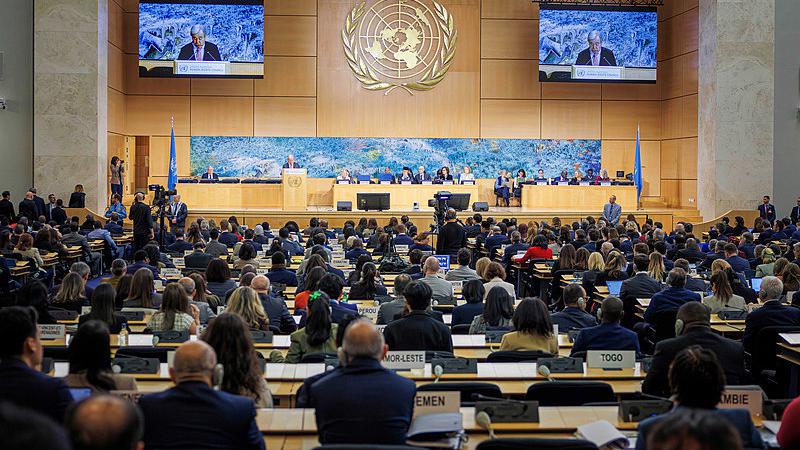
UN Secretary-General Antonio Guterres addresses the opening of the 61st session of the UN Human Rights Council, Geneva, Switzerland, February 23, 2026. (Photo: VCG)
Chinese civil society organizations showcased China's human rights philosophy and highlighted the country's progress on human rights protection at the 61st session of the United Nations Human Rights Council held in Geneva from February 23 to March 31.
Representatives from groups, including the China NGO Network for International Exchanges and the Chinese Association for International Understanding, participated in multiple discussions on cultural, educational and environmental rights.
During a session on cultural rights, Gu Qunye, an expert from the Shandong Tongshan Welfare Public Development Center, outlined efforts to expand access to arts and cultural education for children in rural areas. He said such programs aim to help young people express themselves, build confidence and strengthen connections with their cultural heritage, while also encouraging cross-cultural understanding.
At a general debate on economic, social and cultural rights, Jing Wenkai of Tsinghua University highlighted the role of education in advancing youth development. He pointed to initiatives aimed at reducing financial barriers for low-income students, volunteer teaching programs in less-developed regions, and online platforms that broaden access to educational resources.
Environmental issues were also raised during the session. Zhang Jinghan, an environmental advocate, emphasized the importance of a clean and healthy environment, calling for stronger legal frameworks, greater transparency, and increased public participation in environmental governance.
In discussions on human rights situations requiring special attention, participating organizations shared their initiatives aimed at safeguarding the basic rights of children affected by conflict and war. They emphasized the importance of fostering intercultural dialogue and mutual respect, highlighting China's role in promoting international civil cooperation and advancing human rights globally.
Other Chinese organizations, including the China Foundation for Human Rights Development and the China International Association for Promotion of Science and Technology, also contributed through in-person and virtual statements, adding to broader exchanges on human rights issues at the session.