


LHASA, April 1 (Xinhua) -- Along a national highway, a sea of pink and white peach blossoms blankets the mountainside, with Tibetan-style houses nestled in between.
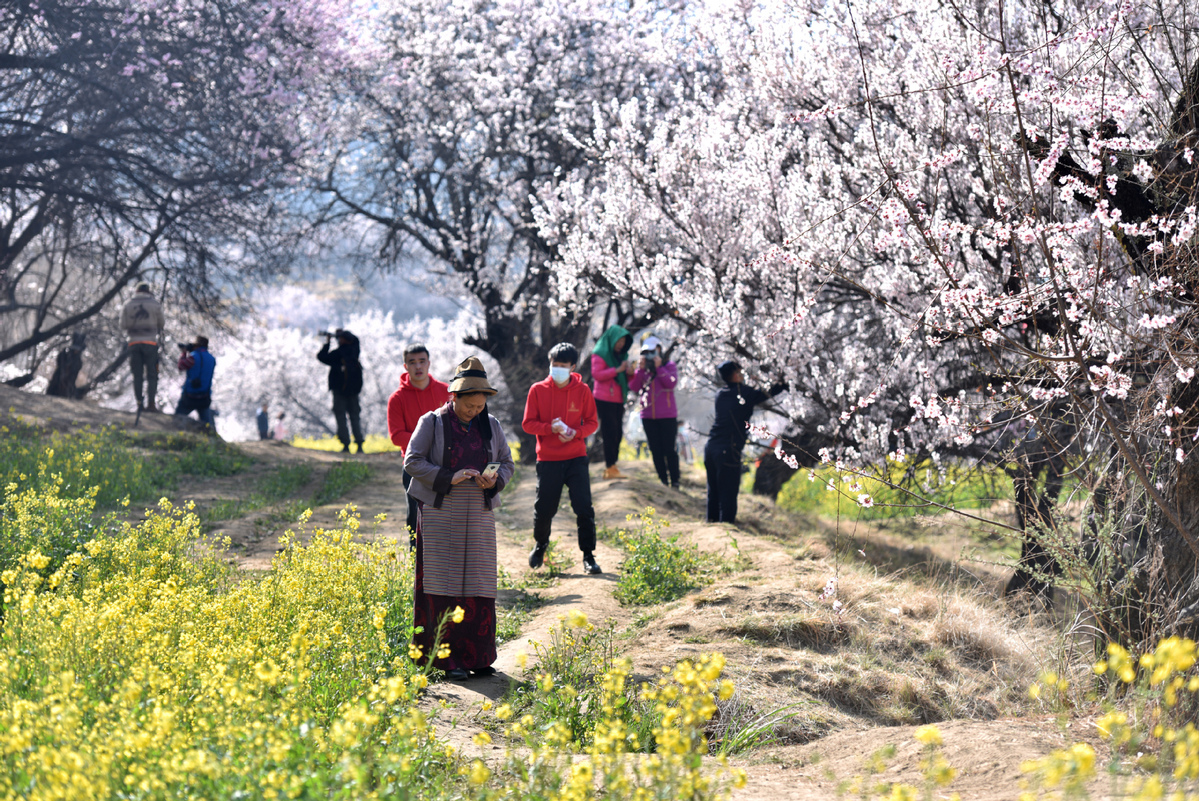
People enjoy peach blossoms in Galai village, Nyingchi city, Tibet autonomous region famous, on March 27, 2021. (File photo: Xinhua)
This is Galai Village in the city of Nyingchi, southwest China's Xizang Autonomous Region. Every spring, flocks of visitors swarm into the village, weaving through the blooming groves.
"It is indeed a blessing left by the ancestors -- a peach blossom paradise for you," said Chinese President Xi Jinping when visiting the village in 2021.
During the visit, Xi stepped into the home of villager Dawa Gyaltsen, sharing a heartfelt moment with him and his family.
Dawa Gyaltsen recounted his family's diversified income streams from transportation services to dividends from peach blossom festival tourism. "That adds up to several hundred thousand yuan -- a happy family indeed," Xi told the Tibetan villager.
"When Xi learned that my daughter wanted to become a doctor and my son a professional sprinter, Xi encouraged them to reach for their dreams," Dawa Gyaltsen, 42, recalled.
Galai, home to more than 150 villagers, boasts over 1,000 old peach trees, some dating back as far as about 700 years.
A local village cadre told Xi that in the past, wild peach trees were felled for firewood. It was only in recent years that rural tourism blossomed into a pillar industry and they have come to realize that "lucid waters and lush mountains are invaluable assets."
Thanks to the paired assistance program between Guangdong Province and Nyingchi, the village now boasts its own peach blossom resort. Pit latrines have given way to clean toilets, muddy paths to stone trails, and ancient-style pavilions now dot the wild peach forest for visitors to rest.
Since 2021, the same year when Xi visited Galai, the village has further upgraded its tourism facilities by digging deeper into its cultural roots. Tourists can try traditional activities like archery and horse riding, guided by professionals and dressed in Tibetan attire. These experiences transform a simple flower-viewing trip into an immersive cultural encounter, shifting the village's revenue model from ticket sales to diversified, experience-based tourism.
Fueled by the "peach blossom economy," Galai Village's per capita disposable income jumped to 41,300 yuan (about 5,986 U.S. dollars) in 2025, compared to an annual per capita income of less than 2,000 yuan in 2000. The collective income for the village exceeded 8 million yuan.
Last year, Nyima Dorje, a village cadre, wrote a letter to Xi on behalf of the residents, detailing the income and the latest transformation of the village. Xi's reply left Nyima Dorje delighted. "Learning that the village has undergone new changes in recent years and villagers' incomes have increased, I feel happy for you," the reply letter reads.
Even more exciting was Xi's arrival in Lhasa, the regional capital, later in 2025 to celebrate the 60th founding anniversary of Xizang Autonomous Region, where he was welcomed by locals, including Nyima Dorje.
The transformation of Galai Village epitomizes Xi's commitment to Xizang's development.
Since Xi became the general secretary of the Communist Party of China Central Committee in 2012, he has presided over two key national symposiums on Xizang and established the Party's strategy for governing Xizang in the new era.
While chairing the seventh national symposium on work in Xizang in 2020, Xi stressed the need to consolidate the achievements of poverty alleviation and effectively link the effort with rural revitalization.
The picturesque Galai Village has carved a unique path in rural tourism, exemplifying China's broader push for rural revitalization.
In February, the country's "No. 1 central document" for 2026 outlined plans to advance agricultural and rural modernization and promote all-around rural revitalization. Meanwhile, the newly-released 15th Five-Year Plan (2026-2030) calls for fostering rural specialty industries and new business forms, including rural tourism.
This year, Galai Village introduced 50 peach trees of a new variety with pinker blossoms. These trees will bloom after the wild peach season ends, extending the viewing period for visitors and, in turn, generating more tourism revenue.
"Our research continues, as we want the village's wild peach blossoms to bloom even longer," said Zeng Xiuli, a Lhasa-based researcher who has studied wild peach trees on the plateau for nearly two decades.