


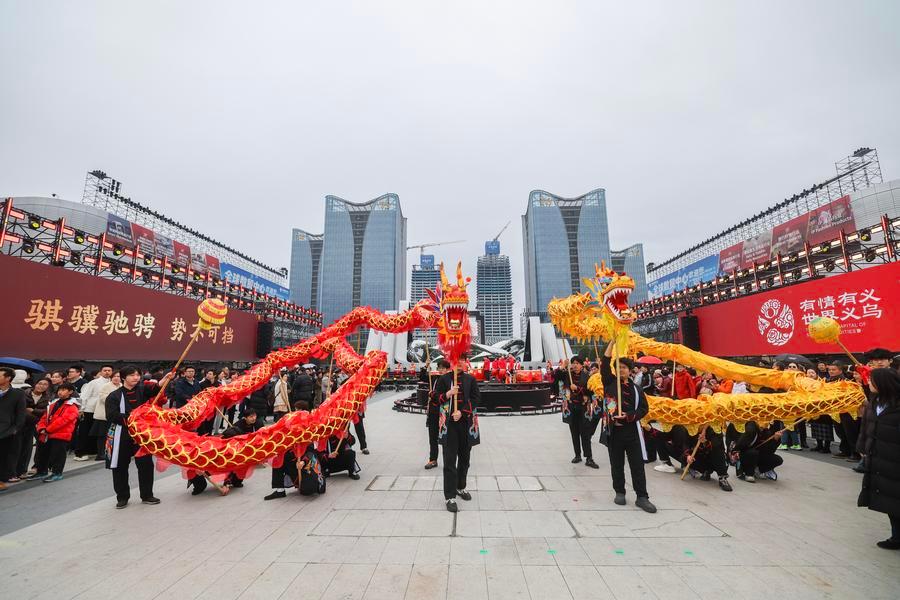
This photo taken on Feb. 28, 2026 shows a dragon dance performance at the Global Digital Trade Center in Yiwu, east China's Zhejiang Province. (Photo: Xinhua/Xu Yu)
The Yiwu Global Digital Trade Center, a landmark project in the construction of the sixth-generation market in Yiwu city — known as "the world's supermarket" — in east China's Zhejiang Province, marks a major step forward in the shift from traditional trade to a fully integrated digital trade ecosystem.
Yiwu's market has undergone multiple rounds of transformation, growing from a humble roadside market into a modern international trade hub — hence the current sixth-generation designation.
Spanning a construction area of 1.25 million square meters, the center brings together five functional zones: marketplaces, office buildings, commercial districts, apartments and a digital trade port.
"The experience of running a store at the center is great — the environment is much better and the stores are more spacious," said Chen Meijun, general manager of Yiwu Litian Toy Co., Ltd., who has also secured office space at the center.
"I display and sell products on the lower floor and handle negotiation and design upstairs — I no longer have to shuttle between my store, showroom and factory," Chen said.
The center's marketplace zone focuses on emerging sectors, including smart equipment, trendy toys, fashion and jewelry, in line with new global consumer trends.
"This time, the layout adjustments of Yiwu's market are about refining and strengthening existing industries — advancing their segmentation and upgrading, and promoting more high-end, IP-driven and internationalized development," said Zhu Xingping, deputy general manager of the center.
The smart equipment section has attracted nearly 200 leading domestic enterprises, with products ranging from smart drones to unmanned equipment. This concentration of companies has become a major draw for firms seeking a springboard into overseas markets.
The center has also introduced a new model in which products are organized by consumer theme, such as fashion or maternity and baby goods, making it easier for buyers to find everything they need in one place.
Zhu noted that rising living standards have made buyers increasingly attentive to the shopping environment and value for money, rather than simply engaging in a price war. That shift, he said, is one of the key forces behind Yiwu's latest upgrade.
Data shows that 52 percent of merchants at the center are young second-generation business owners, heirs to families who built their enterprises during an earlier stage of Yiwu's rise. Approaching commerce with a mindset and methods distinct from those of their parents, this new generation is quietly reshaping the market.
Among them is Ji Ruixin, a shop owner born after 1995 who runs a silver jewelry store at the center. Her family has been in the jewelry trade for over 30 years, but she has little interest in her predecessors' bulk-wholesale model. Instead, she blends traditional ethnic craftsmanship with contemporary fashion, focusing on distinctive, handcrafted pieces that resonate with younger consumers.
"The older generation valued orderliness, but I prefer designing irregular-shaped pieces — I want to create a style of my own," she said.
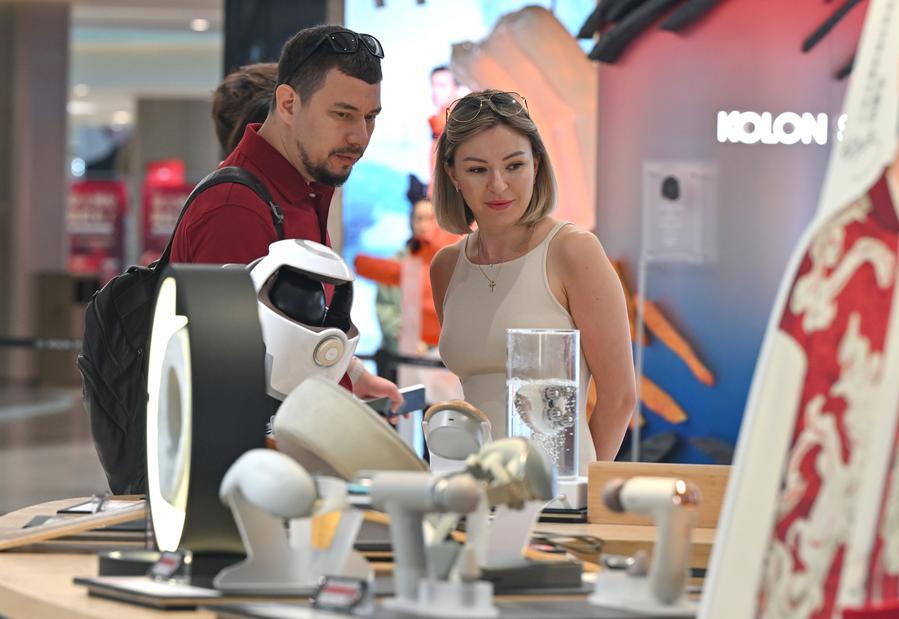
Foreign customers shop at a duty-free shopping mall in Sanya, south China's Hainan Province, Nov. 9, 2025. (Photo: Xinhua/Guo Cheng)
The approach has paid off. Ji now showcases more than 4,000 original designs and has taken her pieces to fashion weeks while venturing into overseas markets.
"In the past, we often had to go to Japan, South Korea, Europe or the U.S. to chase trends. Now, by tracking how foreign buyers shop in Yiwu, we can use our own designs to shape market trends," she said, adding that the local market has become a new trendsetter in the global accessories industry.
Beyond innovation in product design, young merchants have launched livestreams and created short videos to attract overseas buyers.
The steady flow of orders owes much to the center's digital trade ecosystem. Ji said AI tools have transformed her workflow.
"In the past, seven or eight designers together would produce about 100 new styles a month on average. Now, with AI assistance, our store launches around 500 new styles a month at half the cost," she said.
The tool she relies on is the "World Yiwu" trade AI model, offered free of charge to merchants at the center. The model integrates AI design, multilingual translation and AI video creation, covering the full chain from design and production to marketing and deal-closing.
The "World Yiwu" model currently features 14 AI-driven applications across six major use cases, with cumulative usage exceeding 1 billion calls, Zhu said.
Beyond AI, digital service platforms and smart devices have further streamlined cross-border transactions at the center. For example, the "Yiwu Pay" platform facilitates cross-border payments.
"We will bring our services and resources together to support merchants throughout the process of going global, extending the benefits of trade digitalization to more merchants and helping them better connect with overseas markets," Zhu said.