


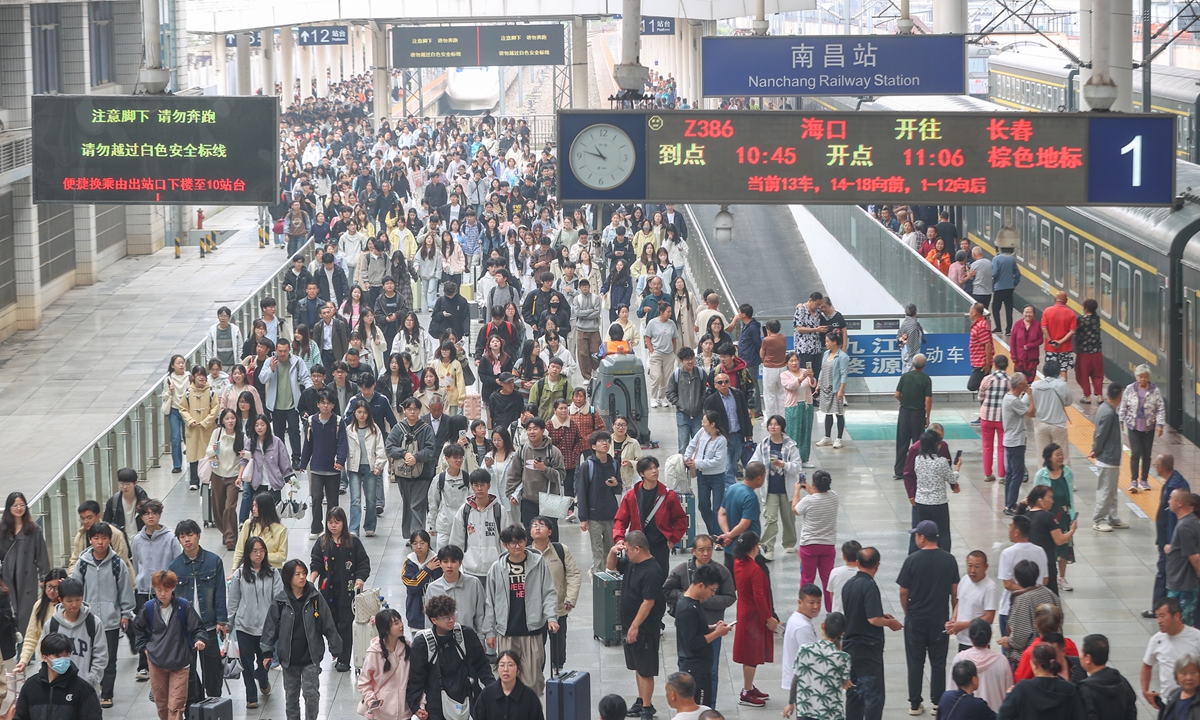
Passengers walk along a platform at a railway station in Nanchang, East China’s Jiangxi Province, on April 4, 2026. Photo: VCG
On the first day of the Qingming Festival holiday, a sharp rise in tourist flows highlighted strong demand for cultural and tourism consumption, with total cross-regional trips estimated at about 296 million on Saturday, up 2.7 percent year-on-year, according to state broadcaster CCTV News, citing data from the Ministry of Transport.
Passenger traffic remained strong across the country’s major transport networks, pointing to solid mobility demand and a brisk start to the holiday travel period, a Chinese expert said.
In the breakdown, railway passenger volume is expected to reach 21.9 million trips; highway passenger traffic volume to be about 270.74 million person-times; waterway passenger volume is estimated to reach 1.353 million person-times, up 11.7 percent year-on-year, and civil aviation passenger volume is likely to reach 1.92 million, the data showed.
Additionally, China State Railway Group Co, the nation’s passenger train operator, said in a statement to the Global Times on Saturday that the national railway network is expected to handle 21.9 million passenger trips, with 1,173 additional passenger trains scheduled.
As of 8 a.m. on Saturday, China’s railway ticketing platform 12306 had cumulatively sold 61.25 million train tickets for the Qingming Festival holiday, according to the statement.
Transport authorities attributed the notable rise in cross-regional trips to the overlap this year between the Qingming Festival holiday and students’ spring break.
During the holiday, the average daily traffic volume on national highways will reach approximately 61 million vehicles, with an increase of about 3 percent year-on-year.
In addition, several travel hotspots also released their first-day holiday travel figures, pointing to strong mobility momentum.
Railways in the Yangtze River Delta are expected to handle 4.55 million passenger trips that day, potentially setting a new single-day record, up 360,000 from the same period last year, an increase of 8.6 percent, China Media Group reported on Saturday.
China Railway Wuhan Bureau Group Co is expected to add 214 originating passenger trains on Saturday and handle about 1.05 million passenger trips, both record highs for the same period, Changjiang Daily Press Group reported on Saturday. Hankou Station in Hankou, Central China's Hubei Province, is also expected to handle about 205,000 passenger trips, also a record high for the same period.
Reports also showed that a considerable number of travelers on the road before the Qingming Festival holiday officially began.
Travel demand was already heating up on Friday, when the railway network handled 18.252 million passenger trips, with transport operations remaining safe, stable and orderly, according to China State Railway Group Co.
The film market is also bracing for a busy holiday season.
According to data from online platforms, as of 12:53 PM on Saturday, the box office for new films released during the 2026 Qingming Festival holiday has exceeded 100 million yuan ($14.52 million).
The top three films at the box office are: "It's OK," "The Super Mario Bros. Movie 2," and "Now I Met Her."
The large-scale holiday travel directly boosts “hard” demand in areas such as transportation, accommodation and dining, and with consumption playing a more prominent role in China’s economic policy agenda, the holiday effect is becoming an increasingly important driver of spending, Bian Yongzu, executive deputy editor-in-chief of Modernization of Management magazine, told the Global Times on Saturday.
He added that policy support should go beyond improving basic services such as transport and lodging, and place greater emphasis on details and the supply side by providing more targeted and diversified products and services tailored to public sentiment, evolving social trends and the preferences of different consumer groups.
Only by better matching consumer demand can holiday travel be more effectively converted into actual spending and the potential of the holiday economy be further unlocked, he said.