


BEIJING, April 5 (Xinhua) -- On the first day of the spring break, eight-year-old Wang Siyuan could hardly contain his excitement as he ran into a science museum in the eastern Chinese city of Hefei.
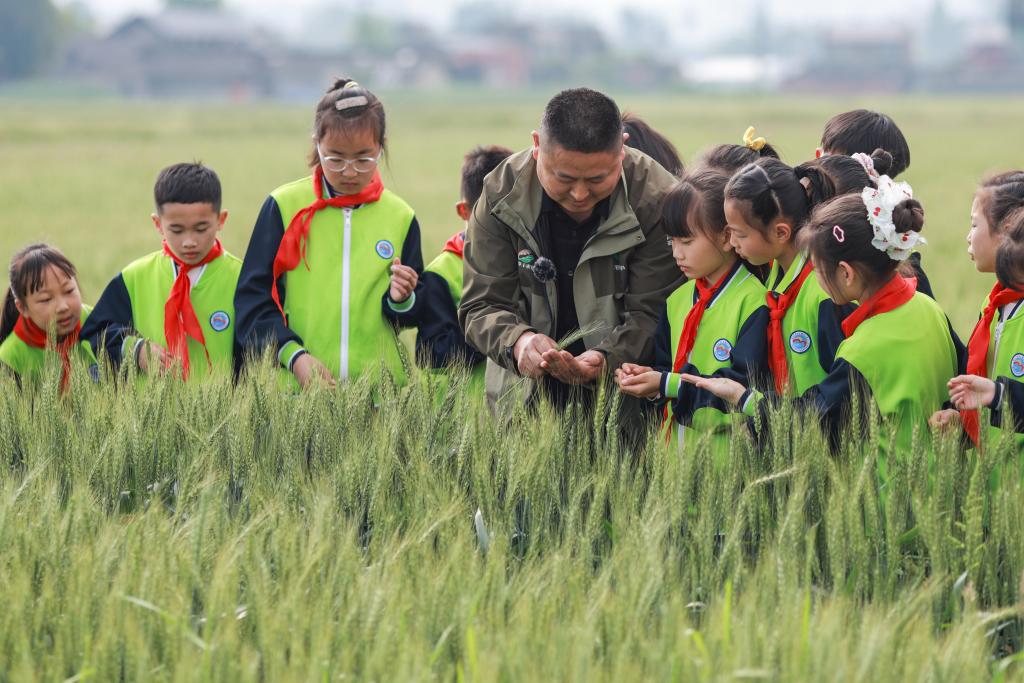
Students visit a grain and edible oil production base during the spring break in Meishan City, southwest China's Sichuan Province, April 1, 2026. (Photo: Xinhua)
"It feels like we're walking in space," he shouted, tugging at his parents as he rushed toward an interactive exhibit.
The outing had long been on his wishlist. "He's been talking about coming here for days," his father said. "Now that the spring break has started, his wish has finally come true."
Across China, primary and secondary schools in several regions have introduced a new spring break, often timed around the three-day Qingming Festival in early April or the five-day May Day holiday, allowing more children like Wang to combine time off into six to eight-day vacations.
Following earlier pilots in provinces such as Zhejiang and Sichuan, more regions -- including Jiangsu, Anhui, Shandong, Hunan and Guizhou -- have joined this year, pushing the policy toward wider adoption.
"So far this year, nearly 100 cities from more than a dozen provincial-level regions have introduced spring breaks," said Ma Liang, a professor at the School of Government, Peking University. He added that the arrangements vary depending on local conditions such as climate, academic schedules and prior consultation with parents.
Unlike traditional school holidays, the spring break comes with fewer written assignments. Instead, schools are encouraging practical experiences and family interaction.
"We don't assign written homework to first and second-grade students, and we strictly control the workload for others," said Hou Xiaolei, principal of a primary school in Zhenjiang, Jiangsu Province. "We want children to experience the beauty of the season firsthand."
Local governments are also rolling out a wide range of educational and cultural programs. In Sichuan, authorities have curated more than 100 study-tour routes, while in Nanjing, Jiangsu, over 100 activities -- from nature exploration to industrial technology and cultural heritage -- are on offer.
In Hefei, Anhui Province, children can visit research centers to learn about cutting-edge technologies such as "artificial minisun", quantum science and smart factories.
The idea of spring and autumn breaks for primary and secondary schools first emerged in Hangzhou, capital of Zhejiang. As early as 2004, the city took the lead in piloting the system, which was later expanded across the province.
At the outset, the policy sparked debate. Supporters argued that such breaks allow students to gain hands-on knowledge beyond textbooks, promote physical and mental well-being, and stimulate consumption. Critics, however, voiced concerns over reduced classroom time and increased childcare pressure, especially for dual-income families.
In recent years, with the implementation of the "double reduction" policy aimed at easing academic burdens, calls for more flexible school schedules have grown louder.
This year, the idea gained further momentum after being included for the first time in the government work report, which calls for spring and autumn holidays for primary and secondary school students in localities where conditions permit.
Authorities have also moved to address the mismatch between children's holidays and parents' work schedules. In some regions, employers are encouraged to grant leave to workers with school-age children, while schools and local governments are offering free childcare services and supervised activities for families in need.
Some companies have gone further. A machinery firm in Kunshan, Jiangsu, recently introduced a three-day paid spring break for employees, encouraging them to spend time with their children or simply relax and enjoy the season.
The new holiday is also driving travel demand. Zhang Aiping, an associate professor at Yangzhou University, said that the spring break not only refreshes the mind and body but also serves as a growth driver for consumption.
Yang Han, a researcher at travel platform Qunar's big data research institute, said that the alignment of spring breaks with the Qingming holiday has effectively boosted domestic demand, with cities that have actively adopted the break not only seeing more travelers heading to other destinations but also attracting visitors through supportive policies, helping energize local tourism markets.
Data from travel platforms show a sharp rise in family trips, with parent-child travel accounting for nearly a quarter of the bookings during the Qingming holiday. Popular destinations include major cities such as Shanghai, Beijing and Guangzhou, as well as resort areas like Sanya, while bookings for theme parks, museums, zoos and science centers have also surged.
Experts believe that the focus of spring travel is shifting from simply viewing scenery to immersive experiences, with themed and personalized tourism expected to lead the trend.
For educators, the impact goes beyond tourism. Gao Jinfeng, a primary school principal in Jiangsu, said that the spring break opens a window for "learning beyond the classroom."
"We hope the break will give students time to relax, broaden their horizons and recharge, helping them grow in a healthy and balanced way," she said.