


This year's Qingming Festival holiday has been more than a traditional period of remembrance for the Chinese. It has served to test China's newest economic lever.
Several provinces and municipalities aligned the Qingming Festival holiday with the spring break this year. The concept of spring breaks for primary and secondary students first emerged in Hangzhou in 2004. This year's government work report, for the first time, called for introducing such breaks where conditions permit—elevating the policy from local trials to a national guideline. Now, promoted across eight provincial-level regions, spring breaks featuring varying holiday durations have ignited a significant targeted consumption surge.
Family travel has rapidly emerged as the primary driver of this trend, with the travel agency Tongcheng Travel reporting that family-related bookings accounted for nearly 40% of all holiday products between April 1 and April 6—a sharp increase from 23% the previous year. This cohort saw a nearly 200% year-on-year increase in bookings, led by the Yangtze River Delta region. The shift is particularly visible among teenagers. Data from Qunar Travel, another travel platform, shows that 2.7 times more children aged 13 to 18 traveled with their parents during this period and collected their "life's first air ticket."
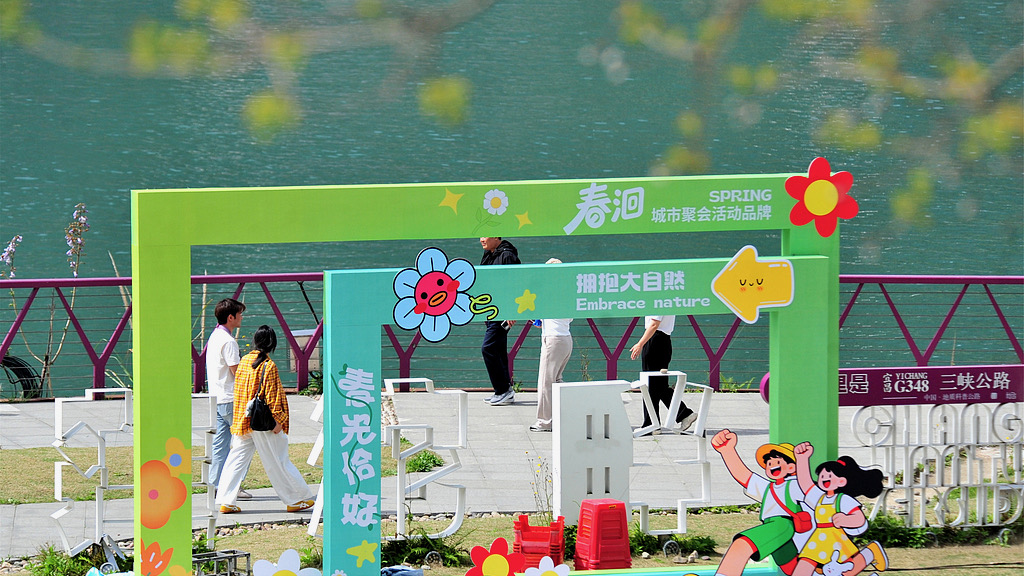
Tourists take boat tours along the Yangtze Gorges in Yichang to soak in the spring scenery, April 4, 2026. /VCG
Zheshang Securities predicted that a full nationwide spring and autumn breaks rollout to cash-in on this emerging "time dividend" may inject up to 103.9 billion yuan ($15.1 billion) into China's GDP, with even conservative scenarios yielding between 23 billion and 46.6 billion yuan in new economic activity.
This year's "spring break plus Qingming Festival holiday" model tested several contributing factors, such as workplace flexibility, academic relief, and transport readiness, to unlock the potential market.
To solve the perennial "parent-child schedule gap," local governments in Jiangsu Province, Zhejiang Province, and Anhui Province urged employers to prioritize leave requests from working parents and support their flexible working hours. In the meantime, educators took steps to ensure the break was used for exploration rather than rote learning. Schools in Zhejiang Province, Sichuan Province, and Shandong Province called for "no homework during breaks," while provinces such as Guangdong Province and Jiangsu Province strictly prohibited extra-curricular tutoring during the period. These efforts were bolstered by the railway operator of the Yangtze River Delta region, which proactively boosted capacity to handle a record 4.7 million passenger trips on April 4—the day connecting the spring break to the Qingming Festival.
With China's average annual days off now at a historic peak of 117, the policy focus has shifted from the quantity of rest to the quality and timing of leisure. By leveraging the "spring/autumn break" model, China is effectively creating a new consumption cycle with minimal disruption to current workflows and, hopefully, a maximized sense of well-being for its labor force.