


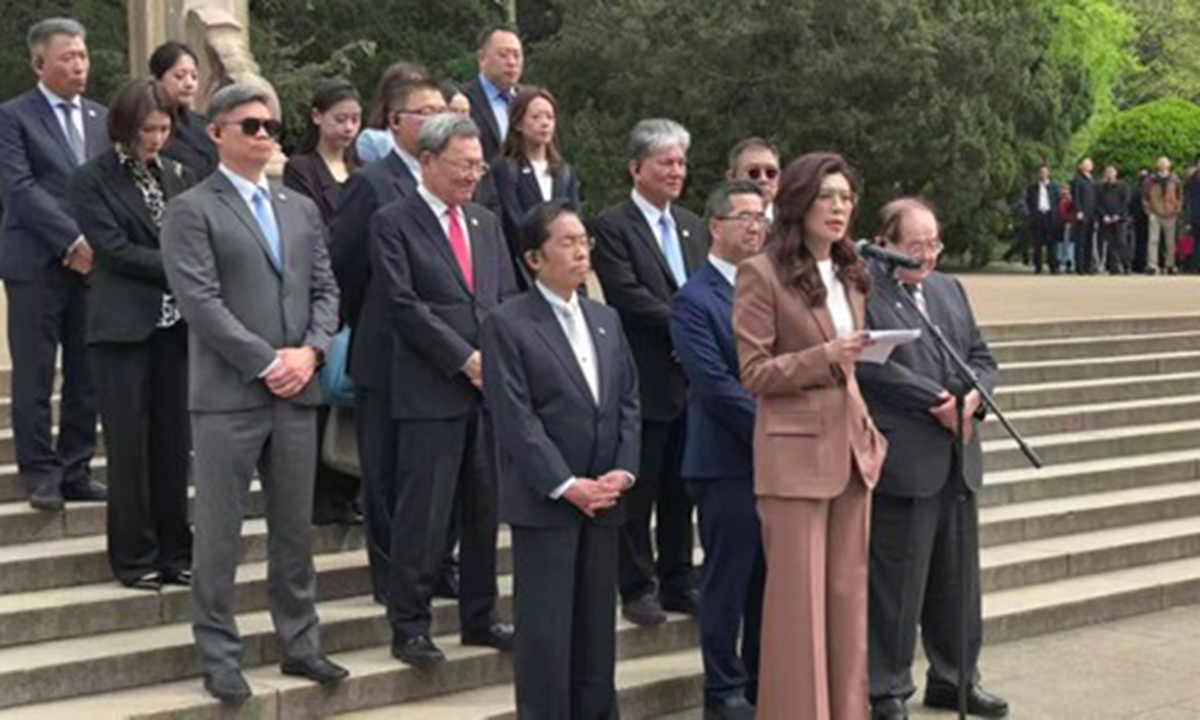
Cheng Li-wun, chairwoman of the Chinese Kuomintang (KMT), delivers a speech during a visit to the Sun Yat-sen Mausoleum in Nanjing, East China's Jiangsu Province, on April 8, 2026, as she leads a KMT delegation to pay homage. (Photo: People's Daily)
Cheng Li-wun, chairwoman of the Chinese Kuomintang (KMT) party, led a KMT delegation on Wednesday morning to pay homage to the Sun Yat-sen Mausoleum in Nanjing, capital of East China's Jiangsu Province, according to the Xinhua News Agency.
The mausoleum lies in the eastern suburbs of Nanjing. Sun Yat-sen, a founding figure of the KMT and a revered revolutionary leader who played a pivotal role in overthrowing imperial rule in China, died in 1925. His remains were buried here in 1929, Xinhua reported.
"Today, after 21 years, I returned to Sun Yat-sen Mausoleum, and my heart is filled with countless emotions," Cheng said in a speech lasted about 18 minutes at the Sun Yat-sen Mausoleum, according to a video of the visit published by Taiwan media United Daily News (UDN) on its YouTube channel on Wednesday.
Twenty-one years ago, in early 2005, cross-Straits relations were extremely tense, and then chairperson of the KMT Lien Chan hoped to represent the mainstream public opinion in Taiwan and break the ice between the two sides, Cheng noted, adding that she was deeply moved by this, and at Lien's invitation, formally joined the KMT and served as a spokesperson, according to the video.
Cheng arrived in Shanghai on Tuesday. The visit, which covers Jiangsu, Shanghai and Beijing, will run through Sunday, according to Xinhua.
Cheng's trip marks the first time in a decade that a KMT chairperson has led a delegation to the Chinese mainland. The visit is regarded as an important part of the exchanges and dialogue between the KMT and the Communist Party of China under the new circumstances. Paying homage to the mausoleum has long been an important part of KMT chairpersons' visits to the mainland, per Xinhua.
Such an arrangement itself embodies the historical memory of the development of cross-Straits relations, Zheng Jian, a professor of Taiwan studies at Xiamen University, told the Global Times.
Both sides of the Taiwan Straits belong to one China. People on both sides are Chinese and part of one family. Affairs across the Straits are family matters of compatriots on both sides and should naturally be discussed and resolved by members of the family themselves. Our compatriots on both sides have sufficient wisdom and ability to properly handle their own issues, Zhu Fenglian, a spokesperson for the State Council Taiwan Affairs Office, said on Wednesday when asked to comment on Cheng's visit to the mainland.
We are willing, on the common political foundation of adhering to the 1992 Consensus and opposing "Taiwan independence," to work together with all political parties, organizations, and individuals in Taiwan island, including the KMT, to promote the peaceful development of cross-Straits relations, seek peace in the Taiwan Straits, bring well-being to our compatriots, and achieve national rejuvenation, Zhu said.