


Chinese scientists breed rice that resists disease without yield loss
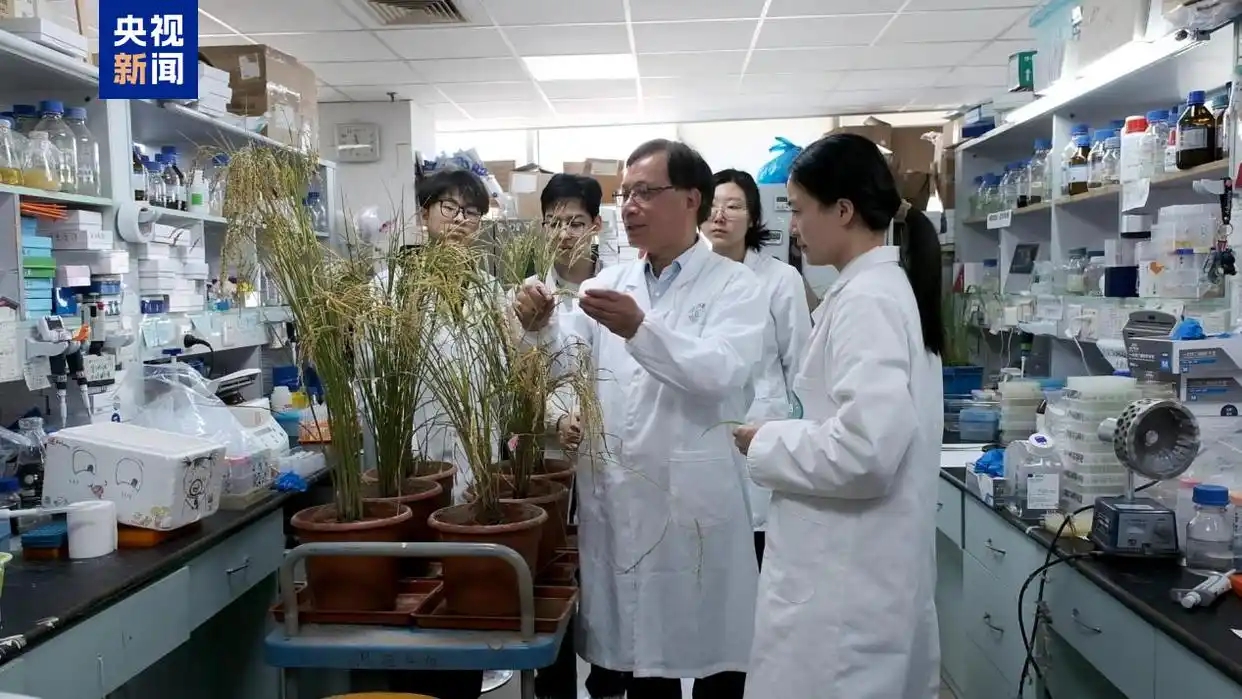
The research team conducts rice disease-resistance breeding research. (Photo: CMG)
Chinese researchers have made a breakthrough for global food security by breeding a new strain of rice that resists disease without sacrificing yield.
In recent years, rice bacterial blight has resurged due to global warming and limited resistance sources, threatening stable rice production. To tackle this, a team led by He Zuhua from the Center for Excellence in Molecular Plant Sciences at the Chinese Academy of Sciences, in collaboration with Shanghai Jiao Tong University, Zhejiang University, and Shanghai Normal University, successfully cloned a broad-spectrum disease-resistance gene, Xa48, and clarified how rice resistance evolves over long-term cultivation. The study was published on Wednesday in the journal Nature.
Bacterial blight can reduce rice yields by 20-50%. Traditionally, indica rice grown in southern China is more resistant, while northern japonica rice is highly susceptible, yet, until now, the genetic reasons remained unclear. By screening thousands of rice varieties, the team identified Xa48 in an indica variety called Shuangkezao. Xa48 produces a "recognition protein" that accurately detects and combats bacterial blight strains common in Northeast Asia.
The researchers then combined Xa48 with another resistance gene, Xa21, to achieve broad-spectrum resistance similar to wild rice, overcoming the traditional trade-off between disease resistance and high yield. Field trials showed that the new varieties maintained stable resistance even after typhoons and floods, without reducing yield. This is the first study to demonstrate that the stacking of Xa48 and Xa21 can expand resistance range while preserving high productivity.
The breakthrough is already being applied to develop new rice varieties across China and offers critical technological support for green pest management and national food security.