


New Zealand is closely watching China's economic trajectory and the opportunities created by further opening-up as Beijing begins its 15th Five-Year Plan (2026-30) period, New Zealand's Ambassador to China Jonathan Austin said, underscoring how directly China's performance affects his country's own economic outlook.
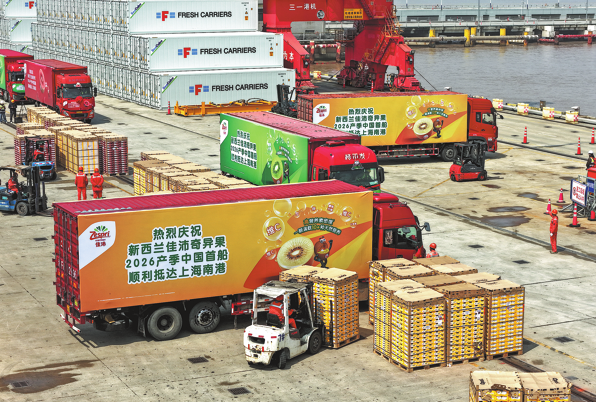
The vessel Kehuai carrying over 4,000 metric tons of New Zealand kiwifruit docks at Shanghai's Nangang terminal on March 30, marking this year's first direct kiwifruit shipment from New Zealand to China. (Photo: China Daily)
"China is New Zealand's largest trading partner. Twenty-five percent of our exports come to China," Austin said. "How well China performs has a direct impact on how well our economy performs."
He said Wellington studies China's five-year plans closely and is paying particular attention to the opportunities that may arise as the Chinese economy opens further. "We're interested in the opportunities that may come from further opening-up of the Chinese economy," he said.
Austin said New Zealand had benefited from China's development substantially over the past several decades. "I can say with my hand on my heart that New Zealand has been a major beneficiary of China's extraordinary economic rise," he said, adding that expanding trade with China helped his country weather the global financial crisis better than it otherwise might have.
New Zealand was the first developed country to sign a comprehensive free trade agreement with China in 2008, and brought an upgraded pact into force in 2022.
According to the Chinese Commerce Ministry, China has maintained its position as New Zealand's top trading partner, largest source of goods imports, and largest export market for 11 consecutive years.
Austin described current trade ties as stable and mutually beneficial, with Chinese consumers benefiting from New Zealand's high-quality products, especially agricultural goods, even as the trade mix evolves to include strong growth in "cosmetics and health supplements and even inputs into advanced manufacturing".
New Zealand, in turn, benefits from China's manufacturing strength, technological progress, and a wide range of affordable and increasingly sophisticated imports that support households, businesses and decarbonization efforts, he added.
Beyond trade
The bilateral relationship extends well beyond trade, with education, tourism, business links and family ties giving it greater depth and resilience, he noted. According to the ambassador, more than 27,000 Chinese students are currently studying in New Zealand, making China one of the country's most important sources of international students.
At the same time, Austin acknowledged that the two countries do not agree on every issue. "But mature relationships are not built on pretending that differences do not exist," he said, "but on the ability to discuss these differences openly, respectfully and constructively, while ensuring that they do not get in the way of cooperation where our interests align."
Looking beyond the bilateral relationship, Austin said New Zealand is concerned about a global environment in which international rules and norms are being undermined, economic relationships are being reassessed in a more contested setting, and market openness is becoming more constrained.
Against that backdrop, he said, New Zealand would continue to support multilateral and regional cooperation, including through Asia-Pacific Economic Cooperation.
APEC is a regional economic forum established in 1989 to leverage the growing interdependence of the Asia-Pacific. The 33rd APEC Economic Leaders' Meeting will be held in Shenzhen, China, in November.
"APEC, through open dialogue and best practice cooperation, plays a key role in shaping regional economic policy and upholding the multilateral rules-based trading system," Austin said.
In another development, the Speaker of the New Zealand House of Representatives Gerry Brownlee will lead a delegation to China from Sunday to Thursday.