


HOHHOT, April 11 (Xinhua) -- After years of technological innovation and investment, China has become the world's leading driver of robust growth in the renewable energy industry, demonstrating strong resilience amid the recent global oil market turmoil.
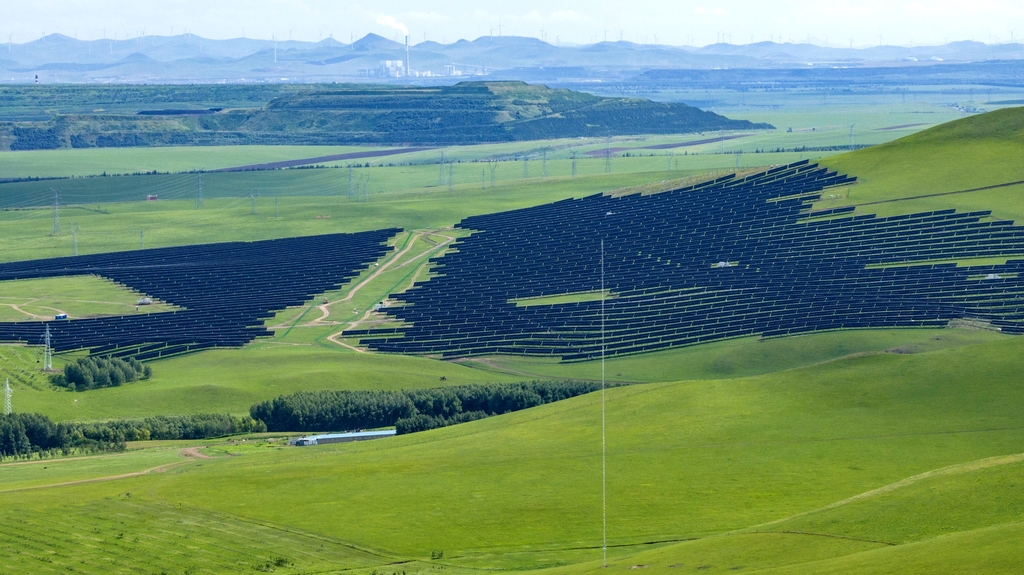
File photo: IC
Now, renewable energy is more than a substitute or backup for traditional energy in the country. From upgrading traditional industries to powering AI computing, green power is emerging as a brand-new production factor, helping China develop emerging and future industries.
In north China's Inner Mongolia Autonomous Region, where exploitable wind and solar energy resources account for about 57 percent and 21 percent of the national totals, the use of renewable energy has changed local industries, providing a microcosm of this green transformation.
TRANSFORMATION OF TRADITIONAL INDUSTRIES
For decades, Holingol in eastern Inner Mongolia has developed into a major aluminum industrial base in northern China, using abundant local coal and thermal power for aluminum smelting. However, electrolytic aluminum production consumes roughly 13,500 kWh per tonne, resulting in substantial carbon emissions.
Today, Holingol's rich wind resources, capable of generating power for up to 4,400 hours a year, are transformed into a stable industrial power supply through intelligent energy management systems.
The city generated some 6.5 billion kWh of green electricity in 2025, saving about 1.95 million tonnes of standard coal and reducing carbon emissions by 5 million tonnes. The cost of green power is only 0.15 to 0.18 yuan (about 0.02 U.S. dollars) per kWh.
The low-cost and stable power supply has attracted numerous enterprises, including an aluminum company from south China's Guangdong Province.
In the company's production workshops in Holingol, molten aluminum undergoes multiple processes before becoming aluminum foil rolls just 0.012 millimeters thick, a popular product for users from both home and abroad.
The company's administrative director, Wang Jue, attributed its relocation to Holingol's comprehensive advantages in energy, electricity pricing, raw materials, and industrial support.
The aluminum industry cluster in the city has formed a complete industrial chain from electrolytic aluminum to high-value-added products such as battery foil and automotive lightweight materials. In fact, energy-intensive industries powered by green electricity here no longer imply high carbon emissions, but represent green manufacturing.
Beyond Inner Mongolia, renewable-powered aluminum smelting is being promoted in regions rich in solar and wind power. China's 15th Five-Year Plan outline, released last month, also proposes an orderly transfer of qualified high-energy-consuming industries to areas rich in renewable energy resources.
SYNERGY WITH AI COMPUTING
Beyond transforming traditional industries, renewable energy is being harnessed to generate high-value computing power through data centers.
While some countries are challenged by the massive power consumption of artificial intelligence (AI), China is witnessing a synergy between green electricity and AI computing power, and the Horinger data center cluster in Hohhot, the capital city of Inner Mongolia, is one such demonstration project.
The cluster's electricity is mainly supplied by wind farms dozens of kilometers away, at a delivered price of roughly 0.36 yuan per kWh. The cluster comprises more than 50 data centers, the largest of which is the China Mobile Hohhot Data Center. About 88 percent of the power used by the center is green.
According to the center's deputy general manager Li Chenggui, the center boasts a computing power of 20,100 petaflops, including 16,700 petaflops of intelligent computing power.
"We provide server leasing, model training, and data storage services for more than 100 clients, supporting massive computing power demands in the Beijing-Tianjin-Hebei and Yangtze River Delta regions," Li said.
Xuanwu Intelligent Computing, headquartered in Beijing, has deployed a 30,000-GPU cloud rendering center in the Horinger cluster. AI training, big data analysis, and real-time rendering of online games performed by users in Beijing are all completed at Horinger.
"It takes over two hours by high-speed train to travel the nearly 500 kilometers from Hohhot to Beijing, but computing power crosses this distance in less than two milliseconds," said Xiao Liangpeng, general manager of the company.
Behind the Horinger cluster is the common practice of "electricity-computing synergy." China's data centers are built mostly in regions rich in green electricity, such as Inner Mongolia, Guizhou, Gansu and Ningxia. When cheap green electricity drives computing power, the value created can increase dozens to over 100 times, providing a new model for the deep integration of the digital economy and energy transition.
CONVERTING TO GREEN FUELS
Green energy is also upgrading the traditional fossil fuel system. Through sci-tech innovation, fluctuating green electricity is being converted into green fuels at scale, which can fit existing fuel storage and transportation systems.
In the city of Chifeng in Inner Mongolia, rows of wind turbines and solar panels generate electricity to power a nearby zero-carbon hydrogen industrial park. This is China's largest-scale green hydrogen and ammonia project to date.
Built and operated by Envision Energy, phase one of the project was officially commissioned in July 2025 and can produce 320,000 tonnes of green synthetic ammonia annually. It operates off the grid, with all energy supplied by green electricity.
According to Envision Energy's chief hydrogen engineer Zhang Jian, the renewable energy generation and chemical production in the project achieve intelligent responses within seconds through AI-powered systems, transforming unstable wind and solar resources into stable industrial electricity. Then the green power electrolyzes water to produce green hydrogen, which is used to synthesize green ammonia.
The project won the Energy Transition Changemakers award at the 28th session of the Conference of the Parties (COP28) and obtained two certifications from the International Sustainability and Carbon Certification system.
In February, the project sent the world's first shipment of green synthetic ammonia to the Republic of Korea.
The city of Ordos in Inner Mongolia is advancing another green fuel technology route. In a methanol demonstration project led by a local subsidiary of China Coal and the Dalian Institute of Chemical Physics (DICP) under the Chinese Academy of Sciences (CAS), wind and solar power are used to electrolyze water to produce green hydrogen, which then reacts with captured CO2 to synthesize green methanol.
According to Li Can from the DICP, also a CAS academician, the advantage of this technology route is that green methanol can use existing oil and gas storage and transportation facilities, at costs far lower than building new hydrogen pipeline networks.
The project is scheduled for commissioning this November. It will produce about 100,000 tonnes of green methanol annually and consume about 150,000 tonnes of CO2, providing a new carbon-reduction pathway for local coal chemical industries.
The country's 15th Five-Year Plan outline proposes extending the green hydrogen industry chain to green ammonia and methanol, which are widely used as low-carbon fuels and in the chemical industry. Such projects are being constructed and commissioned in Inner Mongolia, Xinjiang, Jilin and Heilongjiang.