


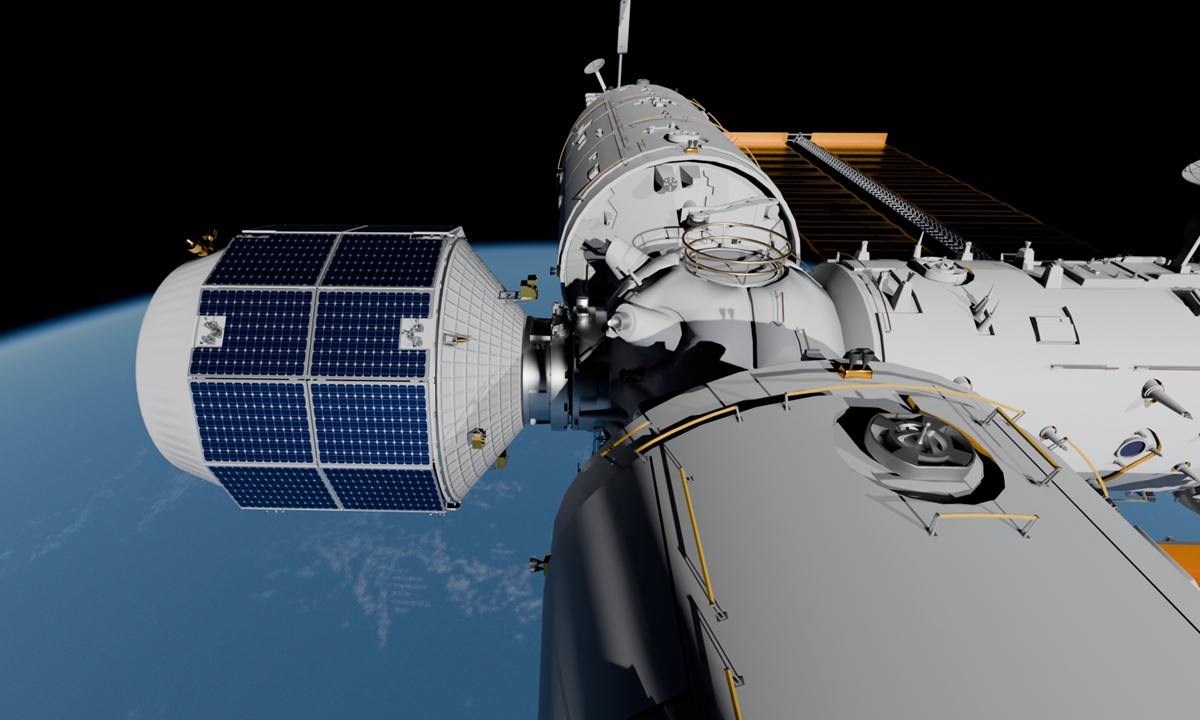
An illustration of future operation of Qingzhou cargo spacecraft, provided by its developer - Innovation Academy for Microsatellites of the Chinese Academy of Sciences. (Photo: Innovation Academy for Microsatellites of the Chinese Academy of Sciences)
China's Qingzhou experimental cargo spacecraft, which was successfully launched on March 30, released on Wednesday to the public its first batch of scientific and engineering experimental results. The spacecraft has successfully completed flight control tests, actively raised its orbit to 600 kilometers and officially entered the long-term operation phase, Global Times learned from the spacecraft's developer, Innovation Academy for Microsatellites (IAMCAS) of the Chinese Academy of Sciences.
The Shanghai-based academy announced Wednesday that this test flight focused on three main aspects - key technology verification, low-cost design exploration, and mission expansion. All predetermined objectives were successfully accomplished, laying a solid foundation for the subsequent formal development of the Qingzhou cargo spacecraft.
Per the academy, the entire spacecraft weighs 4.2 tons and carries one ton of scientific experimental payload. It is designed with a three-year on-orbit operational capability.
It is now systematically carrying out key technology verification of the flight platform as well as stability and expansion mission tests, the academy disclosed to the Global Times Wednesday.
The experimental spacecraft has achieved multiple breakthroughs in key platform technologies, said the academy. It adopts new technologies and processes in the design of its pressurized module, propulsion system, laser Inertial Measurement Unit, thermal control and environmental control systems and related products.
Its core design features autonomous proximity and safe departure for large-inertia spacecraft, long-term on-orbit residency capability, distributed integrated spacecraft management, and scalable energy systems.
While ensuring system reliability, these innovations have significantly reduced development costs, providing technical, development, and launch process validation
Further elaborating on test flights, the academy revealed that the spacecraft's universal payload platform enables "plug-and-play" integration of payloads. So far, six new technology payloads have completed testing, and experiments such as active vibration isolation and on-orbit metal manufacturing have achieved positive results, filling multiple technological gaps in related fields.
The Qingzhou experimental spacecraft began simultaneous concept demonstration and design in October 2024. The scheme was finalized in January 2025. After 11 months of development, it was successfully launched into orbit on March 30, 2026.
This test flight not only provides critical data support for the formal development of the cargo spacecraft and explores a new, efficient, and reliable development model, but also opens up a feasible path for low-cost, commercialized space operations and cooperation.
Looking ahead, the Qingzhou cargo spacecraft will continue to be optimized, striving to build a reliable bridge for cargo transportation between Earth and space, promoting the high-quality development of China's commercial space industry, and contributing to humanity's journey of exploring the universe, the academy noted.
The Qingzhou cargo spacecraft test vehicle will be followed by a final version that will dock with the China Space Station and provide cargo supply services, Xinhua News Agency reported on April 1, citing the academy.