


In a single county, there are dozens of active folk opera troupes. One rural troupe stages more than 300 performances a year and has over 2 million followers on video platforms - a sign of the growing popularity of Gezai Opera in Zhangpu county, Zhangzhou, East China's Fujian Province.
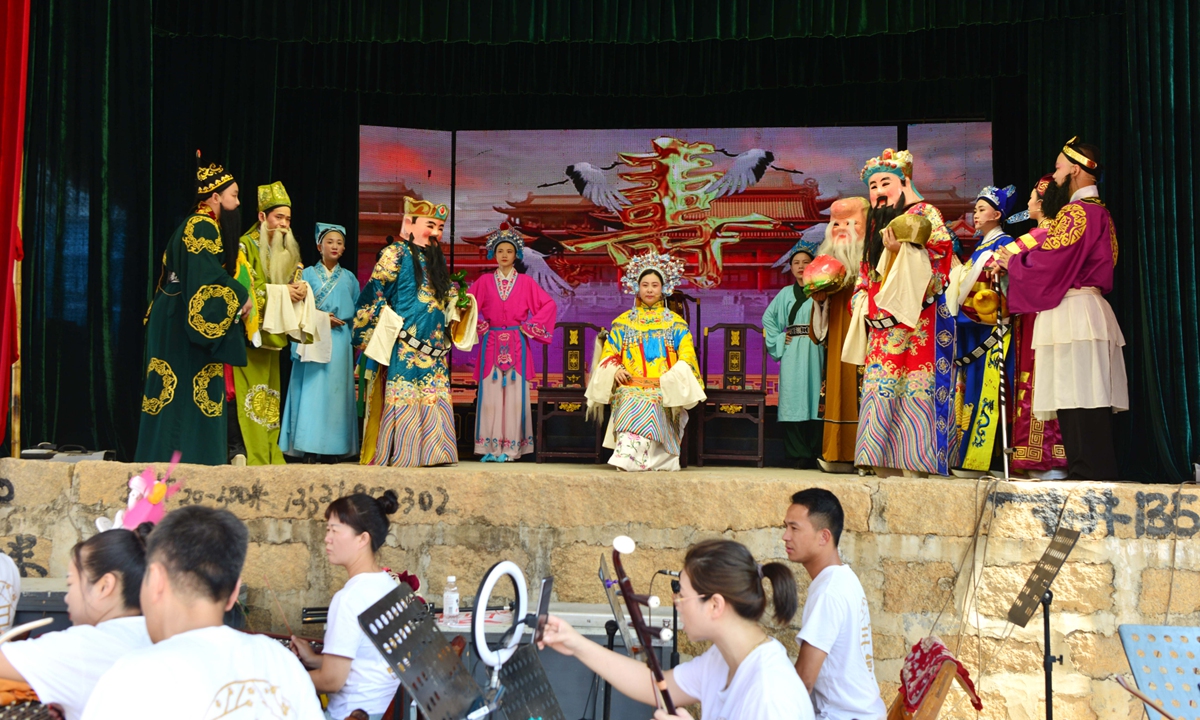
Gezai Opera, also known as Xiang Opera (Photo: VCG)
Gezai Opera, also known as Xiang Opera, is a traditional art form from southern Fujian. Along with Min Opera, Liyuan Opera, Gaojia Opera and Puxian Opera, it is considered one of the province's five major local operas and is listed as a national intangible cultural heritage.
How popular is it in Zhangpu's countryside?
"Rehearsal tonight!" After dinner, while it is still light out, 62-year-old Zhao Ahua, a villager of Chengnei village, the Huxi She Ethnic Township, calls on her neighbors to gather at the village square.
"We love watching opera. Wherever there's a show, we go. And we love performing too, so we formed our own troupe," she said.
In Zhangpu's rural areas, nearly every village has a stage. During festivals or family celebrations, it is common to invite a Gezai Opera troupe to perform.
In recent years, Gezai Opera has moved beyond villages and gained wider recognition.
Inside Yi'an Fort, a Qing Dynasty (1644-1911) Minnan (southern Fujian) residential castle, Cai Dongmei, a string puppetry folk artist and social media host with the Fenggui Culture Xiang Opera troupe, organizes her own "village gala." Against a backdrop of traditional southern Fujian architecture, string puppets leap and spin in her hands as she sings Gezai Opera melodies. One livestream drew 1.69 million views, bringing newfound attention to the once-quiet village.
"In the past two years, more enthusiasts of traditional architecture and folk culture have come to visit," said Chengnei villager Huang Hongwei. Sensing the growing interest, he opened a travel photography shop in August 2025 and began running a social media account highlighting rural life.
In February, Chengnei village hosted a farmers' cultural gala. Cai and Zhao's troupes were invited to perform, drawing an audience of more than 1,000. "Good shows are for everyone to enjoy," said Wang Lichao, a publicity official of the Party committee of the Huxi She Ethnic Township. During traditional festivals like the Spring Festival and Chongyang Festival, the area hosts "village galas," enriching residents' cultural life and boosting tourism, according to Wang.
The steady run of performances provides more stages for folk artists.
"We're performing almost every day across different towns, and some holiday bookings are already scheduled through 2028," Cai said. As her reputation has grown thanks to Gezai Opera, so have her opportunities. The three troupes she organizes or participates in now employ more than 100 performers.
On Saturday, in the nearby Zhaojiacheng village, troupe leader Yang Wangtai led a performance of the classic opera The Sequel to Meng Lijun. "We stage more than 100 performances a year, supporting over 20 cast and crew members. More than 10 of those I trained are from my own village."
Yang is from Dabaishi village, Zhangpu county. He founded the troupe in 2014 and has trained many Gezai Opera performers in his home village.
According to Yang Chengliang, a Party branch committee member of Dabaishi village, the village has established four Gezai Opera folk troupes, directly creating jobs for around 40 residents.
To encourage higher performance standards among folk troupes, Zhangpu county supports the creation of quality productions through measures such as purchasing public-interest performances.
"We also organize opera competitions such as the "Top 10 Folk Art Troupes" and host festival "village galas," giving folk troupes ample opportunities to perform and expand their markets," said Lin Qun, head of the social cultural arts division of the Zhangpu County Culture, Sports and Tourism Bureau.
With the resounding beat of gongs and drums and graceful melodies, Gezai Opera on rural stages, honed over generations, carries an increasingly rich Minnan flavor.
The article was originally published on the People's Daily on April 15, 2026.
(Source: Global Times)