


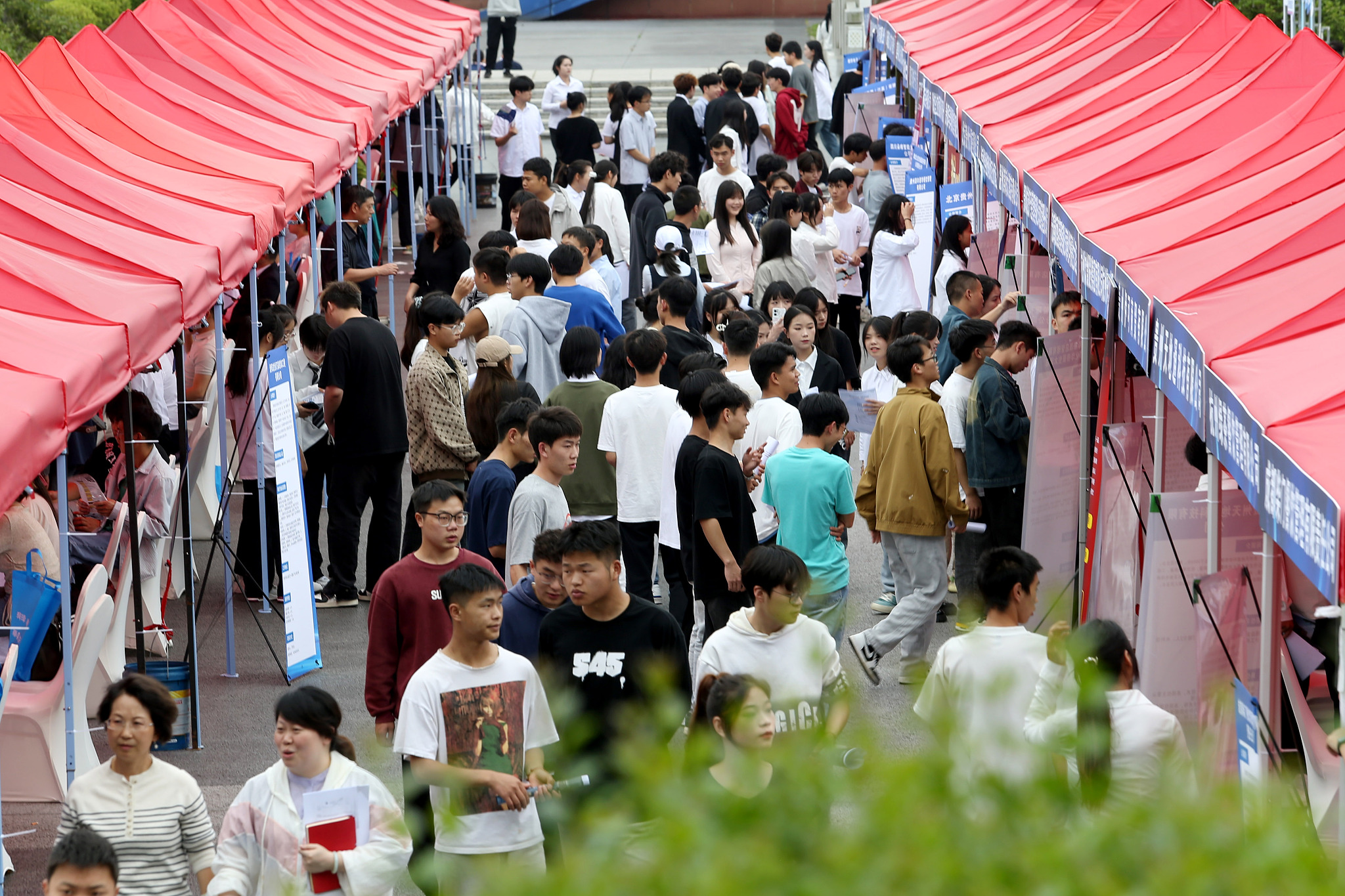
College graduates seeking jobs at a campus job fair, Guizhou Province, June 6, 2024. (Photo: CFP)
Around 80 percent of mid — to high-net-worth parents in China are concerned about the impact of artificial intelligence on their children's future employment, but only about a quarter have taken concrete action, according to a survey.
According to sociologists, as AI evolves from an auxiliary tool into a core driver of productivity, it is fundamentally reshaping traditional education systems and job markets. The long-held belief that attending a good school and choosing a good major will secure a good job is being challenged.
In the AI era, families' anxieties are shifting from education to career planning and life trajectories. However, a gap remains between awareness and action for most families.
The report, released in early April by the Fudan International School of Finance, is based on data from 1,900 mid — to high-net-worth families on the Chinese mainland, Hong Kong and Macao. It found that about half of the families have preliminary ideas on how to respond to AI's impact on employment but have not implemented any measures, while more than 20 percent said they do not know how to begin preparing.
When asked which jobs AI is most likely to replace, more than three-quarters of respondents pointed to operational and production roles, including factory workers, technicians and drivers. About 73 percent said sales, marketing and customer service jobs are also at high risk. Even in professional fields such as engineering, accounting and legal consulting, nearly 37 percent of parents believe AI will have a significant impact.
In response, some parents said they no longer view admission to a top university as the number one goal. Instead, they are placing greater emphasis on developing their children's overall abilities and resilience.
Zhuang Yuan, a mother of a 10-year-old in Shanghai, said she believes many repetitive and standardized jobs will be replaced by AI. She therefore focuses on cultivating her child's character and skills such as communication, teamwork and independent problem-solving — areas that are difficult for AI to replicate.
For Ni Wenwen, a mother of a 12-year-old girl, the realization that her child needs skills that differentiate humans from machines has prompted changes at home. From the beginning of the current semester, her child has been riding a bicycle to and from school alone, a journey of more than 2 kilometers.
"For my child, going home alone means assessing road conditions, taking responsibility for her own safety and managing her time," Ni said. She added that working in the advertising industry has made her more aware of the pressures AI is bringing, prompting her to rethink how to prepare her child for the future.
"Communication skills and the ability to solve real-world problems are not things children can learn through exams. They are developed through experiences like this," she said.
The Fudan report reflects this shift. About 60 percent of families now prioritize soft skills — including character building, interpersonal communication and problem-solving — compared with 43 percent who prioritize admission to prestigious universities. Meanwhile, about half of the surveyed parents said they focus on building social networks and ensuring stable income support for their children.
The definition of success is also evolving. About two-thirds of families now prioritize economic independence and a comfortable lifestyle, while 45 percent value career success and 30 percent emphasize high academic achievement. Families also increasingly value global perspectives and the ability to contribute positively to society.
Sociologists and education experts noted that future-oriented education should not produce individuals who function as passive tools in the AI era. Instead, it should cultivate people who can harness technology, create meaning in uncertain environments and retain strong emotional awareness.
"Families should focus on helping children develop the ability to adapt to changes and maintain a stable mindset in an era of profound transformation, where there is no single optimal path," said Zhao Zizi, a senior middle school teacher in Shanghai's Xuhui district with nearly three decades of experience.