


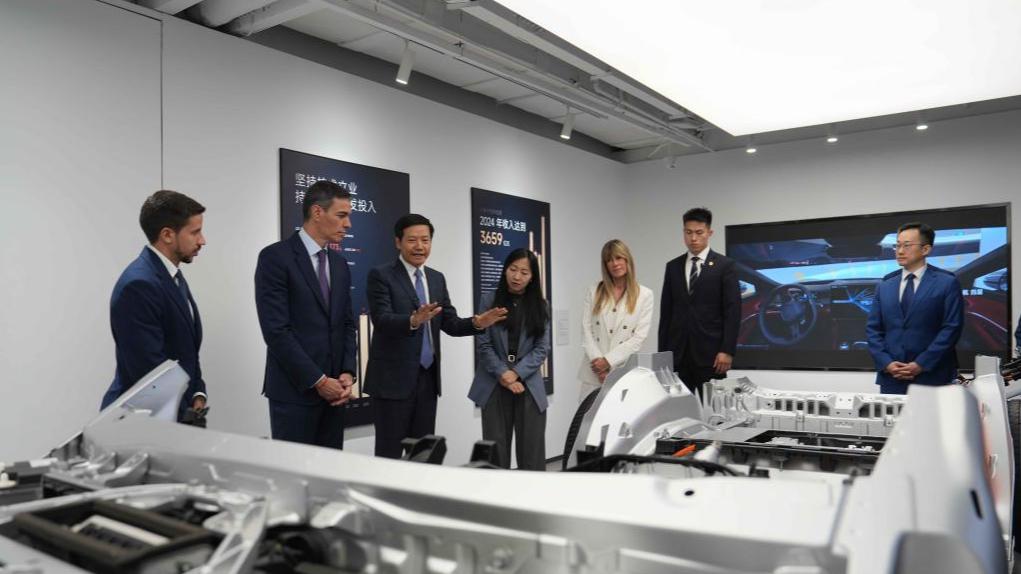
Spanish Prime Minister Pedro Sanchez visits the headquarters of Chinese tech firm Xiaomi in Beijing, capital of China, April 13, 2026. (Photo: Xinhua)
Chinese President Xi Jinping met with Spanish Prime Minister Pedro Sanchez on Tuesday in Beijing, with both sides reaffirming political trust and outlining a forward-looking agenda for cooperation in trade, green development and emerging industries.
The meeting comes as China continues to advance high-level opening up and Europe places renewed emphasis on sustainable growth and industrial transformation. Against that backdrop, the two countries are positioning their partnership as both stable and evolving.
A political foundation built on continuity and alignment
Xi called for placing China-Spain relations "at the forefront" of each side's foreign policy priorities, emphasizing mutual support on sovereignty and long-term strategic cooperation. Sanchez reaffirmed Spain's adherence to the one-China principle and described bilateral ties as guided by "strategic resolve," underscoring the consistency of Spain's China policy.
Both leaders also framed their relationship within a broader global context. Xi called for safeguarding the international system with the United Nations at its core and promoting an inclusive form of economic globalization.
Sanchez echoed the importance of multilateralism and explicitly rejected a "new Cold War" mentality, as well as attempts to decouple or sever global supply chains. He stressed that stronger communication, mutual understanding and cooperation between Europe and China serve the common interests of both sides and contribute to global stability and development.
Cooperation expands from trade to next-generation sectors
Beyond political alignment, the meeting pointed to a broadening cooperation agenda.
According to Madrid, the visit includes a package of agreements covering economic cooperation, market access and sectoral collaboration, alongside additional arrangements in science, education and cultural exchange. These agreements aim to facilitate trade flows, support business connectivity and deepen institutional ties.
Trade remains a central pillar. China is one of the European Union's largest trading partners, with bilateral trade reaching hundreds of billions of euros annually, providing a strong foundation for continued engagement. Spain has also seen steady growth in exports to China in recent years, supported by improved market access and sector-specific agreements.
At the same time, both sides are clearly looking ahead.
Xi highlighted cooperation in new energy and the intelligent economy, linking these areas to China's broader push for innovation-driven development. These sectors also align closely with Europe's priorities. The EU has committed to achieving climate neutrality by 2050, with sustained investment in renewable energy, green technologies and industrial upgrading.
This overlap creates a natural platform for cooperation, one that moves beyond traditional trade and into areas shaping long-term economic transformation.
People-to-people exchanges were also emphasized, including cooperation in education, research and culture. While less visible than economic agreements, these channels continue to underpin the relationship, providing continuity and supporting deeper engagement over time.
A steady partnership in a changing global landscape
The significance of the visit lies not in a single announcement, but in the broader direction it reinforces.
Both sides characterized their relationship as one that can adapt while still maintaining stability. Xi emphasized that China's development will continue to generate opportunities for global growth, while Sanchez highlighted the role of cooperation in addressing shared challenges, including economic development and climate change.
At the European level, engagement with China remains an important component of broader international cooperation. Recent China-Europe exchanges have reaffirmed a commitment to dialogue, economic cooperation and joint efforts in areas such as climate governance.
In this context, the China-Spain relationship stands out as a channel through which practical cooperation can continue to expand.
Looking ahead, the meeting's focus areas – spanning trade, investment, green development, technological innovation and multilateral coordination – point to a partnership that is steadily becoming more structurally integrated, even as the global landscape continues to change.
Through this meeting, both sides appear intent on sustaining this momentum, building on existing foundations while creating space for new avenues of cooperation. In a period of adjustment, such steady progress may prove especially significant.