


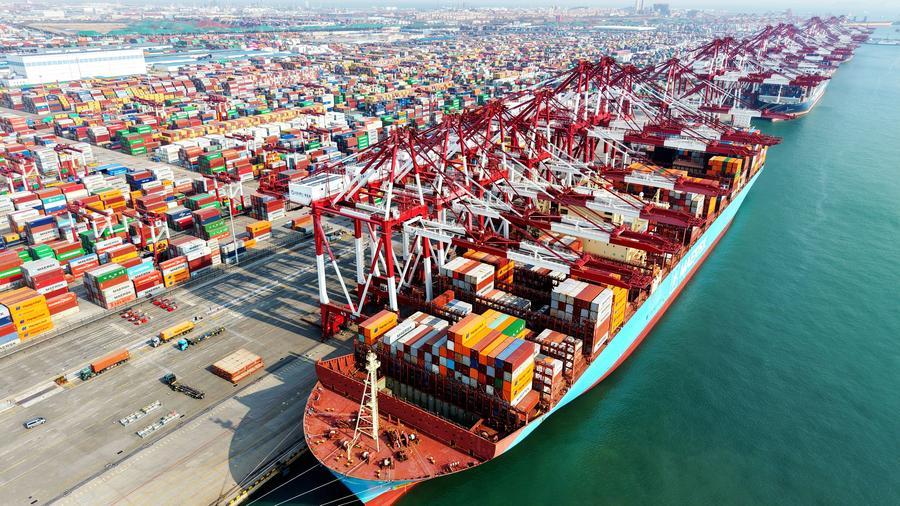
An aerial drone photo of Qingdao Port in Qingdao, Shandong Province in east China, taken on March 10, 2026. (Photo: Xinhua)
Editor's note: Zhang Jianping, a special commentator for CGTN, is the deputy director of the academic committee of the Chinese Academy of International Trade and Economic Cooperation of the Ministry of Commerce. Zhang Yaxi is a master’s student at the School of Economics, Peking University. The article reflects the authors' opinions and not necessarily the views of CGTN.
Against the backdrop of evolving geopolitical conflicts, global trade frictions, and international markets growing increasingly risk-averse, China has released its macroeconomic data for the first quarter (Q1) of 2026, drawing close attention from global markets. Whether the Chinese economy can stabilize expectations and provide confidence in this complex external environment is a key benchmark to assess its full-year economic trajectory. According to the released indicators, the economy maintained steady growth in Q1, with recovering domestic demand and resilient external demand.
In the consumer sector, offline consumer payment volume rose by 3.4%, goods consumption by 5.2%, and services consumption by 0.9% year on year. The Consumer Price Index climbed 0.9% year on year, indicating overall stable price levels and a gradual recovery in household consumption capacity.
In the investment sector, loans to enterprises and public institutions increased by 8.6 trillion yuan ($1.26 trillion), among which medium- and long-term loans rose by 5.42 trillion yuan ($794 billion), accounting for 63% of the total corporate loan growth. This demonstrates stabilizing business expectations among enterprises.
The business vitality index of startups rose 8.8%, and that of tech-innovation enterprises grew 8.1% year on year, showing a rebound in corporate dynamism. Capital investment in frontier sectors including artificial intelligence and humanoid robots surged by 45.5% year on year. This reflects a concentration of venture capital in high-tech and high-growth sectors, alongside positive signs of optimized investment structure and a shift in growth drivers.
In foreign trade, total imports and exports reached 11.84 trillion yuan ($1.74 trillion), up 15% year on year, hitting a record high for the same period in history. Exports of electric vehicles, lithium batteries, and wind power generation units and components surged by 77.5%, 50.4% and 45.2% respectively.
Trade with Belt and Road Initiative partner countries totaled 6.06 trillion yuan ($888 billion), a 14.2% year-on-year increase, constituting 51.2% of China’s overall imports and exports. Imports and exports with ASEAN, Latin American and African economies grew by 15.4%, 15.4% and 23.7% respectively. China consolidated its diversified market layout and demonstrated strong risk resilience amid volatile global conditions at the start of the year.
In the financial sector, broad money supply grew 8.5% year on year at the end of March, and the outstanding social financing stock expanded 7.9% year on year, with credit supply remaining at a reasonably ample level. Total trading volume across China's national futures markets jumped 58.43% year on year, marking a remarkable upturn in market activity. In addition, the March Manufacturing Purchasing Managers' Index returned to the expansion range, with sub-indices including new export orders and imports rebounding, signaling recovering expectations among market entities.

Tourists visit the Hanyuan Stele Forest cultural garden in Kaifeng City in Henan Province, central China, on April 5, 2026. (Photo: Xinhua)
The annual Central Economic Work Conference in December had stated the need to "steadily advance institutional opening up." This also constitutes the core direction of external opening during the 15th Five-Year Plan period (2026-2030). China is aligning with high-standard international economic and trade rules, establishing more transparent institutional arrangements in areas such as property rights protection, environmental standards, and government procurement. It will promote further opening up in three aspects: expanding the scale of unilateral opening, deepening institutional innovation, and enhancing regional cooperation.
For unilateral opening, effective from May 1, China will levy zero tariff on imported goods from the 53 African countries it has diplomatic relations with, a first for a major global economy. This unilateral opening-up model offers other developing countries more favorable trade access and broader development opportunities, reflecting a policy logic of voluntarily sharing benefits and opening the market.
Regarding institutional innovation, the Hainan Free Trade Port has completed over 100 days of island-wide special customs operations, fully implementing the policy of tariff-free domestic sales of value-added processed goods. In Q1, Hainan's customs supervised sales of goods worth 290 million yuan ($42.5 million) into the mainland. Meanwhile, 23 pilot free trade zones across the country continue to conduct stress tests in areas such as cross-border data flows, intellectual property protection, and environmental standards, accumulating institutional experience for higher-level opening.
As for regional cooperation, the China-ASEAN Free Trade Area 3.0 Upgrade Protocol was signed in October 2025, covering new issues such as digital trade, the green economy, and supply chain connectivity, and providing a practical foundation for reforming the multilateral trading system. By making domestic rules more transparent, law-based, and internationally aligned, China is hedging against uncertainties in external trade policies, providing stable institutional expectations for multinational corporations and demonstrating its commitment to openness, cooperation and mutual benefit.
In conclusion, Q1 data indicates that the resilience of China's economy stems from the coordinated progress of domestic demand recovery, stabilizing business confidence, and institutional opening up. At the start of the 15th Five-Year Plan period, China is transforming its growth into a predictable global certainty through unilateral opening, transparent rules, and regional cooperation. This systematic stabilizing capability amid external headwinds is precisely the essence of China's role as the global "anchor of confidence."
(If you want to contribute and have specific expertise, please contact us at opinions@cgtn.com. Follow @thouse_opinions on X, formerly Twitter, to discover the latest commentaries in the CGTN Opinion Section.)