


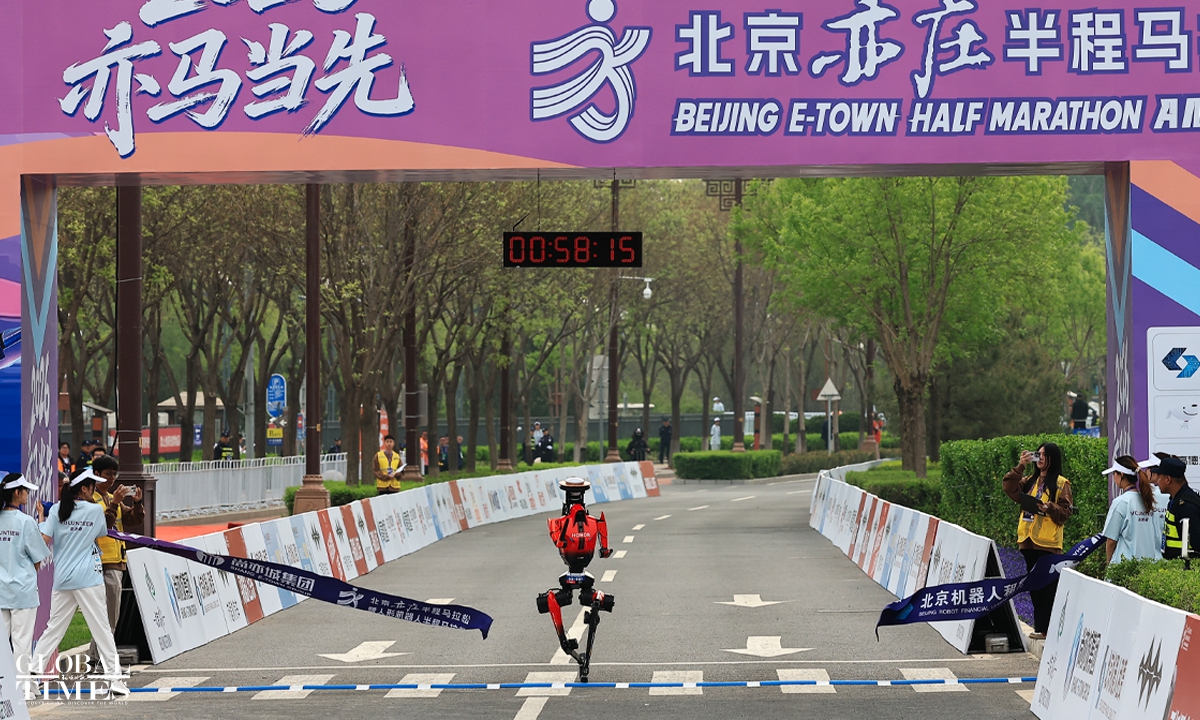
Honor's autonomously navigated "Lightning" crosses the finish line at the 2026 humanoid robot half marathon on April 19, 2026. Photo: Li Hao/GT
The 2026 Humanoid Robot Half-Marathon kicked off on Sunday morning in Yizhuang, Beijing.
More than 100 teams reportedly participated in the field test, including several international teams. Robot "Lightning" from Chinese smartphone manufacturer Honor won the championship, with the model running over 21 kilometers in a net time of 50 minutes and 26 seconds, beating the human world record of 57:20.
Compared with the previous editions, this year's event has eliminated the requirement for on-site human supervision. Rules are designed to guide and encourage robots to operate fully autonomously throughout the competition. The event has garnered widespread attention from international media, becoming a key showcase for global AI capabilities.
From its initial conceptualization to its rapid development, AI has come a long way over nearly 70 years. In recent years, global AI development has entered the fast lane, evolving from basic human-machine interaction to general-purpose Large Multimodal Models, marking a period of rapid growth.
AI involves machines emulating human intelligence. It constitutes a comprehensive system comprising intelligent sensing, information storage, information transmission, information processing (computing power, algorithms, large models) and smart terminals. Its goal is to improve efficiency, reduce costs, and achieve harmony between people and between humanity and nature.
A humanoid robot running a marathon is, in essence, a comprehensive test of various technologies. Behind every upgrade lies an iterative technological breakthrough.
This edition of the Humanoid Robot Half-Marathon serves as a testament to the strength of China's manufacturing sector and the advantages of its industrial chain. The AI development has never been confined to the research and development (R&D) of virtual models. As it moves into the physical world and enters the next phase of its journey, the integration of software and hardware has become a prevailing trend - requiring not only robust model-building and training capabilities but also the deep integration of technology with hardware. This progress relies on the collaborative efforts of multiple fields, including materials, energy, and information technology, as well as the support of a complete and mature industrial chain.
After years of development, China has established a competitive edge in the R&D of large AI models. Leveraging its robust manufacturing system, the country has built a complete industrial chain spanning from core components production to end-product assembly. This provides comprehensive support for robotics R&D, covering everything from servo motors and control chips to high-strength flexible materials for robotic bodies.
Compared to other countries worldwide, China's industrial advantage lies in "full-chain synergy" - the ability to conduct independent R&D on core technologies while ensuring large-scale, precision-oriented hardware production. This advantage has made China a crucial testing ground for the global implementation of AI applications.
It is worth noting that China's industrial advantage was not achieved overnight but is the result of long-term accumulation and continuous innovation. Guided by policy, Chinese enterprises have continuously increased R&D investment in AI and robotics, achieving breakthroughs in core robotic challenges such as battery energy storage, low-latency communication and heat dissipation technology.
At the same time, China's vast market demand provides abundant application scenarios for technological iteration. Nevertheless, AI and robotics remain a field of global joint exploration and progress. While China has its own strengths, it still has room for improvement.
The hosting of the Humanoid Robot Half-Marathon is not merely a technical competition but also a demonstration of China's industrial strength. It bears witness to China's transition in the field of AI from playing catch-up to keeping pace and, in some areas, taking the lead. It also foreshadows that in the next phase of the AI race, China will become an indispensable key participant and driving force.
The journey of AI is long and fraught with challenges. Each year, the competition allows us to witness not only global advancements in AI technology but also the steady improvement of China's industrial capabilities. In this technological race that shapes the future,
China is leveraging its industrial strengths and innovative vitality to steadily propel AI into the next phase of its journey. By making smart devices the new engine driving the leap forward in AI technology, China is contributing its pragmatic strength to the development of global AI technology.
The author is director-general of the Zhongguancun Modern Information Consumer Application Industry Technology Alliance. opinion@globaltimes.com.cn